
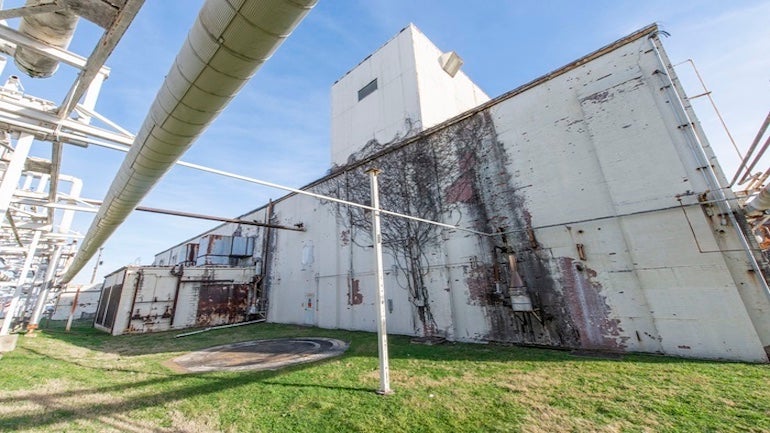
The Oak Ridge Office of Environmental Management (OREM) and clean-up contractor United Cleanup Oak Ridge (UCOR) continue to make steady clean-up progress at the Y-12 National Security Complex. The latest advancement involves taking the final steps to ready the Old Steam Plant for demolition – one of many projects to remove outdated and deteriorating infrastructure to clear space to support important national security missions.
The Old Steam Plant, also known as Building 9401-1, is a single-story, 13,454-square-foot facility constructed in 1943. Over the decades, it supported multiple missions, including uranium enrichment support activities, fuels testing and maintenance and storage operations. Crews have removed materials from the facility, preparing for its teardown that is slated to start this summer.
“Being able to start this project a year ahead of schedule showcases the talent and commitment of our teams leading the transformation at Y-12,” said Joanna Hardin, portfolio federal project director for Y-12. “Completing Alpha-2’s demolition early has resulted in a trickle-down effect allowing us to deliver more risk reduction, clear the way for more modernisation, and demonstrate responsible stewardship of taxpayer dollars by avoiding costs associated with maintaining and overseeing this facility for a longer period.”
Since major clean-up began at Y-12 in 2020, OREM and UCOR have completed demolition of Alpha-2, the former Criticality Experiment Laboratory and the former Biology Complex, which collectively total more than 650,000 square feet. Together these removals have cleared more than 20 acres for Y-12 to reuse.
Now crews are busy preparing for the next wave of Y-12 demolitions The first project in that sequence is Beta-1, a 210,000-square-foot former Manhattan Project uranium enrichment facility. Beta-1 is scheduled to be demolition-ready by the end of the year.
The Y-12 National Security Complex is a Department of Energy (DOE) Nuclear Security Administration (NNSA) facility in Oak Ridge, Tennessee, responsible for maintaining the nation’s nuclear weapons stockpile, supplying enriched uranium for the US Navy, and reducing global nuclear proliferation threats.
It was originally built in 1943 for the Manhattan Project and serves as the primary US centre for manufacturing and storing highly enriched uranium components. The complex focuses on ensuring a safe and effective nuclear deterrent, processing and storing special nuclear materials, and developing advanced manufacturing technologies. Y-12 supplies enriched uranium for the nuclear reactors used in US submarines and aircraft carriers.
The site is operated by Consolidated Nuclear Security and is one of the nation’s most secure sites, with a focus on high-security manufacturing. The site is undergoing modernisation, including the construction of new facilities such as the Lithium Processing Facility, aimed at updating ageing infrastructure. The complex is one of the world’s most secure sites. While the New Hope Center offers public exhibits, the main operational areas are strictly prohibited to unauthorised visitors.
Y-12 is located within the roughly 33,000-acre Oak Ridge Reservation as do K-25 and Oak Ridge National Laboratory (ORNL), only a few miles apart. During the Manhattan Project, they were known by their code names: X-10 (now ORNL), Y-12, and K-25. ORNL is now an Office of Science lab focused on research while Y-12 under NNSA remains a secure facility and K-25 is part of the Manhattan Project National Historical Park heritage centre and industrial park.
Originally Y-12 and K-25 were sister sites working toward the same goal using different technologies. Their relationship was one of redundant paths to the same finish line pursuing two different enrichment technologies. Y-12 used Electromagnetic Separation while K-25 used Gaseous Diffusion. In 1945, the two sites worked together in a sequence to speed up production for the “Little Boy” bomb. S-50 (Liquid Thermal Diffusion), a third, smaller plant provided initial enrichment; K-25 took the material from S-50 and enriched it further (up to about 20%); and Y-12 took the semi-enriched material from K-25 and increased it to weapons-grade (roughly 80-90%).
After WWII, K-25’s Gaseous Diffusion proved to be much more efficient for mass production. Y-12 stopped enriching uranium in 1946 and shifted its focus to precision manufacturing (turning the uranium into weapon parts) and lithium separation. K-25 continued to enrich uranium for decades until it was shut down in the 1980s.


