
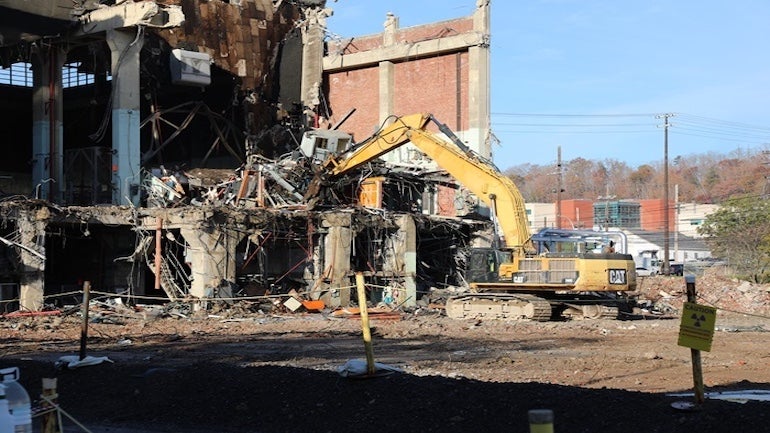
The final wall of a 325,000-square-foot former uranium enrichment facility has been taken down, marking the completion of the Oak Ridge Office of Environmental Management’s (OREM) largest demolition project yet at Y-12 National Security Complex. Demolition of the Alpha-2 building by OREM and cleanup contractor United Cleanup Oak Ridge (UCOR) cleared away a Manhattan Project-era facility, helping modernise the site to support important national security missions.
“This has been a massive undertaking,” said Alpha-2 Federal Project Director Morgan Carden. “The ability to not only complete a task of this scale, but achieving it months ahead of schedule, speaks volumes about the skill, expertise and commitment of this team.”
Preparing Alpha-2 for demolition took four years of work beginning in 2020. It involved meticulous removal of radiological and chemical hazards from inside the facility and rerouting active utility lines – including steam, air, gas and water – outside the facility that are essential to Y-12’s operations.
Alpha-2’s teardown began in September 2024 with crews finishing above grade-demolition this month. That work was made possible through collaboration by a mix of highly skilled employees versed in a wide array of fields including characterisation, safety, waste handling, project management, craft and engineering.
The work started with removal of the carpentry shop followed by the south and north low bay areas, and then the 80-feet tall high bay area. The demolition generated massive amounts of waste and debris – approximately 62m pounds in total.
This project is only the beginning of Y-12’s transformation. Crews will begin tearing down the 9401-1 Steam Plant in the summer, and OREM and UCOR will also complete deactivation on the next former uranium enrichment facility slated for near term demolition: the 210,000-square-foot Beta-1 facility.
With Alpha-2 down to the ground, characterisation and debris disposition is underway. This work involves further sampling, analysing, downsizing, packaging and shipping of remaining waste for disposal. That work is expected to be completed this summer.
The Department of Energy (DOE) Y-12 National Security Complex managed by Consolidated Nuclear Security, is a central pillar of the US Nuclear Security Enterprise. Built in 1943 during World War II, Y-12’s original purpose was to enrich uranium using calutrons. It produced the uranium used in the atomic bomb dropped on Hiroshima. The site is currently undergoing a massive multi-billion dollar transformation to replace ageing Manhattan Project-era infrastructure. Ongoing efforts include the demolition of high-risk facilities and mercury remediation in local soil and water.
Today, Y-12’s core responsibilities include:
- Manufacturing, refurbishing, and dismantling components for every weapon in the US nuclear stockpile, specifically the “secondary” stages of thermonuclear weapons.
- Providing the safe and secure storage of the nation’s inventory of highly enriched uranium.
- Supplying enriched uranium feedstock used to fuel the US Navy’s nuclear-powered aircraft carriers and submarines.
- Working to reduce global nuclear threats by securing and retrieving vulnerable nuclear materials from around the world.
Uranium Processing Facility (UPF) is a major new a multi-billion-dollar manufacturing complex under construction to replace 1940s-era processing buildings. It will replace ageing, World War II-era facilities (specifically Building 9212) with modern structures that meet current safety and security standards.
The UPF consists of a complex of interconnected buildings, allowing each to be built to specific safety requirements. The Main Process Building (MPB) is the central nuclear facility housing casting and special oxide production. The Salvage and Accountability Building (SAB) is dedicated to recovering uranium from various waste streams. The Mechanical Electrical Building (MEB) houses the support utilities or the nuclear process buildings. The Process Support Facilities (PSF) is a 24,000-square-foot non-nuclear building for gas storage and support operations, completed in late 2025.
While several subprojects (site readiness, substation, PSF) are complete, the overall project has faced significant cost and schedule increases. It was originally slated for completion by 2025–2026, but the National Nuclear Security Administration (NNSA) now expects the facility to reach full operations by 2034. The project budget was re-baselined in December 2024 to $10.35bn, up from the original $6.5bn estimate. Due to delays, the NNSA will now have to maintain Building 9212 for safe operations until the mid-2030s.


