
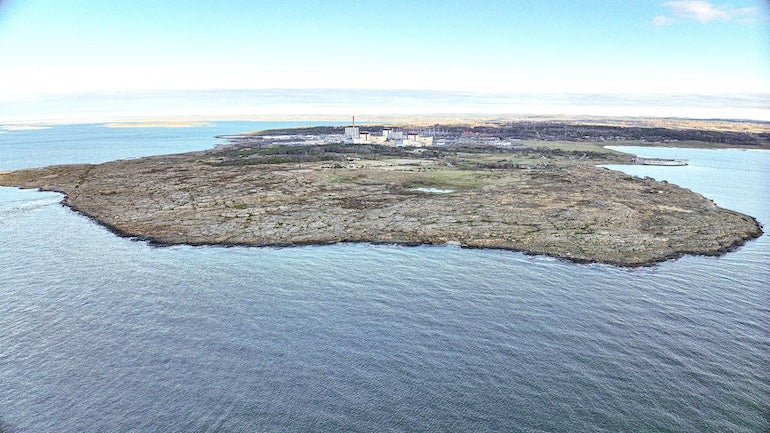
The Swedish government has formally proposed acquiring a 60% stake in Videberg Kraft AB, a project company dedicated to developing new nuclear reactors on the Värö peninsula next to at the existing Ringhals NPP. This is part of Sweden’s updated energy roadmap, which aims to build the equivalent of 10 new full-scale reactors by 2045 to replace its ageing fleet and meet soaring electricity demand from industrial electrification.
Sweden’s parliament in May 2025 approved government proposals for providing state aid to companies seeking to invest in new nuclear. The support will be limited to the equivalent of four large-scale reactors (about 5,000 MWe). The new reactors must be sited at the same location and have a total installed output of at least 300 MWe. The state aid legislation entered into force on 1 August and in December Videberg Kraft applied for state aid to support proposals for either five GE Vernova Hitachi BWRX-300 reactors or three Rolls-Royce SMRs to provide about 1,500 MWe at the Ringhals site. Videberg Kraft is owned by Vattenfall (80%) and backed by a series of industrial firms via the Industrikraft i Sverige AB consortium (20%).
The government’s intervention is designed to “de-risk” nuclear development, as private investors have been hesitant due to massive cost overruns seen in recent European projects. The state plans an initial capital injection of SEK1.8bn ($195m) during 2026–2027 to secure the 60% stake. Beyond the initial purchase, the government is seeking parliamentary authority for up to SEK 34.3bn in construction-period funding. A final decision on technology is expected later in 2026.
To further lower risks for early developers, the state has proposed taking an active role in managing radioactive waste, estimating costs at SEK122bn with potential overruns reaching SEK183bn between 2035 and 2159. “The proposal means that the state should be able to negotiate to assume financial responsibility for a share of fixed costs with the first actor while waiting for new actors to enter a new nuclear waste programme based on established technology,” the government said. “A prerequisite for being able to enter into the agreement is that the support is compatible with the EU’s state aid rules.”
Videberg Kraft says it “s working hard, with ambitious timelines, to be able to apply for the necessary permits to own and operate a nuclear facility. “We are now in an early design phase which will progress into a more detailed design phase once we have selected a final supplier for our project. Right now, we are therefore predominantly focused on the following:
- Selecting the right supplier for the project;
- Securing and characterising the site at Värö;
- Evaluating and selecting the most appropriate plant concept;
- Preparing applications for necessary permits; and
- Negotiating with the Swedish state on financing schemes.
Fredrik Hassel has been appointed Head of Licensing and Permitting at Videberg Kraft. He worked for 10 years as Deputy Director General at the Swedish Radiation Safety Authority (SSM – Strålsäkerhetsmyndigheten) with extensive experience in politics, defence and business. He was seconded from the role of senior advisor in Public Affairs at Saab, part of the Industrikraft i Sverige AB consortium.
Minister of Energy and Enterprise Ebba Busch said: “Sweden is a nuclear power nation and is now becoming even stronger. As industry is electrified and the need for electricity grows, long-term solutions are required. The government is now taking the next step to clarify the state’s role and responsibility in the further expansion of nuclear power.”


