
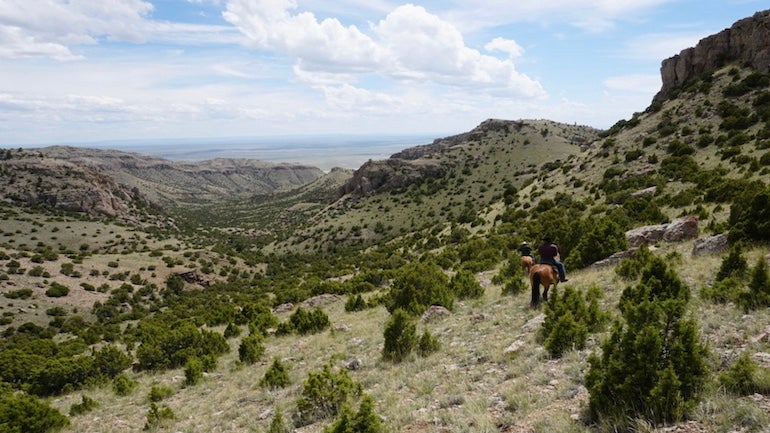
For much of the nuclear industry’s history, uranium exploration has followed a familiar pattern: discovery, rapid delineation driven by strategic urgency, production during favourable price cycles, and long periods of dormancy when economics or politics turn unfavourable. In the United States, few sites illustrate this cycle more clearly than the Copper Mountain uranium district in Wyoming. Once a focus of intense activity during the Cold War, the area now represents what some developers describe as “invisible uranium”. Large and well-documented resources but which are economically sidelined resources that sit between conventional mining paradigms and modern regulatory, technical and data-driven approaches.
Talking to NEi, Thomas Lamb, CEO of Myriad Uranium, explains the invisible uranium concept: “It’s something that’s always been there, but because it hasn’t been economic or politically viable, it’s effectively disappeared from view.” The challenge is therefore not discovery in the classical sense, but reinterpretation – bringing historical data, modern standards, and new analytical tools together to determine whether these dormant resources can be reclassified as viable.
Exploring Copper Mountain
Copper Mountain exemplifies this challenge. The district was first systematically explored in the 1950s driven by US government demand for uranium. This led to the identification of the Arrowhead deposit, which became the Arrowhead mine. “That mine produced about half a million pounds at a grade of roughly 0.15%,” Lamb explains. “Back then, that was quite significant.”
Production continued through the 1950s and 1960s, accompanied by smaller satellite mines such as Bonanza, which yielded approximately 780,000 pounds (around 350 tonnes) at higher grades, and numerous minor operations producing tens of thousands of pounds each. These early mines tended to exploit relatively discrete, higher-grade mineralisation, including uranium-coated sands and boulders.
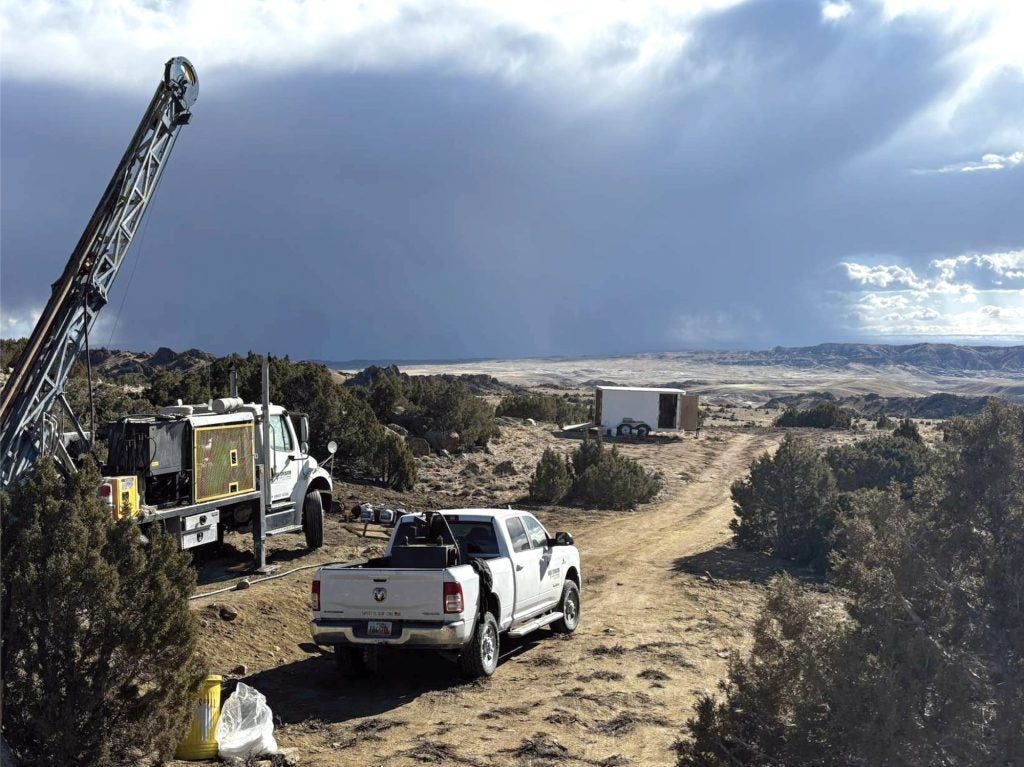
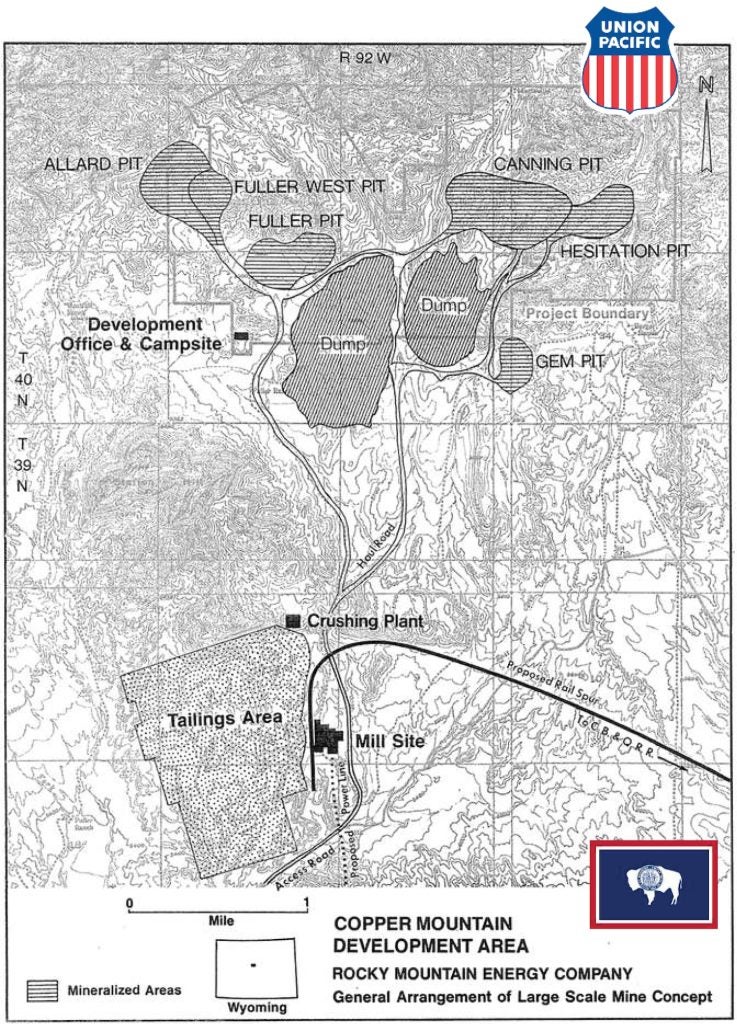
By the 1970s, the strategic picture had changed. Union Pacific’s uranium subsidiary, Rocky Mountain Energy, in partnership with Southern California Edison, pursued a different model. Instead of targeting isolated high-grade pockets, the company sought large-scale, disseminated mineralisation hosted in fractured basement rock across a broad area. “They were looking for something that could supply a lot of reactors over many years,” Lamb says. “That meant lower grade on average, but over a much bigger volume.”
This shift drove an intensive drilling programme of approximately 2,000 bores and the development of multiple conceptual mine plans. Metallurgical testing focused on heap leaching, then a relatively new approach for uranium, adapted from copper and gold operations. Test work reportedly achieved recoveries of 90–94%, supporting the technical viability of large-scale surface processing. Limited early testing also suggested that parts of the district might be amenable to in-situ recovery (ISR), although this avenue was never fully explored.
The collapse of the US uranium sector after the Three Mile Island accident in 1979 abruptly halted progress on nuclear development. Planned nuclear builds were cancelled, uranium prices fell sharply, and projects such as Copper Mountain were shelved. A comprehensive Department of Energy-funded study, published in 1982 by Bendix Corporation, concluded that the district contained an estimated 245 million pounds (111,000 tonnes) of uranium to a depth of 600 feet (180m) within a central area, rising to 655 million pounds (297,000 tonnes) over a larger footprint. However, these findings had little immediate impact. “Once that report was finished, everything just stopped,” Lamb recalls. “Files were scattered, people moved on, and the project went quiet.”
Commercialising Copper Mountain
Subsequent decades saw brief revivals during price spikes in the late 1990s and mid-2000s, followed by renewed dormancy after Fukushima. The cyclical nature of uranium economics left Copper Mountain in a liminal state: well studied, yet technically “historical” under modern reporting standards.
This distinction is critical. Under Canada’s National Instrument 43-101, which Myriad follows for disclosure, historical estimates cannot be treated as current resources without verification. “Even if the old work was extremely thorough, we’re not allowed to call a pound in the ground a current pound unless it’s been validated,” Lamb explains. “That means drilling enough new holes for an independent qualification to sign off on the historical numbers.”
Since becoming operator at Copper Mountain, Myriad has invested approximately US$5.5m, roughly 90% of which has gone into drilling, with the remainder used to expand claim coverage. The objective is not to replicate the 1970s drilling campaign, but to anchor historical interpretations to modern data density and quality requirements. “We don’t need 2000 holes again,” Lamb says, adding: “We need enough to demonstrate that the old data still holds.”
At present, the historically defined mineable resource sits in the range of 16–30 million pounds (7000 – 13,000 tonnes) across several zones. Beyond these locations lie numerous prospects where limited drilling also found uranium, but follow-up work was never completed. “Union Pacific might have drilled four or five holes, hit uranium, and then moved on,” Lamb explains. “We want to go back and do the extra 20 or 30 holes needed to see whether those prospects become deposits.”
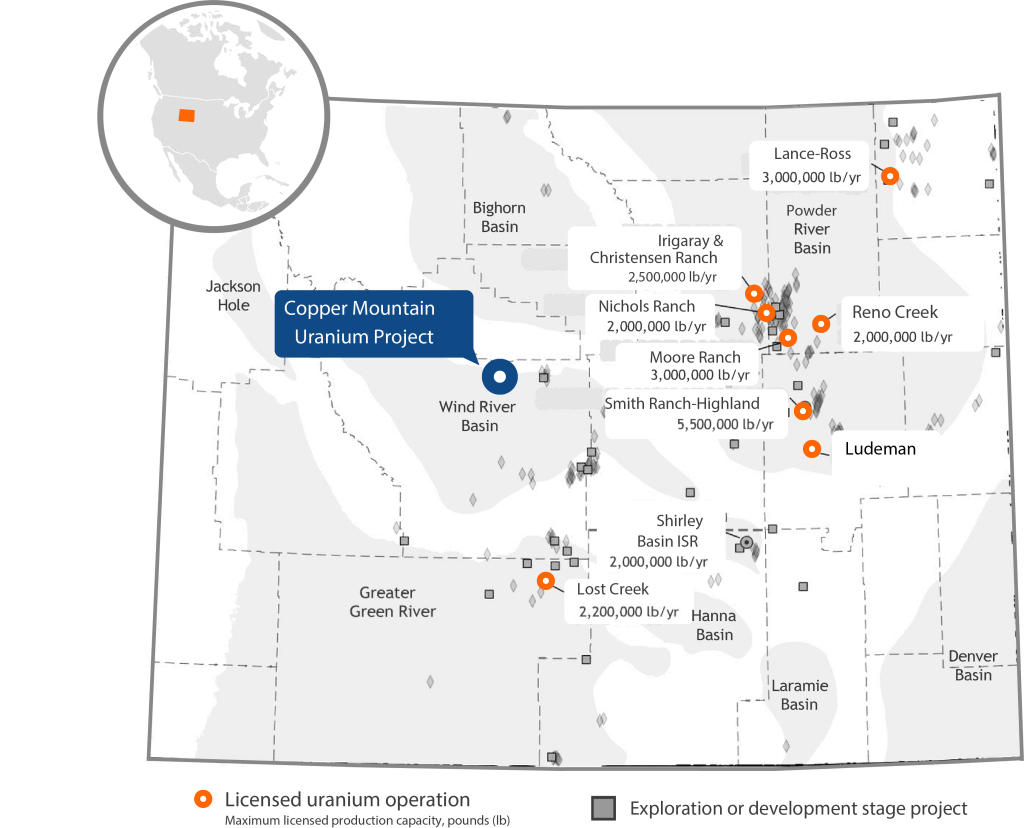
If successful, Myriad believes the mineable resource could expand to 60–70 million pounds (27,000 – 32,000 tonnes). Beyond that lies the broader endowment identified by Bendix – not all of this which would be economic even at today’s uranium prices, but which further frames the long-term options for the district. “If we can move from tens of millions of pounds to hundreds, that changes the strategic picture entirely,” Lamb says.
Mining method selection remains contingent on both geology and uranium price. Heap leaching, ISR, and conventional open-pit or underground mining are all under consideration. “At $80 or 90 per pound [$175 – 200/Kg], you would focus on our higher grade conventional zones and any ISR-amenable areas,” Lamb notes. “At $150 [$330/Kg], everything opens up. You start looking at large-scale surface mining across the whole project area.”
Any recovery scenario would require access to licensed milling capacity. For Copper Mountain, the refurbished Sweetwater mill in Wyoming, now owned by Uranium Energy Corp, represents a plausible destination. “That mill is licensed for both ISR liquor and conventional feed,” Lamb says. “That flexibility is almost ideal for a project like ours.”
New tools and a new look at old data
Alongside these traditional technical considerations, Myriad has increasingly turned to data-driven tools, including artificial intelligence, to manage the sheer volume and complexity of information associated with a multi-decade brownfield project.
At the most basic level, AI is used to aggregate and interrogate disparate datasets. Historical drill logs, geochemical assays, maps, cross-sections and reports are digitised and stored in cloud systems. Modern AI tools can ingest these datasets alongside publicly available geological and regulatory information. “You upload geochemistry, coordinates, maps,” Lamb explains, “and the AI can go and find relevant government data, old technical reports, anything that’s publicly available. It puts it together and delivers insights that are genuinely useful.”
One area where this capability is particularly powerful is multivariate geochemistry. Large datasets containing analyses of 70–80 elements are common in modern exploration, but extracting meaningful patterns from them is time-consuming. “The ratios of obscure elements can tell you how far you are from the core of a system,” Lamb says. “Doing those calculations by hand could take months. AI can do it in minutes.”
However, Lamb stresses that AI is an assistive technology rather than a replacement for geological judgement. “AI daydreams,” he cautions. “It’s designed to be positive and encouraging. You need experienced geologists to check it, interpret it, and sometimes ignore it.”
According to Lamb this reflects broader industry experience: “There’s a lot of money gone into inhaling massive datasets and letting AI narrow targets,” Lamb says, adding: “As far as I understand, it hasn’t really worked. The big deposits haven’t been found that way.”
Where AI appears to offer the most immediate value is in brownfield redevelopment, where extensive but fragmented datasets already exist. In this context, AI accelerates synthesis rather than discovery, allowing human experts to focus on decision-making rather than data preparation. “It’s a force multiplier,” Lamb says. “Not a substitute.”
A future for Copper Mountain
Looking ahead, Myriad anticipates several more years of drilling, resource conversion and mine planning before any production decision. This timeline will inevitably intersect with uranium market dynamics. “You need higher uranium prices to make a project like this work,” Lamb says plainly. “Without that, there’s no point. Higher prices will unlock not just tens, but potentially hundreds of millions of pounds at Copper Mountain. That’s why Myriad Uranium is considered ‘the call option on uranium in the United States’.”
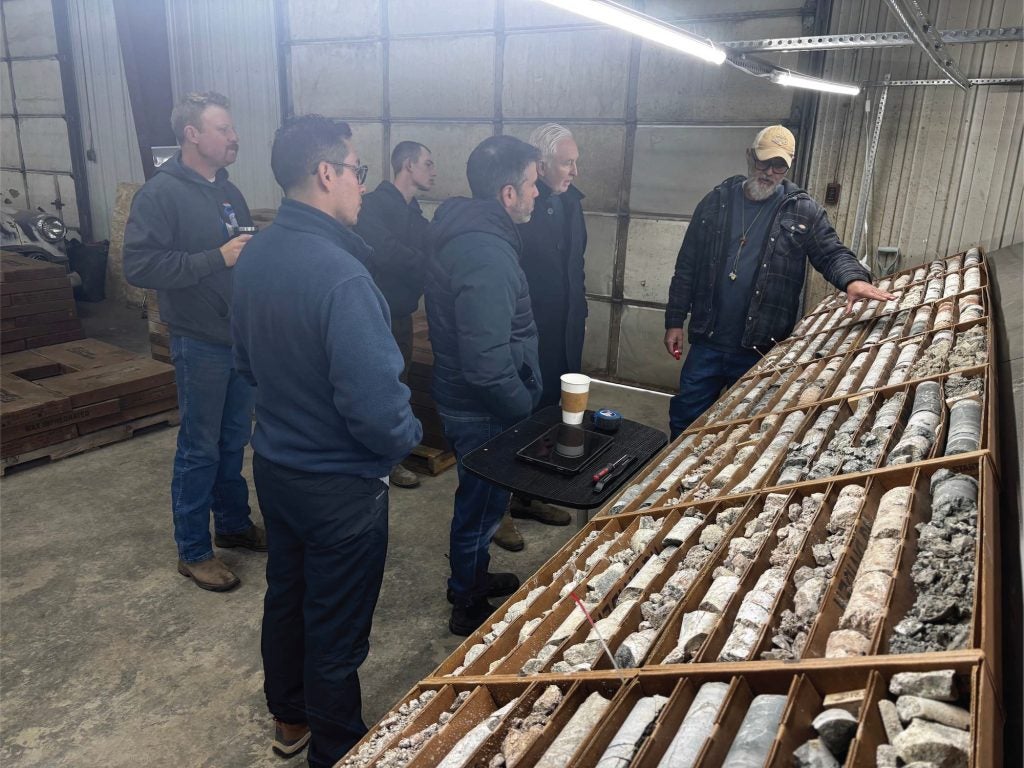
The broader context, however, is increasingly favourable. In the United States, uranium has re-emerged as a strategic commodity, driven by concerns over fuel security, geopolitical risk and domestic supply resilience. “Whatever people think about the reasons,” Lamb observes, “money is pouring into the US fuel cycle – conversion, enrichment, fuel manufacturing, and exploration.”
This shift has implications beyond Copper Mountain. Numerous marginal or politically constrained uranium projects across the US may become viable under a policy environment that prioritises domestic production. “There are plenty of old projects that were marginal,” Lamb says. “If the political will is there, they’ll move.”
As Lamb concludes, the careful re-engineering of existing knowledge supported by modern analytical tools and aligned with contemporary strategic priorities may yet make invisible uranium become visible again.


