
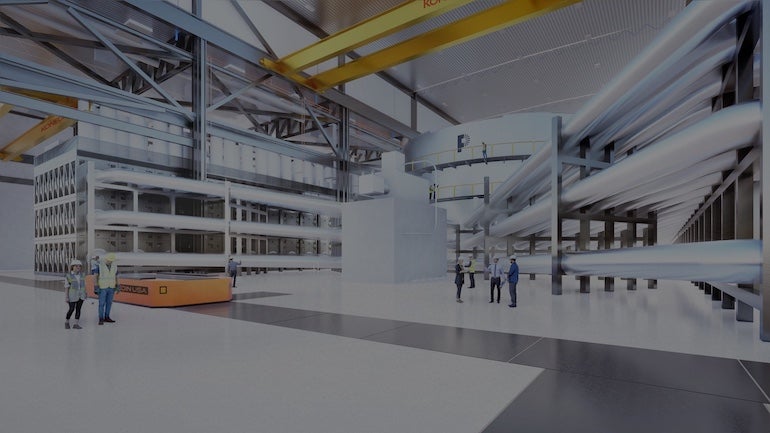
California-based startup Pacific Fusion has broken ground on a $1bn Research & Manufacturing Campus at Mesa del Sol in Albuquerque, New Mexico, where it plans to build a high-yield fusion facility. The decision to build in Albuquerque was heavily driven by the region’s existing applied physics workforce, largely tied to the nearby Sandia National Laboratories with its Z Pulsed Power Facility, the world’s most powerful pulsed-power facility.
The campus will house Pacific Fusion’s Demonstration System, designed to achieve net facility gain by 2030, producing more energy from fusion than the total energy initially stored in the machine. Net facility gain, which has never been demonstrated, represents a key milestone on the path to commercial fusion power.
Pacific Fusion’s focus on net facility gain sets it apart from previous milestones. While the National Ignition Facility (NIF) at Lawrence Livermore National Laboratory (LLNL) has achieved scientific net energy gain (producing more energy than that which directly ignited the fuel capsule), no project has yet achieved net facility gain – producing more fusion energy than the total energy stored in the system. Pacific Fusion’s machine aims to account for all the energy lost during power conversion and system operations, generating more overall energy than the facility’s entire driving infrastructure consumes.
Unlike groups focused on tokamaks or massive lasers, Pacific Fusion is pursuing a pulsed magnetic path to inertial confinement fusion. The company uses intense, precisely synchronised electrical pulses to magnetically compress and heat deuterium-tritium fuel targets. The new 225,000-square-foot campus will house a 156-module pulser array designed to emit high-yield fusion bursts exceeding 100 megajoules. This output is some ten times greater than that of NIF.
Pacific Fusion uses a brick-based pulsed power architecture. Instead of one massive, expensive machine, they use many small, mass-producible modules (the bricks) to deliver the massive electrical currents needed to compress fusion fuel.
This technology also has national security implications. The Demonstration System will produce bursts of high-energy fusion output exceeding 100 megajoules, making it the only “high-yield” fusion facility under construction in the US. High-yield fusion refers to the capability to create certain conditions relevant to national security research, providing a long-sought platform for the science required to maintain the US nuclear stockpile without explosive nuclear testing.
Along with its energy goals, Pacific Fusion has signed a memorandum of understanding with the Department of Energy’s (DOE’s) National Nuclear Security Administration (NNSA) to collaborate on high-yield fusion and related technical areas. This includes an agreement to identify collaboration opportunities related to high-yield fusion, high-energy-density science, pulsed-power technologies, advanced materials, modelling and simulation, and other areas of shared national interest.
Pacific Fusion was founded in 2023 and officially emerged from stealth mode in October 2024 announcing a massive $900m Series A funding commitment led by General Catalyst, which has since expanded past $1bn as technical milestones are met.
The full capital pool was committed by the investor syndicate entirely upfront. To protect investor capital while ensuring the startup has long-term financial runway, the funds are not handed over all at once. Instead, capital is systematically unlocked in tranches only as Pacific Fusion achieves pre-defined engineering milestones.
The capital pool is further bolstered by the New Mexico State Investment Council (SIC), which partnered to anchor the project locally, using performance-based state and local incentives tied directly to job creation and infrastructure milestones at Mesa del Sol.
The investor roster behind the pool includes some of the most prominent figures in technology and finance. In addition to General Catalyst they include Breakthrough Energy Ventures (founded by Bill Gates), Lowercarbon Capital (Chris Sacca), Lightspeed Venture Partners, and DCVC (Data Collective). Billionaire technology and finance founders include Eric Schmidt (former Google CEO and Pacific Fusion Board Chairman), Ken Griffin (founder of Citadel), Patrick Collison (co-founder of Stripe), John Doerr (Chairman of Kleiner Perkins), Reid Hoffman (co-founder of LinkedIn), Mustafa Suleyman (co-founder of DeepMind) and Andrew Forrest (Australian mining magnate and green energy investor).
This syndicate built the pool to provide the engineering team with the absolute capital confidence required to build hardware rapidly, without needing to pause every 18 months to pitch a new funding round. To manage its $1bn capital pool, Pacific Fusion structured its Series A funding into three clear, milestone-based phases. The investor syndicate releases the cash in tranches only when specific hardware, validation, and engineering goals are met.
The timeline for Pacific Fusion’s milestone progression stretches from the company’s stealth founding to their hard target at the end of the decade. Phase I (component and target simulation) was completed ahead of schedule (mid-2025). The company published its foundational technical paper outlining the simulation physics in April 2025, clearing the path for physical hardware development.
Phase II (scaled prototype module) was completed in June 2026, when Pacific Fusion unveiled the 440 GW scaled module prototype, unlocking the second major tranche of venture funding. Testing of the core internal architecture (Sirius) concluded a rigorous 3,000-shot run at LLNL in July 2026. Phase III (production-scale module) is in progress (targeted for late 2026). Pacific Fusion is on track to complete and validate the single, full-scale 1 TW pulser module before the end of 2026.
In parallel with the Phase III module validation, the company is setting up the world’s first automated fusion assembly lines, scaling from San Leandro, California, to the Los Lunas, New Mexico build centre before the end of 2026. Following the groundbreaking at Mesa del Sol, the campus will spend 2027-2029 manufacturing and synchronising the remaining 155 production-scale modules into the final spherical array. The ultimate target to run the integrated demonstration system and achieve net facility energy gain is 2030. A commercial-scale reactor, designed to output roughly five times the energy of the 2030 demonstration system, is projected for grid deployment in the 2030s.
“The country that figures out how to manufacture and deploy these systems at scale will create an entirely new energy industry around them,” said Carrie von Muench, Chief Operating Officer and co-founder of Pacific Fusion. “We want that industry, its supply chains, and its jobs to be built here in America.”


