
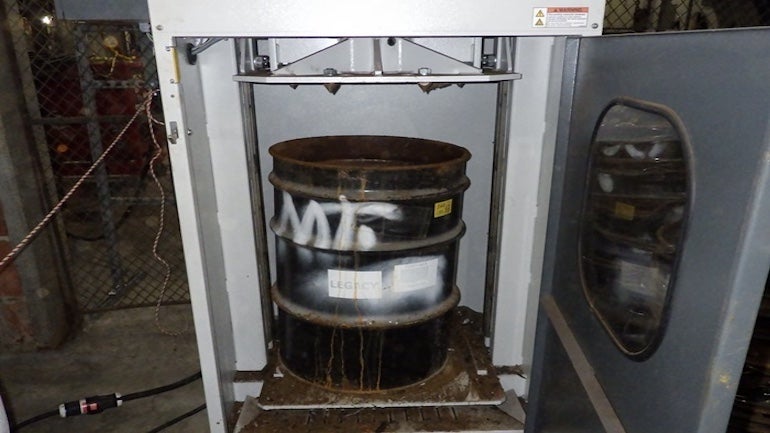
The US Department of Energy (DOE) reports that the Oak Ridge Office of Environmental Management (OREM) and clean-up contractor United Cleanup Oak Ridge (UCOR) are “crushing it” at the legacy Alpha-4 building at the Y-12 National Security Complex accelerating waste disposal by using an innovative approach to squash old drums. This is, avoiding $300,000 in costs and eliminating tasks with higher safety risks.
This builds on earlier cost savings at Alpha-4 (Building 9201-4) resulting from the declassification of materials for more efficient disposal. Combined, these efforts have pushed the clean-up project at Y-12 nearly two years ahead of schedule with $16.3m in cost savings.
Spanning 561,000 square feet over 13 acres of land, Alpha-4 was constructed in the 1940s at Y-12 as part of the Manhattan Project for uranium separation and later supported mercury-based lithium separation during the Cold War before being shut down in the 1960s. Y-12 is a DOE Nuclear Security Administration (NNSA) facility in Oak Ridge, Tennessee, responsible for maintaining the nation’s nuclear weapons stockpile, supplying enriched uranium for the US Navy, and reducing global nuclear proliferation threats. The site is undergoing modernisation, including the construction of new facilities such as the Lithium Processing Facility, aimed at updating ageing infrastructure. Y-12 is one of the world’s most secure sites.
Alpha-4 remains one of the highest-priority and most complex clean-up targets at Y-12. Mercury remediation at Alpha-4 is a massive undertaking. Mercury was used as a solvent in the building’s Column Exchange (COLEX) equipment during the 1950s and 60s. Over time, significant amounts leaked into the building’s structure, equipment, and underlying soil.
As of early 2026, clean-up crews have retrieved nearly 7.5 tonnes of mercury from the site’s external equipment alone. West COLEX was demolished in 2018 after approximately 4.19 tonnes of mercury were recovered. Deactivation at East COLEX was completed more recently, recovering an additional 2.3 tonnes. Inside the building, workers use specialised measures like covering ventilation louvers and using fume hoods to prevent hazardous mercury vapours from escaping into the environment during deactivation.
Alpha-4 cannot be torn down until two major infrastructure projects are fully operational to handle the environmental risks. The Mercury Treatment Facility (MTF), expected to be fully operational in 2025/2026, is designed to treat up to 3,000 gallons of water per minute. It will capture any mercury released into the nearby Upper East Fork Poplar Creek during the high-impact demolition process. The West End Protected Area Reduction (WEPAR) project will reroute the high-security perimeter around Alpha-4, allowing clean-up crews easier access and reducing the overall cost of the project by an estimated 40%.
“Alpha-4 is one of the most complex facilities in our clean-up portfolio,” said Alpha-4 Federal Project Director Morgan Carden. “Despite the challenges inherent with a project of this scale and magnitude, our team is advancing work forward and finding ways to save costs and accelerate the schedule.”
OREM and UCOR are dealing with the contents of the building in preparation for future demolition. An early step involves sorting and segregating legacy containers inside the facility. Crews identified an alternative to the traditional approach for downsizing mercury-contaminated empty waste drums that are not compliant for shipment for disposal. Historically, saws and shears were used to cut drums manually to reduce their size for disposal. This labour-intensive process created sharp metal edges, elevated noise levels, requiring increased personal protective equipment (PPE) and risking injury.
Now a new drum crusher compacts these drums into uniform round “pucks”. This innovation creates efficiencies and avoids costs by allowing workers to reduce the drum size much faster and to place more drums in each waste container for shipment. This significantly reduces risks and removes the need for PPE. Using the drum crusher, a three-person crew can now process 35-40 drums per hour, compared with 10-12 drums using manual cutting methods. To date, workers have crushed 261 of the 354 legacy drums at Alpha-4.
This is the first Oak Ridge project to use the equipment, but there are plans to apply it to other large deactivation and demolition projects at Y-12 that involve large quantities of similar drums and waste containers.
“Thoughtful planning for waste disposal helps eliminate hazards early, protecting workers and support staff while maximizing the value of taxpayer dollars,” said Jonathan McKamey, UCOR’s Alpha-4 superintendent. “We are constantly evaluating and reevaluating our approaches to ensure we implement the safest and most cost-effective methods possible for cleanup.” UCOR continues steady progress throughout the facility in preparation for deactivation. In late 2025, crews achieved “cold and dark” status, which involves isolating all the electrical systems making it safe for future work inside the building.
At Y-12, clean-up crews have demolished over 650,000 square feet of legacy infrastructure since 2020. The most significant recent milestone was complete demolition of the 325,000-square-foot Alpha-2 (Building 9201-2), a former uranium enrichment facility, which was the largest project of its kind at the site to date.
Other completed projects include the Biology Complex – a group of 11 buildings, including the six-story Building 9207 and the three-story Building 9210 – and the Criticality Experiment Laboratory, a former research facility cleared to make room for modernisation.
There are more than 90 facilities still slated for demolition, including approximately 25 classified as high-risk. Key projects currently in the pipeline include: the Old Steam Plant (Building 9401-1) where deactivation is complete, with demolition scheduled to begin in summer 2026; and Beta-1 (Building 9204-1), a 300,000-square-foot facility currently undergoing deactivation, which is expected to be ready for demolition by late 2026.
Two structures, Beta-3 and Building 9731, will be preserved for posterity as part of the Manhattan Project National Historical Park.


