
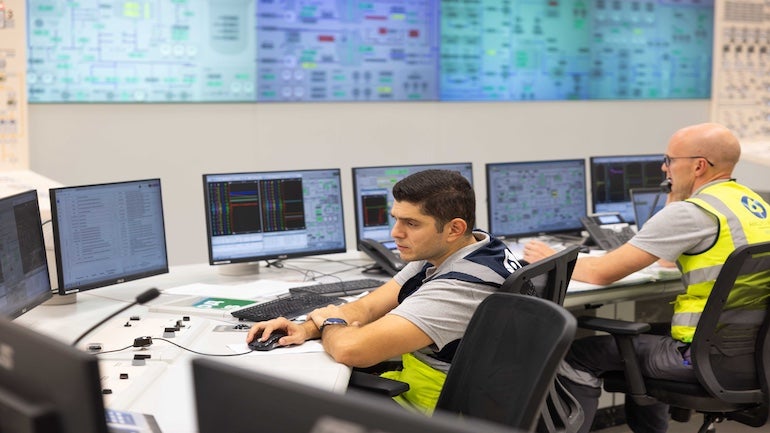
Hydraulic tests of the second circuit for durability have been completed at unit 1 of the Akkuyu NPP under construction by Rosatom in Türkiye. Tests of steam generators, steam reinforcement units and feed water pipelines were carried out over three days. All four steam generators and the pipelines connected to them were tested at a pressure of 12.6 MPa, which is 15% higher than the operating pressure stipulated by the project.
Before increasing the pressure, the steam generators were heated to 126 degrees C, and the maximum water temperature during the tests was 135 degrees C. The pressure level was raised in stages, and at each stage, specialists carefully monitored the equipment parameters and the density of the connectors. It was maintained at a maximum pressure of 12.6 MPa, then reduced to 10.1 MPa for final inspection. The inspection confirmed the equipment’s resistance to high pressure and its readiness for further testing at operating parameters.
“The tests carried out have confirmed the strength of the second circuit equipment, the quality of installation and welded joints,” said Sergey Butskikh, Director General of project company Akkuyu Nukleer. “This is the result of extensive collaboration between builders, installers, adjusters, maintenance personnel, as well as representatives of Rosatom’s external expert organizations who conducted the technical inspection directly during the tests. The results obtained allow us to begin preparations for the hot running–in of the first power unit.”
The work involved the staff of the Akkuyu Nuclear Technical Directorate, technical inspection specialists from the relevant organisations of Rosatom– Atomtehenergo and Rosatom Service, as well as representatives of the supervisory authority, the Turkish Nuclear Regulatory Agency (NDK – Nükleer Düzenleme Kurumu).
Units with VVER-1200 reactors have two circuits. The reactor is part of a closed and sealed primary circuit. As a result of the nuclear fission reaction, a large amount of thermal energy is released in the reactor. It heats the coolant (desalinated water) passing through the primary circuit at high pressure (16.2 MPa) and temperature (up to 330 °C). The circulation of the coolant inside the primary circuit is carried out by the operation of the main circulation pumps.
The heated water from the reactor enters the steam generators, where it transfers its heat to the water of the second circuit, which boils, which leads to the formation of steam. The two-circuit design provides for complete isolation of the circuits from each other: the water from the reactor transfers thermal energy through the heat exchange surface and does not physically come into contact with the water in the steam generators. The resulting steam spins the shaft of the steam turbine. The electricity generated by the generator is supplied to step-up transformers, after which it is transmitted to the switchgear and then supplied to the network.
The plant will eventually host four Russian-designed VVER-1200 reactors. The pouring of first concrete for unit 1 took place in April 2018, for unit 2 in June 2020, for unit 3 in March 2021, and for unit 4 in July 2022. Rosatom is constructing the reactors according to a build-own-operate model. Work continues at the facilities of all four units and auxiliary structures as well as a new town for plant operators. Rosatom targeting the official launch of unit 1 by the end of 2026 for commercial operation in 2027. The remaining three units of the plant are scheduled to come online sequentially, with the goal of full four-reactor operation by 2028.


