
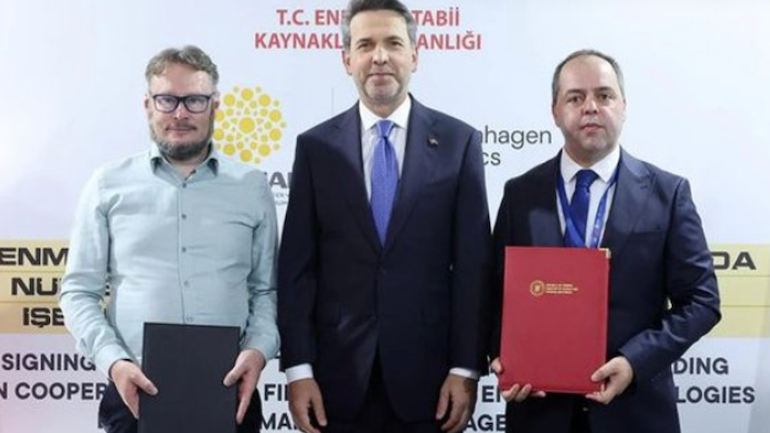
Türkiye’s Energy, Nuclear & Mineral Research Agency (TENMAK – Türkiye Enerji, Nükleer ve Maden Araştırma Kurumu), affiliated with the Ministry of Energy & Natural Resources, has signed a memorandum of understanding (MOU) with Denmark-based Copenhagen Atomics to cooperate on using thorium in next-generation nuclear systems. The cooperation will focus on developing technologies that can use thorium, including the domestic production of thorium compounds, the Ministry said in a statement. Minister of Energy & Natural Resources Alparslan Bayraktar was present at the signing ceremony held at Istanbul Çekmece Campus.
The agreement aims to leverage Türkiye’s thorium reserves to eliminate foreign fuel dependency and establish the country as an international supplier. Türkiye possesses some of the largest thorium resources in the world, with official estimates placing its primary reserves at approximately 380,000 tonnes, ranking it among the top six resources globally. According to the Energy Ministry, recent geological exploration indicates the total resource potential could be significantly higher when including lower-grade deposits.
Thorium in Türkiye is naturally found embedded in complex minerals alongside Rare Earth Elements (REE), fluorite, and barite. Eskişehir (Sivrihisar – Kızılcaören / Beylikova) is the main and most well-documented reserve. It holds roughly 380,141 tonnes of thorium oxide (ThO₂) at an average grade of 0.02%. State mining company Eti Maden also explored a wider 694m-tonne complex ore field there containing a 788 ppm ThO₂ source.
At Malatya (Kuluncak), in 2020, the General Directorate of Mineral Research & Exploration (MTA – Maden Tetkik ve Arama) discovered an additional 3.8m tonnes of low-grade thorium source with a grade of 2.032 ppm. A verified secondary deposit containing roughly 17,000 to 35,000 tonnes of thorium combined with heavy rare earth mineralisations has been identified at Burdur (Çanaklı). Other identified sites include promising thorium beds detected during preliminary mapping in Kayseri (Felâhiye), Sivas, and Diyarbakır.
Because Turkish thorium occurs alongside highly valuable REE, commercial mining plans focus on extracting thorium as a by-product, rather than mining it independently. Depending on the reporting criteria used by bodies such the OECD-NEA or IAEA, Türkiye holds 6-11% of the world’s known thorium.
However, until recently, these reserves remained economically unexploited due to a global lack of commercial thorium-burning reactors. The MOU with Copenhagen Atomics represents Türkiye’s first concrete step toward creating domestic processing pipelines to turn these mineral resources into nuclear-grade fuel.
The agreement also aims to bring Turkish industrial and technology companies, as well as researchers, into efforts to develop high-value nuclear technologies based on these thorium resources. One of the main areas of work will be research and development and project design for producing thorium in Türkiye in a form suitable for use in next-generation nuclear reactors, particularly molten salt reactors.
The parties aim to produce thorium compounds domestically that meet nuclear fuel standards and eventually establish Türkiye as an internationally competitive supplier in the field, the Ministry said.
Copenhagen Atomics is conducting research and development on molten salt reactors that can enable thorium to be used in the nuclear fuel cycle. The company is focused on a modular molten salt reactor concept called Onion Core. Under the agreement with TENMAK, it will assess the technology in terms of Türkiye’s research infrastructure, human resources and industrial capabilities.
In addition to the four-reactor Akkuyu NPP being built by Rosatom, the government plans to build large-scale power stations in Sinop on the Black Sea coast and in the Thrace region. Türkiye targets 15 GWe of conventional nuclear capacity, while also aiming to install 5 GWe of small modular reactor (SMR) capacity by 2050. Bayraktar said SMRs, alongside large-scale reactors, were developing rapidly as part of what he described as a new era for nuclear energy.
“Türkiye is also engaged in significant activities in this area, with many projects progressing in parallel,” he said, adding that investors and public institutions were working together on several projects. He said government incentives had generated significant interest in SMR technologies and that Türkiye was examining how different technologies could be brought into the country. “Over the next few years, it will become clear which of these technologies can advance further and actually be commercialised,” he noted.
He said the TENMAK-Copenhagen Atomics agreement was distinctive because thorium was a prominent fuel option in the Danish company’s SMR technology. “Thorium is very abundant in our country, and a technology based on it is therefore particularly important because we believe it could eliminate dependence on foreign fuel,” Bayraktar said. He added that he hoped the cooperation would produce results and that the work could eventually lead to a commercial product. “The fact that it involves a different fuel, particularly thorium, makes this cooperation important.”
Copenhagen Atomics is developing a modular 100 MWt thorium molten salt reactor (MSR) with an ambitious timeline targeting a critical, nuclear-fission test reactor by 2027 and commercial deployment by 2028-2030. The company is making rapid progress, having achieved milestones with non-nuclear, high-temperature molten salt prototypes (2024) targeting eventual assembly-line production of modular units. In February, Copenhagen Atomics signed a Letter of Intent (LOI) with Rare Earths Norway to secure future access to thorium extracted from the Fensfeltet deposit.
Securing access to thorium is a natural next step in preparing for commercial deployment,” said Thomas Jam Pedersen, CEO and Co-Founder of Copenhagen Atomics following the LOI signing. “Our long-term goal is to mass manufacture reactors on assembly lines. That requires a predictable and scalable supply chain for critical materials, including thorium.


