
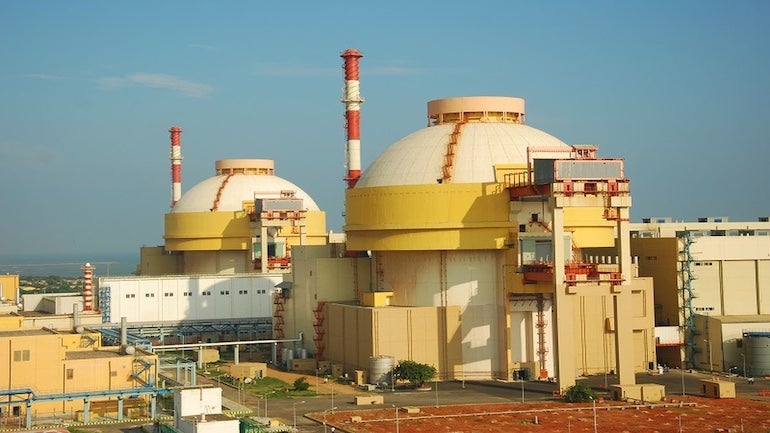
Rosatom Automated Control Systems (RASU – the Instrumentation & Control and Electrical Engineering Division of Rosatom) has delivered equipment for Engineered Safety Feature Actuation System – Computerised Subsystems (ESFAS CS) for units 3&4 of Kudankulam NPP in India’s Tamil Nadu state.
This delivery comprises the digital safety system of the reactor safety apparatus, consisting of nearly 300 manufactured equipment items to protect the station’s VVER-1000 power units currently under construction.
The architecture includes four independent safety trains for each reactor unit. All safety trains are physically separated and powered by independent diesel generators to prevent common-mode failures. The system uses advanced non-programmable modules to execute critical safety automation functions smoothly and securely.
In addition to the core ESFAS CS subsystems, the RASU shipments include:
- Operational dispatch control systems;
- Radiation monitoring and fire protection systems;
- Automated systems for water treatment control; and
- A batch of electrical equipment for the reactor control and protection system, alongside 189 low-voltage cabinets.
The general design and equipment integration for this expansion phase are managed by Rosatom’s Engineering Division, Atomstroyexport (ASE).
Specialists developing the ESFAS CS for units 3&4, using the operating experience of the same system at Kudankulam 1&2, were able to implement a number of optimised solutions. These included the application of non-programmable modules that process signals from sensors without the use of microprocessors. This helps to reduce the dependence of safety functions on application software and increases the resistance of equipment to potential common cause failures.
ESFAS is the system which monitors the process parameters of a power unit when there is a deviation from normal operation conditions. In case of an accident, the system automatically initiates the start of safety instrumentation and control systems and sends commands to actuators (boron injection pumps and other active protection means) in order to prevent a beyond-design-basis accident and bring the reactor plant to a safe state. The system also ensures reactor cooldown, which is a controlled decrease of coolant temperature and pressure down to safe values after the shutdown.
The final delivery of ESFAS CS equipment another step towards equipping the units with Russian automation, control and safety systems, implemented through industrial cooperation coordinated by ASE, with the participation of Atomenergoproekt (part Rosatom’s Engineering Division), Atomtechenergo (part of Rosatom’s Electric Power Division), RASU JSC, and equipment manufacturers. Installation on site will be followed by the pre-commissioning stage, which includes off-line and integrated tests of the systems. Following the tests, the systems will be prepared for commissioning and operation.
Kudankulam NPP will comprise six units with VVER-1000 reactors. Work began following an intergovernmental agreement between India and Russia signed in 1988. Units 1&2 (Phase I) are already in operation and work is underway to build units 3-6 (Phases II and III). The customer and operator of the station is NPCIL, the general contractor is ASE, general designer Atomenergoproject and equipment designer OKB Gidropress. Upon completion of these projects, the Kudankulam site will have a total installed capacity of 6,000 MWe.
RASU unites the industry’s competences in the industrial automation, instrumentation and electrical engineering, establishing the technological foundation for control of nuclear energy and production facilities. The Division acts as a full-scope supplier of monitoring, control and energy distribution systems for NPPs at all lifecycle stages for dozens of operating and new build power units in Russia and abroad, as well as for industrial enterprises, solar and wind power plants. The Division includes a research institute with its own production facilities; a manufacturer of radioisotope devices; and a leading company specialising in converters and EV charging infrastructure.


