
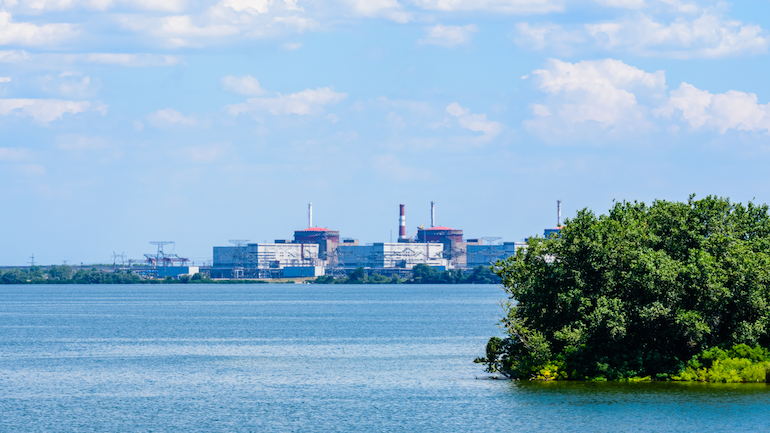
The Zaporizhia NPP (ZNPP) has been without off-site power since 20 August and is relying on emergency diesel generators (EDGs) to provide the electricity needed for essential nuclear safety and security functions. International Atomic Energy Agency (IAEA) Director General Rafael Mariano Grossi has underlined the importance of ensuring the site has sufficient diesel fuel available.
The plant lost connection to its only remaining off-site power line, the 330 kilovolt (kV) Ferosplavnaya-1 line following military activity on the northern side of the Dnepro River. Since then, it has been operating several EDGs to supply the power required for its own needs, most importantly for pumps that cool all six reactors and their used fuel pools.
In view of the extended loss of external electricity, the IAEA team at the ZNPP has been closely monitoring the diesel fuel situation. The team has visited most of the site’s 20 EDGs to observe fuel levels in their tanks and to assess how long the available reserves could support the plant if off-site power is not restored. On 28 August ZNPP reported that it had approximately ten days of diesel fuel available on site for EDG operation, which is the minimum regulatory requirement.
The IAEA team was also informed that the most recent delivery of fuel to the plant’s off-site fuel farm took place almost half a year ago, in March. A further delivery, planned for May, was delayed because of frequent military activity in the area. IAEA has not been able to visit this fuel storage since March 2025, with the ZNPP citing security reasons.
However, the team recently observed the transfer of several dozens of tonnes of diesel fuel from two different off-site locations near ZNPP to the plant both to report on the nuclear safety situation of the plant and to provide security assurances during the transfers. Grossi said the Agency is closely monitoring the site’s ability to continue relying on EDGs for an extended period.
“The availability of diesel fuel is of paramount importance whenever a nuclear power plant loses off-site power, as is the ability to maintain uninterrupted logistical supply chains to and from the site. The current situation once again shows why reliable external power and secure supply routes are indispensable for nuclear safety and security. Without the restoration of off-site power or additional diesel fuel deliveries in the near future, the plant could face a station blackout within approximately ten days,” he warned.
In this context, IAEA is working to establish another localised ceasefire zone, which would be the seventh such arrangement negotiated by the Agency since late last year, to facilitate repairs to the Ferosplavnaya-1 line as soon as possible. If successful, the repairs would restore off-site power to the ZNPP.
Rosatom Director General Alexey Likhachev told Sputnik: “It’s impossible to keep relying on our own diesel generators indefinitely, and we need to resolve the issue of restoring external power supply as soon as possible. According to the ZNPP administration, the damaged section of the Ferosplavnaya-1 line is located in territory controlled by Kyiv. The 750 kV Dneprovskaya line, which was damaged as a result of earlier attacks was repaired on 23 June, but has not yet been put into operation as its reactivation requires the co-operation of Ukraine.
Likhachev emphasised that providing the plant with diesel fuel is a priority for Russia, so fuel and lubricants will be delivered to the plant whatever the circumstances. At the same time, he noted that Russia is counting on IAEA assistance. “We expect that IAEA staff will accompany the convoy carrying fuel, which has become a critical resource under the current circumstances and on which the nuclear safety of the ZNPP directly depends,” he said.
Meanwhile, the IAEA team at the ZNPP has continued to report hearing military activity, including explosions, several times a day, often at distances that appeared to be close to the site. The plant also continued to report military activity in the nearby city of Enerhodar, where many plant staff live, as well as alleged drone activity in and around the site.
IAEA has been informed of three recent drone incidents at the site of the ZNPP. One drone attack on 25 August reportedly occurred near the cooling pond, injuring two plant employees. The following day, another drone detonated on the site of the dry used nuclear fuel storage while a third drone – also on 26 August – reportedly hit the sprinkling device of the ZNPP’s power units system. Radiation levels at the site remain normal.
“Attacks that threaten nuclear power plant staff or strike areas related to the spent fuel storage or cooling pond are unacceptable and must stop. Even when there is no impact on nuclear material, such incidents carry serious risks for nuclear safety and security. I again call for maximum military restraint to protect nuclear facilities and the people who work there,” Grossi said.
ZNPP reported on its Telegram channel on 22 August that a drone attacked an official vehicle belonging to plant operators, which was located on the territory of the control centre of the plant’s hydraulic workshop. No one was injured but the vehicle was damaged. The attack occurred approximately 1 kilometre from the perimeter of the plant and just 800 metres from the plant’s open switchgear. “It is especially important that the attack was carried out deliberately against people who were at their workplace while performing their duties,” ZNPP said. “This attack demonstrates how serious the threat remains for the plant’s personnel, who continue to ensure the safe operation of the nuclear facility.”
On 25 August, ZNPP reported that a targeted attack on two employees who were injured. “The attack occurred in the area of the plant’s hydraulic structures at a time when employees of the repair and construction workshop were carrying out their official duties,” ZNPP said. “ One of the victims is in a serious condition, the other is in a moderate condition. Both employees were promptly evacuated to a medical facility. They are receiving all the necessary medical care, and their condition is under the doctors’ control.”
The following day, ZNPP reported a drone attack on the site of the dry storage facility for used nuclear fuel. Although there was no significant damage or casualties, ZNPP emphasised that an attack on a used nuclear fuel storage facility is extremely dangerous and unacceptable, the consequences of which could be serious if the infrastructure were damaged. “Any impact on the systems and structures that ensure the safe storage of used nuclear fuel creates a potential threat to nuclear and radiation safety.”
ZNPP noted the used fuel is safely stored in special ventilated containers and any attck is dangerous primarily due to the possible damage to the complex’s infrastructure and the containers. “At the same time, the storage facility is a reliable and unique complex, created with a large margin of safety and designed for long-term safe fuel storage. This week, the complex celebrated an important date – on 24 August, it turned 25 years old.”
Today, the complex houses 173 containers and is designed to safely store up to 380 containers for 50 years. Its condition is constantly monitored by specialists, and the facility itself is under the supervision of IAEA inspectors. “The 25 years of reliable operation is the result of the work of generations of specialists. And today it is especially important to remember that nuclear safety must not become a target for attacks.”


