
Bruce Power has finished installing all 480 calandria tubes into the unit 4 reactor, outperforming its previous timeline by 25 days compared to the unit 3 milestone. This achievement sets a new speed record for Candu reactor refurbishments.
The eight pressurised heavy-water Candu reactor units at the Bruce site in Ontario (Bruce A – units 1-4, and Bruce B – units 4-8) began commercial operation between 1977 and 1987. Bruce Power’s CAD13bn ($10bn) Life Extension Programme, which includes Asset Management and Major Component Replacement (MCR), began in 2016 and includes units 3-8. Units 1&2 have already been refurbished and were returned to service in 2012. MCR will extend the life of the site until 2064. Work is already completed for units 6 and 3.
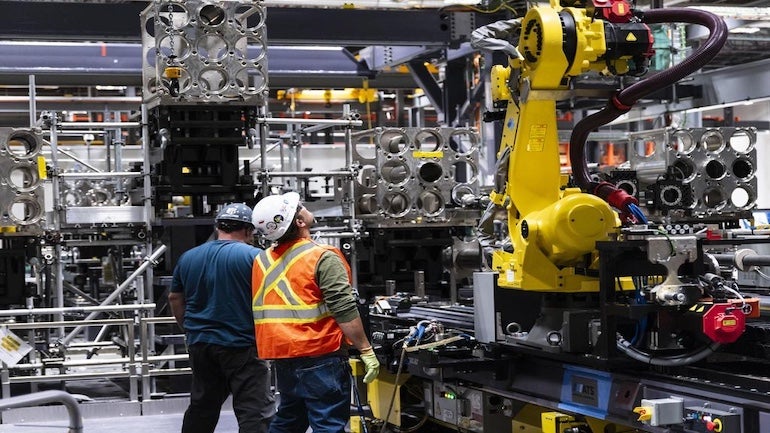
The rapid pace at unit 4 was driven by a custom six-axis robotic tooling system, designed to increase worker safety and limit radiation exposure. It was first deployed during the unit 3 MCR project. Technicians have since refined their automated processes based on lessons learned to boost precision and performance.
During peak installation in August, the team set a single-day Candu refurbishment record by installing 20 calandria tubes in a 24-hour window, surpassing the previous record of 16 set during the unit 3 outage.With the calandria tube installation completed, the unit 4 MCR project will shift to its next phase – fuel channel installation.
The first-of-its-kind industrial robotic tooling system was developed locally in Ontario by ATS Industrial Automation. The system uses custom, fully automated six-axis industrial robots operating directly on the reactor face. Remote-controlled cranes deliver the heavy calandria tubes to these robotic arms.
The advanced machinery works simultaneously from both sides of the reactor face. It slides custom inserts into each tube before precisely rolling the joint to micro-measured dimensions, ensuring a completely leak-tight seal.
By shifting the most physically demanding and repetitive installation tasks to automated machinery, the system massively reduces worker radiation exposure in alignment with ALARA (As Low As Reasonably Achievable) goals. Technicians use AI-driven inspection software to assess the reactor core prior to installation, feeding high-precision geometric profiles back into the robot’s motion control parameters.
The MCR outage for unit 5 is scheduled to begin in November. The total refurbishment window is projected to run until summer 2029. With units 6&3 already back in commercial service and unit 4 ahead of schedule, the refined methods and tooling software from the unit 4 calandria tube installation will serve as a template for unit 5
“Once again, Ontario’s nuclear sector is demonstrating its world leadership and proven track record of delivering large-scale refurbishments on budget and ahead of schedule,” said Stephen Lecce, Ontario Minister of Energy & Mines. “With electricity demand projected to rise by up to 90% by 2050, Ontario continues to set the benchmark for the world as we build new nuclear for the next generation.”


