
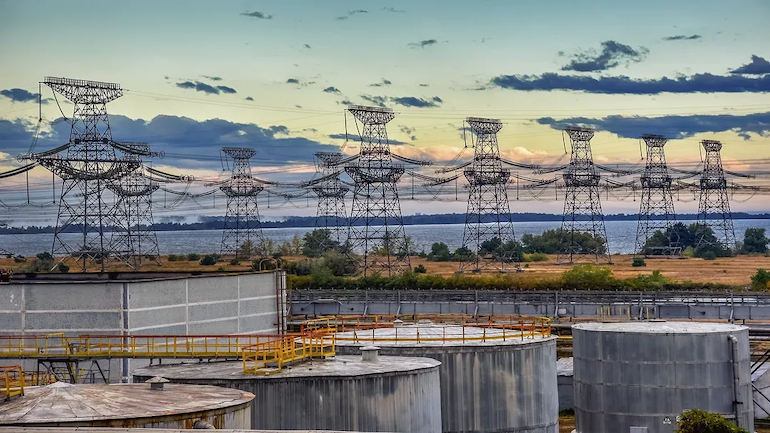
Repairs have been completed to the 750 kV Dneprovskaya power line at the Zaporizhia NPP (ZNPP) and to the switchyard of the Zaporizhia Thermal Power Plant (ZTPP), which helps supply electricity to the ZNPP through the back-up 330 kV Ferosplavnaya-1 line. However, the Dneprovskaya line has not yet been brought back into operation because of damage to a substation some 100 km away.
The substation was reportedly damaged during military activity in late May, and IAEA staff experts who recently visited the facility noted severe damage to essential equipment. Repair efforts are not expected to be completed in the near term, but are on-going, and the Agency will continue to monitor the situation closely.
The technically complex repairs at ZNPP were preceded by extensive de-mining, were carried out on the frontline under the protection of a localised ceasefire mediated by the International Atomic Energy Agency (IAEA). According to the Agency, IAEA teams monitored the work in challenging conditions, including nearby drone activity and the sound of military activity in the area.
“Of the six temporary ceasefires that we have negotiated since late last year to help protect nuclear safety at the ZNPP, this was the most challenging to implement,” said IAEA Director General Rafael Grossi. “It required several months of delicate negotiations, followed by mine clearance and repairs on high pylons across the Dnipro River. The IAEA monitored these activities on the ground to confirm they were carried out as agreed.”
“He added: “Both sides worked constructively with us to enable the repairs to proceed. Despite the many military and technical challenges, this demonstrates that concrete progress remains possible, even during a large-scale war. We will continue our efforts to reduce the ever-present danger of a nuclear accident.”
The ceasefire enabled repairs at the two separate locations. During the de-mining and repairs of the 750 kV Dneprovskaya line, the IAEA team based at the ZNPP observed the activities on the plant side of the frontline, while another Agency team was deployed on the opposite side of the Dnipro River to monitor developments from there. This work focused on several high pylons across the waterway, where the transmission line runs up to 100 metres above the water.
At the ZTPP, repairs were completed both on switchyard equipment and on a back-up transmission line connecting the Ferosplavna-1 line to the plant, making it more robust.
“Repeated damage to the electrical infrastructure on which nuclear power plants depend continues to create serious nuclear safety and security risks. I once again call for maximum military restraint around all nuclear facilities and the power infrastructure they require,” Grossi said.
On several occasions while monitoring the work under the sixth ceasefire, the IAEA was informed of, and observed, unidentified drones nearby, requiring the teams to leave the area more than once. Military activity has also continued to be reported daily in the vicinity of the ZNPP, including near the city of Energodar, where IAEA team members twice observed thick smoke.
“Nuclear power plant staff must be protected at all times. They carry out essential work for nuclear safety and security, often in extremely difficult circumstances, and must never be targeted,” Grossi emphasised said.
Commenting on the long-running issue, Mohit Prasad, Practice Head in the Power Strategic Intelligence division of NEi parent company Global Data, said: “The completion of repairs to the Dniprovska transmission line marks a positive step towards improving power security at ZNPP. However, the broader situation remains unresolved, as the line cannot yet be returned to service due to significant damage at the connecting substation. While the repairs reduce the immediate risk of prolonged power interruptions, they do not restore the plant’s full external power resilience.
Prasad continued: “Throughout 2026, ZNPP has experienced repeated disruptions to both its primary Dniprovska line and the 330 kV Ferosplavna-1 backup line. Military activity led to the disconnection of the Dniprovska line in March, while the Ferosplavna-1 line suffered multiple outages in April, twice forcing the plant to rely on emergency diesel generators to maintain reactor cooling and other essential nuclear safety systems. Although repair works-some facilitated through temporary local ceasefires brokered by the IAEA-have restored backup connections on several occasions, the recurrence of these outages highlights the continued fragility of the plant’s external power supply.
The events at ZNPP demonstrate how the conflict in Ukraine has transformed high-voltage transmission infrastructure into a critical component of nuclear safety. Maintaining reliable grid connections is now as important as protecting the nuclear facility itself, underscoring the growing interdependence between transmission network resilience and nuclear security in conflict-affected regions.”


