
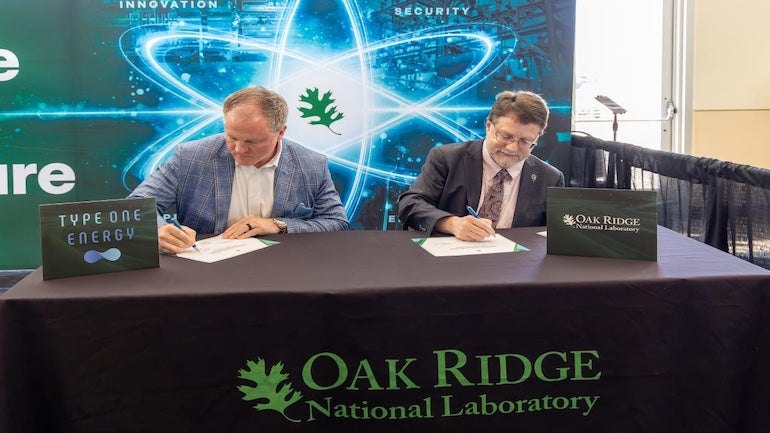
The Department of Energy’s Oak Ridge National Laboratory (ORNL) has transferred a critical suite of fusion-fuelling technologies to the private sector by licensing them to Type One Energy. The milestone agreement, signed during the Nuclear Opportunities Workshop (NOW) in Knoxville, Tennessee, bridges decades of government-funded research with commercial application.
The inventions licensed to Type One, a fusion company based in Oak Ridge, focus on cryogenic pellet fuelling. This process forms solid hydrogen isotope fuel (deuterium and tritium) just above absolute zero and injects them at high speed into a fusion plasma. This is more effective at fuelling the core of a plasma than other methods, such as gas puffing, and contributes to improved plasma performance.
Type One is developing next-generation stellarator technology to accelerate the commercialisation of fusion energy. In July 2025, Type One Energy signed the first set of commercial contracts related to Project Infinity, which is developing fusion power plant technology to supply the Tennessee Valley with energy by the mid-2030s. The Tennessee Valley Authority (TVA) is helping to develop tailored welding and fabrication techniques for Project Infinity.
These manufacturing and construction methods will be used for Type One’s Infinity One stellarator fusion machine currently being deployed at TVA’s Bull Run Fossil Plant near Knoxville. They are also intended for the potential subsequent TVA fusion power plant project based on Type One’s Infinity Two stellarator technology. In June, Type One completed the first formal design review of its planned Infinity Two power plant.
Type One has previously worked with ORNL on several major technology collaborations, including a recently-announced high-heat flux test facility and a joint project in the Innovation Network for Fusion Energy (INFUSE) programme.
The specific inventions transferred to Type One by ORNL include:
- Tritium-Compatible Cryogenic Pellet Gas Gun: This uses tritium-compatible materials, real-time pellet size control and a simplified, robust design that minimises stress-induced failures for reliable, long-term operation in fusion environments.
- Tritium-Compatible Cryogenic Screw Extruder for Plasma Energy Pellet Injection: This cryogenic extruder. tailored for tritium service and radiation resistance, maintains hermetic containment during continuous pellet production while accommodating a wide range of extrusion temperatures, flow rates, cross sections and isotope mixtures.
- Pressure Relief Device for Cryogenic Fusion Fuels: This reusable pressure relief and check valve provides overpressure protection through repeated operation in tritium fuel systems at temperatures below 20 kelvin, protecting injector seals and enhancing the safety of fusion fuelling systems.
- Solid Conveyance with Single Phase Change Method for Cryogenic Extrusion Recirculation: This recirculation system creates a more efficient, closed-loop fuelling process by recycling excess extrusion into gas for pellet production, reducing tritium inventory and eliminating the need for external gas handling and processing systems to support long-term reactor operation.
ORNL’s licensed technologies address a gap in fuel performance, containment and recirculation challenges by providing a novel extrusion system that can produce pellets at rates appropriate for reactor operations. The system is expected to efficiently and safely provide flexible continuous plasma fuelling.
Fusion reactors that run on deuterium and tritium must be continuously refuelled to replace ions consumed in the reaction and lost from the confining magnetic fields. While deuterium is relatively abundant and can be handled with conventional equipment, tritium’s scarcity and radioactivity present unique challenges for reprocessing and containment, and no current pellet injectors are able to produce pellets at required rates.
Prior to this technology transfer, no commercial pellet injectors were capable of manufacturing and recycling tritium fuel at the continuous repetition rates required for a power plant. Type One Energy will immediately deploy these technologies into the development of its Infinity One prototype fusion reactor. Successful scaling of these fuel cycles will directly inform the company’s future commercial design, Infinity Two, which aims to eventually deliver 300-350 MWe of electricity to the commercial grid.
“Type One Energy is a valued partner in advancing fusion energy research,” said ORNL Director Stephen Streiffer. “This licence is an exciting next step in our partnership, moving our fuelling research out of the lab and into application, and we look forward to seeing these technologies contribute to the future of fusion energy.”
John Canik, Chief Science & Engineering Officer at Type One, noted: “Our continuing collaboration with Oak Ridge National Laboratory is accelerating the commercialisation of fusion energy. Fuelling the fusion reaction with high repetition and high reliability is one of the most essential technologies for continuous generation of fusion power.”


