
The latest version of the International Atomic Energy Agency’s (IAEA) Small Modular Reactors – Catalogue 2024 (updated to June 2025) reports advances in design developments of all the major technology lines. It covers land-based and marine based water-cooled reactors; high temperature gas cooled reactors; liquid metal, sodium and gas-cooled fast neutron spectrum reactors; molten salt reactors; and microreactors. The content on the specific small modular reactor (SMR) designs is provided by the responsible institute or organisation.
The catalogue was developed by the Nuclear Power Technology Development Section, Division of Nuclear Power of the IAEA Department of Nuclear Energy (NENP/NPTDS) in cooperation with SMR technology developers from member states.
The IAEA has been publishing Booklets (or catalogues) on the status of small modular reactor (SMR) technology developments biannually since 2012 to provide member states with a concise overview of the latest status of SMR designs. Since then, the SMR booklet has been listing an increasing number of designs, with the 2022 edition featuring 83 designs. Although close to a hundred designs could have been listed in the 2024 edition, only 70 active designs with demonstrated sustained development were selected. “Even among these active designs, not all of them are expected to develop into real commercial products, as some designs are developed as proofs of concept or study material,” the introduction notes.
Frederik Reitsma, head of the Nuclear Power Technology Development Section told NEi that the new listing was based on updates. “In the past we included older designs that were maybe not actively being pursued anymore. So we basically just ask for updates. The ones we didn’t get updates for, we didn’t include them again. Also, we didn’t include small projects such as university student projects – otherwise there would have been over 90.”
Mohammad Hadid Subki, a senior technical expert in the Nuclear Power Technology Development Section, specialising in SMRs, said about 1% of the earlier listings had been dropped which were no longer showing progress of development in the past three or four years. “We focused only on the others, not only near-term deployable projects but even pre-conceptual designs for deployment beyond 2030 – but projects that are active,” he noted.
According to the latest assessment by NENP/NPTDS on the Deployment and Development Status of SMRs, (see map) there are currently two in operation and four under construction as well as nine in the advanced stage of licensing. Of these 15, the majority (eight) are pressurised water reactors (PWRs) as well as three high temperature reactors (HTRs – two gas cooled and one fluoride salt cooled) one boiling water reactor (BWR), and one lead-cooled fast reactor.
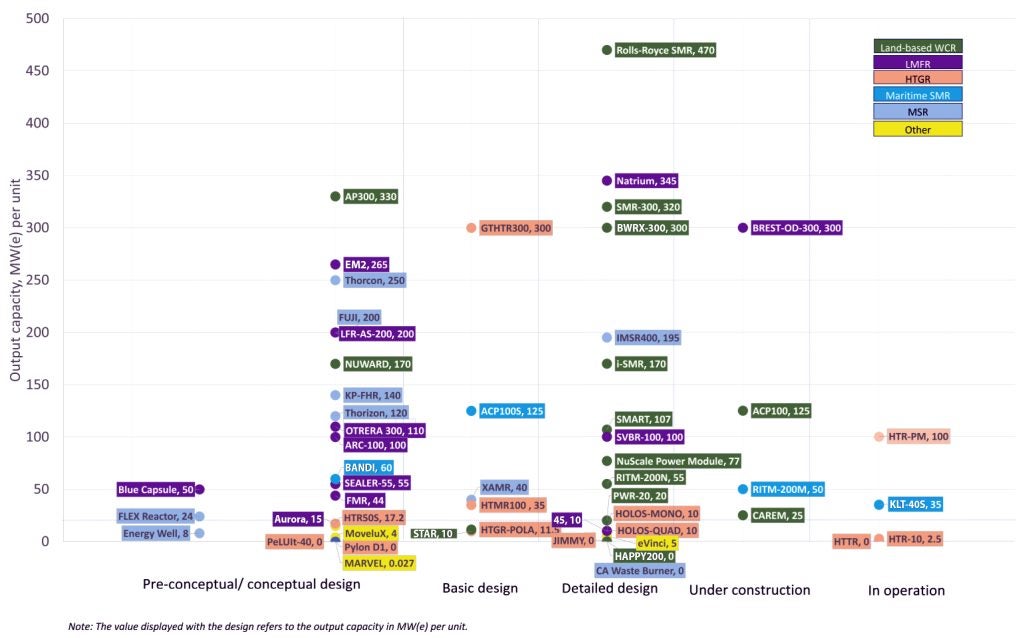
Most of the PWR designs are integral pressurised water reactors (iPWRs) in which major primary system components, such as steam generators, the core, and even the pressuriser, are integrated within a single reactor pressure vessel (RPV). This removes the need for large primary coolant piping, which greatly reduces the risk of large loss-of-coolant accidents and increases inherent safety. However, they are more complex to construct than classic loop-type PWRs. Many developers are now adopting this design for next-generation SMRs.
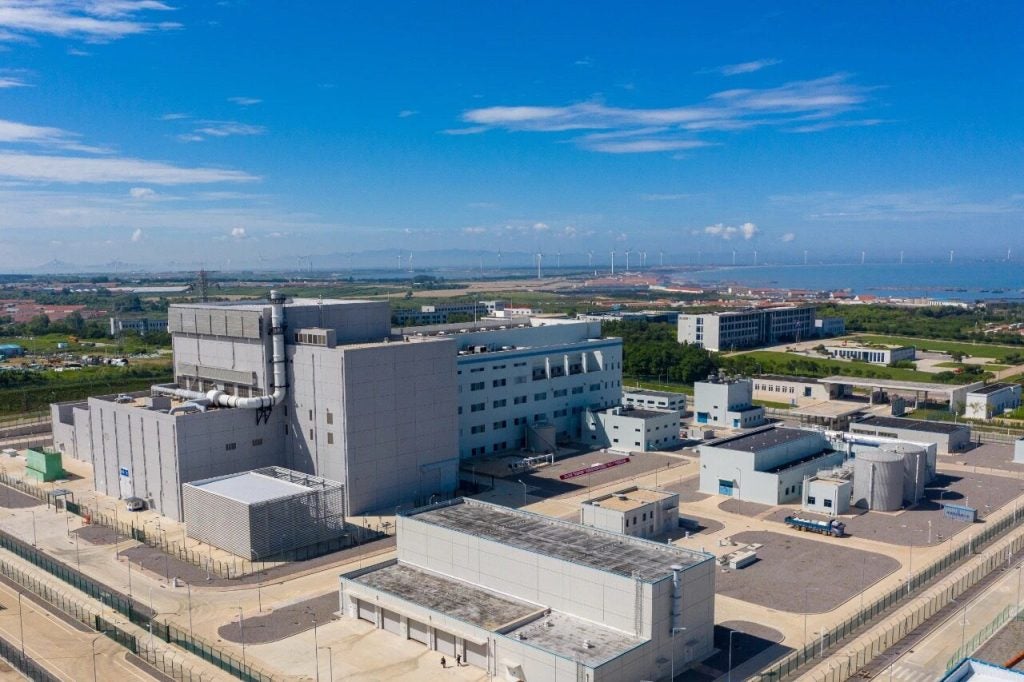
Already in operation are: Russia’s floating NPP Akademik Lomonosov powered by two 35 MWe KLT40S integral (PWRs), which began operation in May 2020 and has already completed its first fuel cycle; and China’s HTR-PM comprising two pebble-bed high temperature gas cooled reactor (HTGR) modules generating 200 MWe from a single turbine unit, which began operation in 2023.
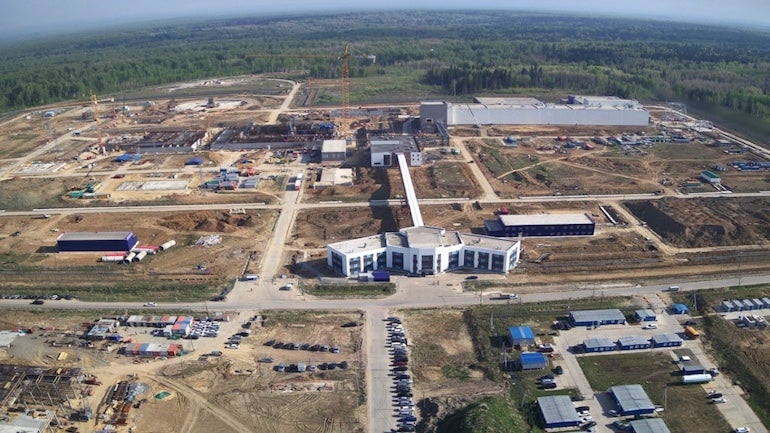
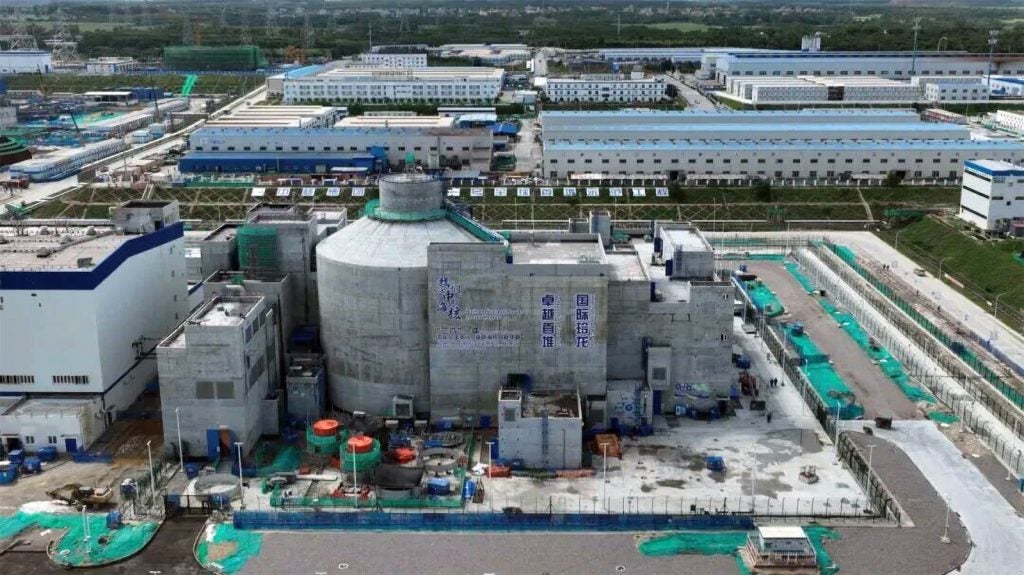
Those under construction include: China’s ACP100, a 125 MWe integral PWR, expected to start operation in 2026; Russia’s 300 MWe BREST-OD-300 lead-cooled fast reactor, expected to begin operation in 2028/29; Argentina 32 MWe CAREM integral PWR (construction was suspended late 2024 to focus on design revision); and Russia’s 50 MWe RITM-200M integral PWR for floating NPPs planned for operation by 2030.
SMRs in the advanced stage of licensing include RITM-200N, BWRX-300, VOYAGR, i-SMR, Xe-100, SMR-300, KP-FHR, AP300 and Rolls Royce SMR.
Russia’s 55 MWe RITM-200N integral PWR ground-based SMR received a licence permit for construction in April 2023 and commissioning of a single unit in Yakutia is expected in 2028. Preparation for six units to be deployed in Jizzakh region in Uzbekistan has started marking the first export of an SMR from Russia.
For GE Hitachi’s BWRX-300 (US and Canada) 290 MWe boiling water reactor (BWR) Ontario Power Generation (OPG) was granted a construction licence by the Canadian Nuclear Safety Commission in April 2025. A contract has been awarded to BWXT to manufacture the reactor pressure vessel for the first BWRX-300 to be constructed at OPG’s Darlington site. On-going early site preparation for four units is underway with commissioning for the first unit expected in 2030.
NuScale’s VOYGR (US), a 50 MWe integral PWR was certified by the US Nuclear Regulatory Commission (NRC) in January 2023 and in May 2025 it also received standard design approval for its uprated 250 MWt (77 MWe) NuScale Power Modules. The first six-module deployment is now earmarked for Romania. A US project with the Utah Associated Municipal Power System was cancelled in November 2023 and now the focus in on expanding in several embarking countries.
South Korea’s i-SMR (innovative Small Modular Reactor) is a 170 MWe integral PWR in an advanced development phase, with the government aiming for commercialisation by 2035 and a demonstration plant incorporated into the national energy plan. The i-SMR is currently in the standard design and preliminary design review phase. The government and the i-SMR Development Agency aim to complete standard design approval by 2028. Standard design approval is expected in 2028. In July 2024, an i-SMR simulator was launched to support research, development, and training for the system.
X-energy’s Xe-100 (US) is a 80 MWe, HTGR technology. X-energy announced plans in 2023 to build four Xe-100 SMRs at a Dow industrial site in Seadrift, Texas with construction due to start in 2026. X-energy has also signed a joint development agreement with Energy Northwest for the deployment of up to 12 Xe-100 plants in central Washington State. Amazon had invested in X-energy to support Xe-100 deployment.
Holtec’s SMR-300 (US), a 320 MWe two-loop PWR but with major integration. The pressuriser is built directly on top of the Steam Generator, eliminating external piping and simplifying the coolant system. It has reached an advanced stage of licensing. In February 2024, the Palisades NPP site in Michigan was selected as the site for a first-of-a-kind SMR-300. Holtec has partnered with Hyundai E&C for SMR-300 construction. The SMR-300 has completed the first phase of the UK Generic Design Assessment (GDA) process.
Kairos Power’s 140 MWe Fluoride Salt-Cooled High-Temperature Reactor (KP-FHR) project (US) is progressing, with construction underway on the Hermes demonstration reactor in Oak Ridge, Tennessee for estimated operation in 2027. The KP-FHR received a construction permit from the US NRC in December 2023. In late 2024, In late 2024, NRC also approved the construction permit for Hermes 2, a two-unit plant that will include power generation. Kairos Power plans deployment of a commercial-scale plant in the 2030s.
Westinghouse’s AP300 (US) is a 300 MWe one-loop PWR based on the licensed and operating AP1000 pressurised light water technology. In 2024, it received approval to enter the UK GDA. Detailed design completion scheduled for 2027 and commercial operation for 2033. An earlier design for a 225 MWe integral PWR (Westinghouse SMR) was suspended in favour of the AP300.
Rolls-Royce SMR (UK) is a 470 MWe three-loop PWR. It has completed Step 2 of the UK’s GDA process and progressed to the third and final phase with expected completion in August 2026. Construction is planned to start in 2027. The design was selected by Great British Energy – Nuclear (GBE-N) for the first UK SMRs at Wylfa, aiming for grid power by the mid-2030s.
The project is progressing with key partnerships, including Amentum as programme delivery partner, and is moving towards final contracts, manufacturing, and site preparation, while also exploring international opportunities in Sweden and the Czech Republic.
These 15 projects are among the 70 described in detail in the Catalogue 2024. However, it is notable that of the 11 projects currently being fast-tracked by the US Department of Energy (DOE) under the Reactor Pilot Program announced in August 2925, only one, Oklo’s Aurora Powerhouse, is listed in the catalogue. DOE is working with industry on these 11 projects, aiming to construct, operate, and achieve criticality of at least three test reactors by 4 July, 2026 in line with President Trump’s May Executive Order 14301, Reforming Nuclear Reactor Testing at the Department of Energy.
Oklo is developing the Aurora powerhouse, a 75 MWe liquid metal–cooled, metal-fuelled fast reactor. Oklo’s first reactor is being built at Idaho National Laboratory (INL) with plans to begin operation in 2027. However, the NENP/NPTDS map lists it as in the conceptual design stage. Asked by NEi whether he thought any of the 11 would meet the July 2026 deadline, Frederik Reitsma replied: “I think so, but the question is, what does it mean? It’s probably just a critical facility that they can put together. If they are successful it means just another demonstration step towards deployment.”
The other 10 projects are: Antares Nuclear’s R1- A 500-kWt sodium heat pipe–cooled microreactor that has already received its Nuclear Safety Design Agreement (NSDA) from DOE; Atomic Alchemy’s Versatile Isotope Production Reactor, a 15-MWt light water reactor designed for radioisotope production; Deep Fission’s Deep Fission Borehole Reactor-1, a 15-MWe PWR intended to be built one mile underground; Last Energy’s PWR-5, 5 MWe scaled-down test version of their 20 MWe PWR-20 modular reactor design; Natura Resources’ MSRR, a 1 MWt research molten salt reactor being developed in partnership with Abilene Christian University; Oklo’s Project Pluto, an advanced fast reactor project; Radiant Industries’ Kaleidos, a 1 MWe helium-cooled microreactor scheduled for testing at INL’s Demonstration of Microreactor Experiments (DOME) facility; Terrestrial Energy’s Project TETRA, a test reactor based on 195 MWe Integral Molten Salt Reactor technology; and Valar Atomics’ Ward250, a 100 kWt helium-cooled, TRISO-fuelled HTGR that broke ground in September 2025.
Clearly, these companies failed to provide IAEA with updated information on their projects as they race to achieve criticality. The leading projects in Catalogue 2024, on the other hand, have already achieved, or are approaching, real deployment. The Catalogue can be downloaded from the IAEA website as a PDF document.
In addition, in 2025, IAEA published TECDOC-2110 – Approaches to and Preparation for the Operation of Small Modular Reactors, also available from the IAEA website. The IAEA noted that international organisations have published a wide range of resources on SMRs, addressing topics such as design, technology, engineering, economics, safety, safeguards, security and infrastructure development. However, operational readiness for SMRs has not yet been specifically covered by existing publications. To address the identified gaps in technical publications for member states, the IAEA initiated a dedicated collaboration among its internal experts in various fields, including nuclear power engineering and nuclear power technology development.
As part of this collaboration, a task force was formed to develop the 79-page TECDOC, which presents state of the art information on commissioning, the approach to criticality, connection to the grid, operational limits and conditions, load following operation, assurance of fuel and component integrity, main control room arrangement, human–machine interface and management of operating personnel.
Information on SMRs is available on the Advanced Reactor Information System (ARIS) database.


