
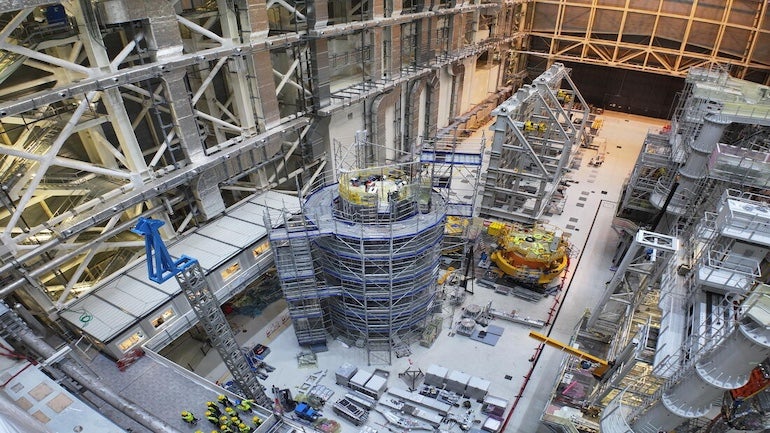
US ITER has completed final deliveries for the central solenoid, the powerful pulsed superconducting magnet for the International Thermonuclear Experimental Reactor (ITER) under construction at Cadarache in France. The most recent deliveries included busbars and leads for electrical connections between the modules; earlier, all magnet modules, support structures, and tooling components had been delivered. The central solenoid assembly stack at ITER is now five modules high.
The 18-metre-tall magnet is now under assembly at the ITER site. Five of six modules are stacked, with the final module to be added later this year. Assembly is the responsibility of the ITER Organisation, with additional technical support provided through an agreement with the US ITER project team based at Oak Ridge National Laboratory.
Each of the six individual sections of the central solenoid magnet is wound from about six kilometres of niobium-tin superconducting cable and weighs more than 122.5 tonnes. Each required more than two years to fabricate, followed by testing and shipment to France.
A spare module was manufactured to reduce technical and schedule risk as part of ITER’s strategy to build redundancy into mission-critical systems. It will only be deployed if a problem emerges with one of the six modules already on site. The 15-year project to produce the modules was completed at General Atomics’ Magnet Technologies Center in Poway, California.
US ITER said it will now receive credit from the international project for the full magnet scope and is in process of closing out this project area. An ITER Domestic Agency receives credit for specific in-kind deliveries when all the terms of the Procurement Arrangement have been fulfilled.
After the six modules are in place, a compression structure will be put in place to apply downward precompression on the module stack, The completed central solenoid will then remain on its platform in the Assembly Hall until all nine vacuum vessel sector modules are installed, after which it will be moved into the centre of the tokamak pit. ITER’s magnetic system is the world’s largest superconducting system. The fully assembled pulsed magnetic system will weigh almost 3,000 tonnes. As well as the central solenoid, it consists of toroidal and poloidal magnetic field coils and correction coils.
“The completion of the central solenoid magnet highlights the capability of the United States to design and deliver the world’s most complex fusion systems,” said Kevin Freudenberg, US ITER Interim Project Director. “Congratulations to the entire team who contributed, including those here at Oak Ridge National Laboratory who led the work, and our suppliers who fabricated critical components.”
US ITER has also delivered the exoskeleton support structure that will enable the central solenoid to withstand the extreme forces it will generate. The exoskeleton comprises more than 9,000 individual parts, manufactured by eight US suppliers.


