
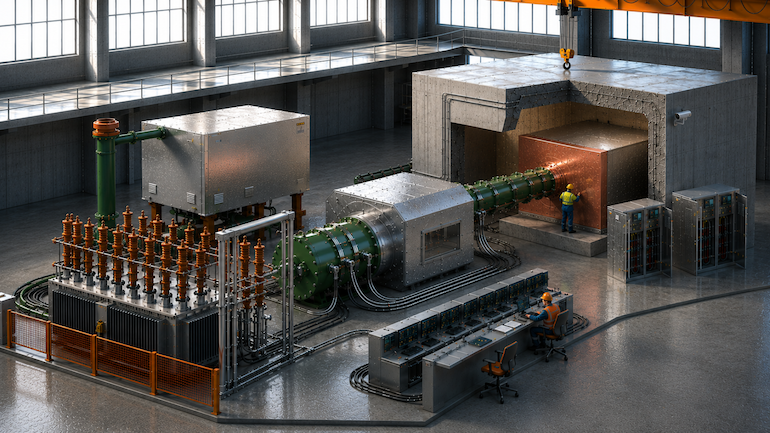
Japanese fusion technology company Kyoto Fusioneering (KF) is relocating its US headquarters from Seattle, Washington, to Oak Ridge, Tennessee to pursue a partnership with Oak Ridge National Laboratory (ORNL) for the development of Unity-3, a first-of-its-kind fusion nuclear test facility. The relocation is accompanied by a $46.9m capital investment in the region and is projected to create 51 new high-tech jobs.
Unity-3, executed as a public-private partnership with ORNL, represents a significant transition for the fusion industry from theoretical physics validation toward scaling the physical supply chain and plant engineering infrastructure required for commercial viability. Unity-3 has received funding from DOE and the State of Tennessee is supporting the relocation and project through its Nuclear Energy Supply Chain Investment Fund.
The facility deepens the strategic partnership KF, DOE, and ORNL launched in January 2026 under DOE’s Innovation Network for Fusion Energy and Fusion Innovation Research Engine Collaborative programmes, which investigated lead-lithium and liquid metal blanket dynamics. Unity-3 is designated a national priority within DOE’s finalised Fusion Science & Technology (FS&T) Roadmap, which aims to realise an operational pilot fusion plant by the mid-2030s.
While global momentum has driven over $12bn in private capital into fusion development, commercialisation faces a critical fuel bottleneck. Commercial fusion reactors rely on a deuterium-tritium (D-T) fuel mix. However, tritium barely exists in nature, and the current global supply – primarily sourced as a byproduct from traditional fission reactors – is highly inadequate. A single 500 MWe fusion plant would deplete almost the entire global inventory within a year. To achieve self-sufficiency, a commercial fusion power plant must breed its own fuel in real-time.
This requires wrapping the reactor core in a lithium-bearing breeding blanket. High-energy fusion neutrons bombard the lithium inside the blanket, causing the atoms to split into helium and tritium. The generated tritium must then be isolated, extracted from coolants (such as liquid lithium), and continuously recycled back into the reactor core.
Breeding blanket and fuel cycle technologies remain among the least mature systems in the fusion space. To date, the entire industry has designed these critical configurations using unbenchmarked computer simulations that have never been verified against a real, engineering-scale fusion-neutron environment. Unity-3 is explicitly designed to eliminate this industry-wide risk.
Unity-3 will use an accelerator-based volumetric D-T fusion neutron source to replicate a high-neutron environment mimicking true reactor conditions. Armed with advanced, high-fidelity sensors, it will measure neutron spectra and depth-resolved tritium production levels with unprecedented precision. These empirical datasets will serve to validate computational models and train AI-accelerated digital twins of diverse blanket concepts.
Rather than forcing private developers to absorb immense vertical integration costs alone, Unity-3 provides a centralised platform to de-risk technology architectures. Multiple prominent fusion startups – including Realta Fusion, Thea Energy, Type One Energy, and Xcimer Energy – are slated to integrate Unity-3 data directly into their respective reactor designs. No other operating or planned facility combines that source geometry, test-article scale, and depth-resolved measurement capability.
“Commercialising fusion is no longer primarily a physics challenge; it is increasingly an engineering and technology challenge,” said Dr Satoshi Konishi, Co-Founder and CEO of Kyoto Fusioneering. “Our expansion to Tennessee represents a deliberate bridging of world-class fusion capabilities: matching Japan’s decades of specialised engineering heritage with America’s premier nuclear innovation ecosystem. By delivering unity-3 alongside ORNL, we are establishing the foundational, shared infrastructure required to accelerate a viable, commercial fusion industry globally.”
DOE’s FS&T Roadmap identifies “integrated neutron and blanket systems” as essential infrastructure for closing the fuel cycle gaps that separate today’s experiments from a fusion pilot plant (FPP). Unity-3 will deliver that capability. It also has an important role to play in DOE’s broader vision for AI-accelerated science. The data it generates – high-fidelity measurements of fusion neutronics and tritium production that have never before been captured – are precisely the data needed to train, benchmark, and validate the digital tools at the core of the AI-Fusion Digital Convergence Platform (DCP), a flagship challenge of the DOE Genesis Mission.
“Oak Ridge National Laboratory has helped lead the nation in nuclear science advancements for more than eight decades, and fusion is an important part of that legacy,” said ORNL Director Dr Stephen Streiffer. “Pairing Kyoto Fusioneering’s deep expertise in fusion technology and integrated systems with ORNL’s strengths in neutron science, materials, advanced manufacturing, and computing gives the United States a place to answer one of fusion’s hardest questions – how breeding blankets perform in a real nuclear environment.”
Bibake Uppal, Kyoto Fusioneering America President, noted: “Oak Ridge has spent generations building the hard things that defined the nuclear age, and it is the ideal home for the next chapter in advanced energy. Every commercial fusion power plant design today relies on a breeding blanket that works, yet the entire sector has been constrained by a total absence of real-world testing infrastructure. Unity-3 solves that industry-wide gating risk. By building an open, confinement-agnostic testing ground with ORNL, we are saving developers from absorbing immense vertical integration costs alone. We came to East Tennessee to build a physical anchor for an allied fusion supply chain – we intend to manufacture here, hire here, and solve this shared problem together.”
Unity-3 is the nuclear element of a coordinated, staged de-risking programme. KF’s Unity (Unique Integrated Testing Facility) programme tackles the blanket and fuel cycle challenge through separate-effects testing. Each distinct class of physics is isolated in a purpose-built facility before they are brought together.
Unity-1, operating in Kyoto, Japan, resolves the non-nuclear behaviour of a liquid-metal breeding blanket: thermal-hydraulics, magnetohydrodynamic effects, hydrogen isotope extraction, materials compatibility, high-temperature heat extraction, and power generation. Unity-2, under development in Ontario through Fusion Fuel Cycles, a joint venture with Canadian Nuclear Laboratories, will demonstrate the world’s first continuous, end-to-end D-T fuel cycle in power-plant-relevant conditions. unity-3 adds the critical fusion-nuclear dimension – the neutronics, tritium production validation, and transmutation effects that can only be measured in a real fusion-neutron environment.
Each facility retires a different category of risk. Together they validate the blanket and fuel cycle systems and supply the data and components needed before full-scale integration. Across the programme, KF is partnering with the US national laboratory complex, with ongoing collaborations on Unity-1 with Idaho National Laboratory, Unity-2 with Savannah River National Laboratory, and Unity-3 with ORNL.


