
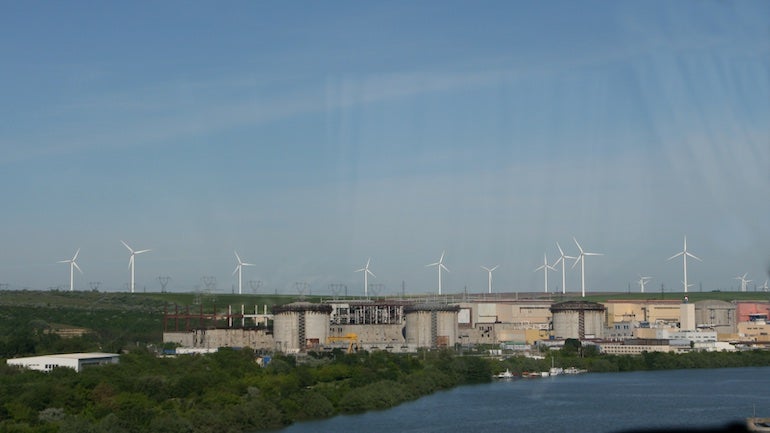
Romanian nuclear utility Nuclearelectrica has shut down its Cernavodă NPP with closure of its second 706 MWe Candu reactor in face of record-low water levels on the Danube. Unit 1 was closed in late July. Cernavodă typically generate about a fifth of Romania’s electricity. “We do not foresee a restart within the next ten days,” the Plant Director Romeo Urjan told AFP.
Romania had tried to postpone plant shutdown by blasting a rock formation and sinking barges filled with rocks in an attempt to redirect the Danube’s flow and secure enough water for cooling the Cernavodă reactors.
Hungary also plans to sink barges and build a sill on the Danube to keep its Paks NPP running. The Paks NPP, with four VVER-440 reactors, generates a third of the country’s electricity.
The Hungarian government has ordered the immediate construction of a submerged weir on the Danube between the Paks plant and the village of Dunaszentbenedek, according to Prime Minister Péter Magyar. As a temporary measure, two 80-metre barges will also be placed on standby near Paks. If necessary, they could be deliberately sunk in a controlled operation to raise the Danube’s water level by around 20 centimetres in the short term.
Magyar said the decision to begin construction of the weir was made after an on-site inspection and based on the unanimous recommendation of water management, energy, and defence experts. Work will initially use 35,000 cubic metres of rock, followed by a further 110,000 cubic metres. Magyar said the construction would begin with a wide layer of rock being placed on the riverbed to prevent the strong current from eroding the bed beneath and around the structure. Large rocks weighing several tonnes will then be placed layer by layer from both banks to form the weir. He stressed that the project had been designed so that nuclear safety standards would not be compromised in any way.
The design of the structure is being handled by Hungarian engineers with the involvement of the Budapest University of Technology and Economics. General Pál Kádár, head of the Defence Administration Office, has been appointed to coordinate and direct the defence and construction operations. The defence minister has deployed around 100 soldiers from Budapest and Szentes to support the operation.
Once completed, the weir will raise the Danube’s water level by up to one metre, Magyar said, adding that it would not pose a danger in the event of a future flood. Construction on the Paks side will take place within the nuclear plant’s area. The government also pledged to compensate for any damage caused by the works. In Dunaszentbenedek, the government also agreed to seek a solution that would leave the local riverbank in better condition than it is now once the weir is completed.
In Bulgaria, the Kozloduy NPP is operating normally, but monitored closely. The plant uses a deeper coastal bay pumping station design for its steam condensers rather than direct reactor cooling, making it slightly more resilient to immediate drops.
Unlike the Cernavodă and Paks plants, which sit directly on the riverbanks, Kozloduy is built roughly seven kilometres inland from the Danube. Water is drawn from the river and funnelled through an open canal to an intermediate pumping station. The shore pumping station features 34 independent pumps, though fewer than 20 are actively needed for daily cooling operations. This gives engineers the unique flexibility to rotate machinery if technical issues arise.
The Danube’s water level at Kozloduy’s shore pumping station has hit its lowest level in recorded history, sitting at 20.62 metres above sea level. If the river drops another 10 to 12 centimetres, the plant will hit its first critical limit. According to the Bulgarian Ministry of Energy, this threshold will automatically trigger a mandatory phased reduction in reactor output.
If the river drops by a full 30 centimetres, the intake pumps risk entering “cavitation mode” (forming destructive vapour bubbles due to low pressure). At this point, the pumps must be shut off entirely, resulting in zero water flow to cool the turbine condensers and forcing an immediate, full plant shutdown.
A specialised task force has been running emergency interventions since early July to keep the plant online. Excavation crews are actively clearing debris, sediment, and mud out of the intake canals to maximise water flow to the shore pumps. Bulgaria’s Energy Minister established emergency contact with Serbia to coordinate a cross-border water rescue. Serbia is strategically releasing water through its upstream Djerdap 1 (Iron Gates) hydropower dam system to artificially bolster the Danube’s water levels downstream near Kozloduy.
The severe regional energy crisis caused by the drying up of the Danube River has forced sudden shifts in how Central and Eastern Europe balances its electricity grid. The total shutdown of Romania’s Cernavodă and severe cuts at Hungary’s Paks have created massive domestic power deficits, requiring emergency interventions across the regional grid. Large, energy-intensive companies have been forced to temporarily halt manufacturing. In Romania, major carmakers like Dacia and Ford suspended production to alleviate demand on the failing network.
Governments have issued widespread requests for voluntary energy conservation. Both Romanian and Hungarian authorities have implemented targeted energy reduction initiatives, calling on households and businesses to cut usage. Fossil Fuel Re-activation: To prevent full grid collapse, environmental restrictions have been temporarily set aside. Romania declared a nationwide state of alert in the energy sector, firing up offline coal facilities – including a major lignite plant.
Central European grid operators have scrambled to increase imports. During peak evening hours, when solar generation drops, countries are importing electricity heavily through the European Network of Transmission System Operators to stabilise the baseline. The drought has exposed a critical vulnerability. If the Danube continues to hit record lows, traditional river-intake operations will remain unsustainable.
Energy ministries are evaluating multi-million-euro infrastructure upgrades. The primary long-term plan involves transitioning plants from once-through cooling to closed-loop systems using cooling towers, reducing direct river water extraction. The crisis is directly impacting future energy plans. Hungary is reviewing design adjustments for its upcoming Paks 2 nuclear expansion, forcing engineers to alter the Rosatom blueprints to include alternative hybrid cooling setups.


