
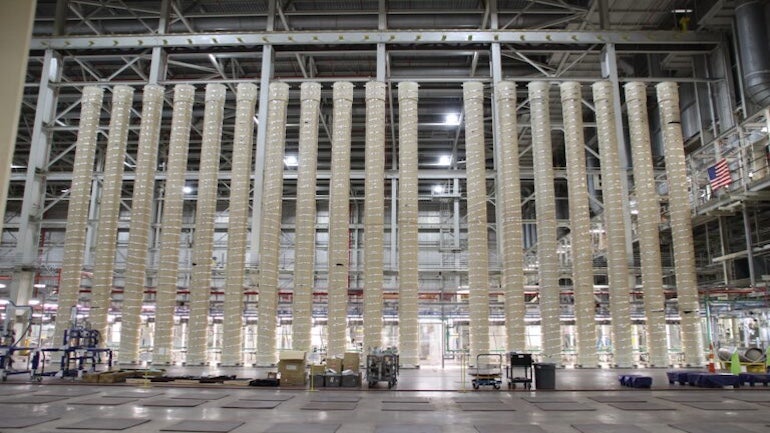
US-based Centrus Energy has announced that its subsidiary, American Centrifuge Operating (ACO), has agreed to a strategic collaboration with Fluor to serve as its Engineering, Procurement and Construction (EPC) contractor as Centrus proceeds with expansion of its uranium enrichment capacity in Piketon, Ohio.
Under the multi-year contract, Fluor will lead engineering and design of the expanded capacity in Ohio, manage the supply chain and procurement of key materials and services, oversee construction at the site, and support the commissioning of the new capacity.
The expansion project includes large-scale production of Low-Enriched Uranium (LEU) to address its substantial commercial LEU enrichment contingent backlog of $2.3bn and growing demand from existing reactors. Centrus also recently announced that it is planning on building 12 tonnes of high-assay, low-enriched uranium (HALEU) annual capacity for next-generation reactors after 2030, with initial commercial quantities expected by the end of the decade.
“This is another critical milestone for us as we begin our expansion in earnest,” said Centrus President & CEO Amir Vexler. “Fluor is a global leader with decades of experience managing complex nuclear construction projects and is an ideal partner as we transition to a large-scale deployment. With centrifuge manufacturing already underway, we are moving full-speed ahead with our expansion.”
Centrus Senior Vice President, Field Operations, Patrick Brown noted: “The addition of Fluor’s extensive experience in launching and supporting large-scale, complex, industrial build outs will empower our major expansion in Ohio. We look forward to this collaborative effort and the opportunities working with a best-in-class EPC will afford Centrus going forward.”
In December 2025, Centrus launched centrifuge manufacturing to support this expansion, and in early January the Department of Energy (DOE) selected Centrus for a $900m task order. This was a fixed-price contract designed to transition the Piketon facility from a small-scale demonstration initiative to commercial-scale production of high-assay low-enriched uranium (HALEU). The contract includes options for an additional $170m for HALEU production and delivery to the DOE, potentially increasing the total value to $1.07bn. It was part of a broader $2.7bn federal initiative to rebuild a domestic nuclear fuel supply chain and to end US reliance on Russian uranium imports.
Later in January, Centrus announced that it is investing more than $560m to transition its advanced centrifuge factory in Oak Ridge, Tennessee, to high-rate manufacturing. Centrus Energy is expanding its footprint in both Tennessee and Ohio to restore domestic uranium enrichment capabilities, with the two locations serving complementary, interdependent roles. The centrifuges manufactured in Tennessee are being installed at Piketon. Centrus was recently notified by the National Nuclear Security Administration of its intent to sole source certain uranium enrichment activities from Centrus.
The Piketon facility, officially known as the Portsmouth Gaseous Diffusion Plant, is a 3,700-acre federal site in southern Ohio that played a central role in the US nuclear complex for over 70 years. Construction was completed in 1956 at a cost of $750m. Its primary mission was producing highly enriched uranium (HEU) up to 97.65 for nuclear weapons and Navy propulsion.
Portsmouth was the final and most advanced of the three massive enrichment sites built by the US government to secure nuclear superiority during the Cold War. It functioned as a critical link in a three-plant complex alongside Oak Ridge (Tennessee) and Paducah (Kentucky).
Unlike the Paducah plant, which primarily produced low enriched uranium (LEU), Portsmouth along with Oak Ridge was capable of producing very highly enriched uranium (HEU). In 1960, it reached an assay of 97.65% uranium-235, the level required for nuclear weapons and naval reactors. After military production was suspended in the mid-1960s, the three plants worked as an integrated system for commercial fuel.
In the mid-1960s, the plant pivoted to producing LEU for commercial nuclear power plants. Under the Energy Policy Act of 1992, the United States Enrichment Corporation (USEC) – now Centrus Energy – leased the plant from the government to privatise enrichment operations. Gaseous diffusion operations officially ceased in May 2001, and the plant was placed in “cold standby”. In 2011, the facility was returned to DOE for Decontamination and Decommissioning (D&D). Demolition of the massive X-326 process building was completed in August 2023.
While a $3bn centrifuge project was abandoned in 1985, recent years have seen a revival to satisfy energy security demands and the need to produce fuel for planned advanced reactors. In 2023, Centrus began producing HALEU at the site at a demonstration level.


