
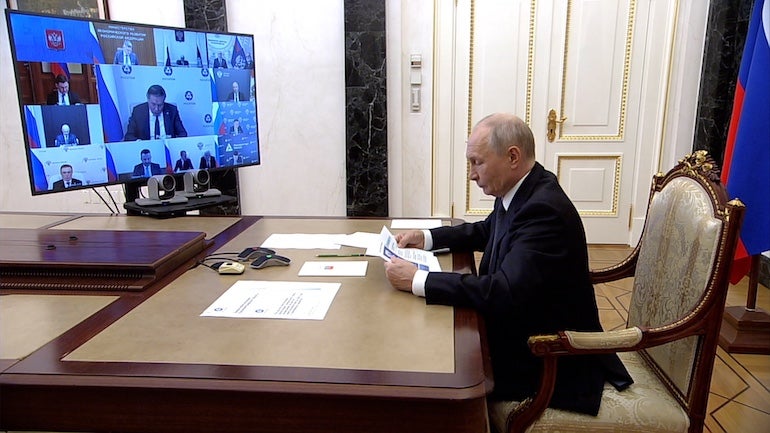
On the occasion of the 81st anniversary of Russia’s nuclear industry, President Vladimir Putin received a detailed report on the current status and future plans of the industry from Rosatom Director General Alexey Likhachev during a high-level meeting held via videoconference.
Opening the meeting, Putin said Russia “is perhaps the only country in the world to have competencies across the entire nuclear energy chain with a solid track record of upholding high safety standards and ensuring the reliable operation of nuclear power plants”.
While nuclear energy accounts for about 20% of domestically produced electric power, there are plans to launch 30 GWe of new nuclear generating capacity, including small NPPs. This will not only replace power units set to reach the end of their life cycle but will also help substantially increase the overall nuclear power generation capacity across a wider geography including the Urals, Siberia and Russia’s Far East.
“This effort is designed to create a solid foundation for infrastructure development with a view to promoting long-term regional and territorial development and facilitating the emergence of new, energy-intensive production sites, including those specialising in the deep processing of natural resources in the Arctic, Siberia and Russia’s Far East, while also serving sectors and powering services which have been playing an increasingly important role in the present-day economy,” Putin noted. “I am referring to electric transport, industrial robotics, automation in the services sector, etc.”
This includes the development of artificial intelligence tools and the construction of data storage and processing centres. “This demand must be calculated and planned for, and the necessary generating capacity must be provided, including, of course, from nuclear power plants.”
In this regard, Putin emphasised five key points.
- First. It is important to ensure technological readiness for the design and construction of NPPs – both large and small – and to have a range of standard power units that can be assembled in series, on a production-line basis. “This means scaling up the manufacture of power engineering products based on domestic developments. Industry and related enterprises, research centres, and laboratories must be prepared for this.”
- Second. A vitally important task is ensuring that NPPs have a sufficient fuel supply. “Here, we must work to strengthen our own resource base, conduct geological exploration, and develop deposits.”
- Third. “Competition in the global nuclear energy industry is fierce, and we must strengthen our technological leadership in this field, continually improve the safety of nuclear generation, and enhance its economic efficiency. Russia possesses the most advanced closed nuclear cycle technologies, which allow for the repeated use of fuel. We must ensure the widespread adoption of such technical solutions.”
- Fourth. The construction and maintenance of nuclear facilities clearly requires highly skilled personnel. Russia is strong in this area, but Russia’s competitors are also advancing rapidly. “Therefore, we must maintain a high standard of training for relevant specialists – scientists, engineers, technicians, and managers – and provide opportunities for existing industry workers to continually upgrade their skills.
- Fifth. Successfully implementing plans in the nuclear energy industry requires a sustainable financial model for its growth. “This model must take into account the specifics of financing investment projects, the scale of investment, payback periods, and so on.”
Putin then gave the floor to Likhachev, who discussed the current situation and outlined future plans. He said nuclear energy in Russia comprises 34 operating units at 11 NPPs, noting that these include the floating NPP Akademik Lomonosov with two reactor units, and six units at the Zaporizhia NPP that Russia took control of at the start of the conflict with Ukraine. Last year, Russia generated over 218 TWh from its nuclear units.
Future developments are guided by the General Scheme for the Placement of Nuclear Power Facilities, approved by the Government in December 2024, which remains in force until 2042. Within the General Scheme, Russia is pursuing three principal objectives.
- The first involves replacing legacy power units. Over the next decade, this includes decommissioning 13 units (some 10 GWe) accounting for one third of the currently operating fleet.
- The second is the transition to a new technological paradigm and to fourth-generation energy systems providing a practically inexhaustible resource base, owing to the inclusion of the uranium‑238 isotope in the fuel cycle and resolving radwaste accumulation by burning long‑lived isotopes and closing up the fuel cycle.
- The third is the earliest possible launch of NPPs in Primorye, Khabarovsk and Kola, and, more broadly, on increasing the share of nuclear generation in the 2040s from the current 20% to 25% by 2045.
The General Scheme outlines a wide range of specific technological solutions including large‑capacity units – the VVER‑1000 and VVER‑1200, including the optimised VVER‑TOI; medium‑capacity VVER‑600 units, including versions equipped with spectral control.
In addition, Russia is implementing a project for small capacity power units based on the latest generation of the RITM‑200 marine reactor, adapted for both land‑based and floating configurations. To date, 15 reactors have been manufactured, with another 13 currently under construction. Russia also has a portfolio of micro‑capacity projects including Rosatom’s Shelf project, as well as the Kurchatov Institute’s Elena thermoelectric power station – both capable of operating autonomously for decades.
Development of next-generation reactors continues, including sodium-cooled fast-neutron reactors, with the world’s first gigawatt-scale capacity, the BN-1200 under construction at the Beloyarsk NPP. In Seversk, the pilot demonstration power complex featuring the 300 MWe BREST-300 lead-cooled fast-neutron reactor will demonstrate the closed nuclear fuel cycle, with both a used fuel reprocessing facility and fresh fuel fabrication facility located on the same site. “We plan to replicate and scale up this technology, creating industrial-scale power complexes in the gigawatt range equipped with high-capacity fast-neutron reactors,” Likhachev said.
According to the General Scheme, Russia is to build 38 power generator units and has already begun work at nine sites. In total, including small and floating NPPs, 18 power generator units are currently under construction in Russia.
As to international projects, Russia is building 28 large-, medium-, and small-capacity power units in nine countries. Projects are progressing smoothly in India, China, Türkiye, Egypt, Iran, Bangladesh, and Hungary, while work has started on projects in Uzbekistan and Kazakhstan.
“We are working to further expand our international presence and have already concluded agreements for the construction of 17 additional power units in six countries,” Likhachev noted. “The most recent example is the signing of an intergovernmental agreement with Vietnam. We are also in negotiations with 15 more countries. Our target is to build approximately 50 individual reactors under these agreements, which will include a balanced mix of large and small units.”
In non-energy areas, Russia offers Nuclear Science and Technology Centres equipped with research reactors. Two such projects are currently being implemented in Bolivia and Vietnam.
On regulation, Likhachev thanked the Federal Service for Environmental, Technological and Nuclear Supervision (Rostekhnadzor) for their collaboration and for their strong support in promoting our international projects. However, he noted that technology is advancing faster than the updating of standards and the technical regulation system.
“In our view, the time has come to update federal standards and regulations to reflect promising developments, ensuring the regulation of new technologies – naturally, without any risk to safety. A number of countries are already implementing early project assessment, whereby the regulator engages with the developer well before the licensing application is submitted, resolving any disputes at that stage rather than during construction or project implementation. I believe we should leverage best practices, including global ones, without, of course, weakening the independence of oversight or, I emphasise again, creating any security risks.”
Likhachev also spoke about industry consolidation and self-sufficiency. “The Rosatom machine-building holding has mastered the full production cycle for the nuclear island and we are entirely self-sufficient in these technologies,” he said. “The localisation of production of the principal turbine hall equipment is also nearing completion. The localisation rate has already surpassed 80%.
Finally, he outlined progress made under the 2020 New Nuclear Energy Technologies national project, which Prime Minister Mikhail Mishustin has approved as five federal projects. Alexander Novak is the supervisor, Sergei Tsivilev the project head, and the lead research organisation is the Kurchatov Institute. The five projects are:
- Serial replicability – within which Rosatom is refining and perfecting VVER technologies for further domestic application and for promotion on the global market;
- Nuclear energy technology – which includes developments associated with fourth generation technologies;
- Development of a research base – which includes the MBIR multipurpose fast-neutron research reactor in Dimitrovgrad;
- Special materials and technologies – which includes molten-salt reactor technology; and
- Thermonuclear energy technologies (fusion).
Likhachev described fusion as an exceptionally important area. “Competition in the field of controlled thermonuclear fusion has now reached its peak. A highly ambitious project is underway in the European Union, the United States, the United Kingdom and China. In cooperation with the Kurchatov Institute, we are preparing to embark on the development of a unique tokamak incorporating reactor technologies. This constitutes our fifth federal project, and we expect it to ensure true technological leadership for us in the most knowledge-intensive sphere of nuclear energy.”


