
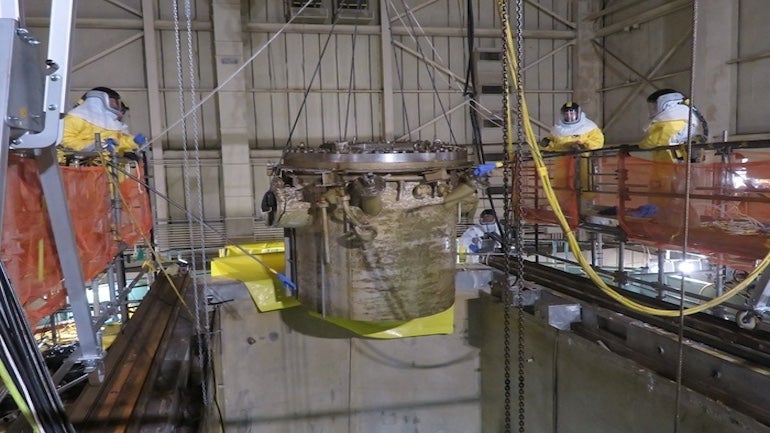
The US Department of Energy’s (DOE’s) Oak Ridge Office of Environmental Management (OREM) has made significant headway deactivating the Oak Ridge Research Reactor after crews removed its reactor vessel two years ago. Focus has now shifted to addressing hazards in the basement of the large facility in the central campus of Oak Ridge National Laboratory (ORNL) after the reactor vessel was loaded into a 32,000-pound protective shipping cask for offsite disposal.
Deactivation progress at the reactor takes place alongside multiple cleanup projects reshaping ORNL’s central campus. Together, these projects eliminate hazards, clear ageing nuclear infrastructure and open space for modernization to support future scientific discoveries. United Cleanup Oak Ridge (UCOR) is the lead environmental cleanup contractor for OREM. The company handles the deactivation and demolition of aging, contaminated nuclear facilities and legacy waste sites from the Cold War era.
The research reactor operated from 1958 until its shutdown in 1987, undertaking neutron research, isotope production, materials testing and reactor development, helping establish Oak Ridge as a global leader in nuclear science.
“Removing the reactor was a tremendous accomplishment, but it also opened the door to the next phase of cleanup,” said UCOR Project Manager Steven Reed. “Our crews continue making steady progress every day, safely removing contaminated systems and preparing the building for the work that will ultimately lead to demolition. It’s complex work, but every milestone brings us one step closer to completing this mission.”
Decades of research also left behind highly contaminated systems and infrastructure requiring deactivation before crews can safely take down the building. Workers have rid the facility of more than 160 waste containers, 16,000 linear feet of contaminated piping, six gloveboxes and approximately 300,000 pounds of lead shielding while continuing extensive characterisation activities. They expect to finish clearing remaining radiologically contaminated equipment from the basement this year.
Crews will then move to the upper floors to address additional piping and equipment removal. Following deactivation, crews will place a concrete-like mixture throughout the lower level to create a stable foundation to support future demolition equipment. Demolition is expected to begin in 2029.


