
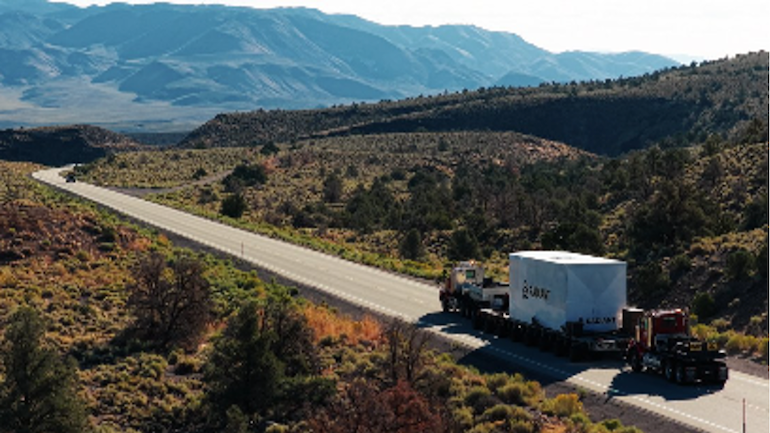
US-based startup Radiant has dispatched its 1 MWe Kaleidos microreactor on a 1,000-mile road trip on a specialised trailer bed from its El Segundo facility to the Idaho National Laboratory (INL). Kaleidos will be installed inside the repurposed Demonstration of Microreactor Experiments (DOME) facility at INL for tests. Once inside the DOME facility, the reactor will be fuelled with tri-structural isotropic (TRISO) fuel fabricated by Standard Nuclear.
Under strict Department of Energy (DOE) and INL oversight, the test sequence will progress through five critical operational phases:
- Installation: safely positioning the physical housing and loading the TRISO fuel load;
- Criticality: powering up the unit to achieve initial zero-power nuclear criticality;
- Thermal validation: scaling operations to maintain a steady 1 MW thermal output;
- Full-power run: activating the system under maximum commercial temperatures and full electricity generation;
- Unattended operation: a final 150-hour continuous endurance test completed entirely without operator intervention.
The entire campaign is targeted to conclude rapidly during the third quarter of 2026. Real-world operating data will support Radiant’s commercial expansion strategy. Test insights will directly back Radiant’s Nuclear Regulatory Commission (NRC) licence application. Simultaneously, NRC is reviewing a Part 70 application for Radiant’s R-50 microreactor production plant in Oak Ridge, Tennessee, with an approval target for the fourth quarter of 2026.
Radiant has secured an active contract with the US Air Force and the Defense Innovation Unit to deploy its first commercial mass-manufactured unit at Buckley Space Force Base by 2028. The units, designed to fully fit inside a standard shipping container and require zero site water for fan-based cooling, will serve as rapid-setup diesel replacements for remote communities, disaster zones, data centres, and defence bases.
INL’s DOME facility was updated for microreactor testing. DOE awarded Radiant exclusive access to the facility for a full year following a competitive selection process. Kaleidos will be the first reactor in DOME to go critical and reach full power in decades. No other reactor developer is running a full-scale, full-power, extended-duration test in 2026. Radiant is testing the same unit that will ship to commercial and military customers.
Meanwhile, Radiant’s 80-acre campus in Oak Ridge, Tennessee, will house its R-50 fuelling and manufacturing facilities. The NRC licence application is already under accelerated review, and construction is well underway. The facility is tracking to be commissioned in January 2027.
“Going critical alone doesn’t generate any meaningful power,” Radiant noted. That’s why it’s called zero-power critical; it proves basic neutron physics, nothing more. Radiant’s test campaign at the DOME is built around a harder, more consequential goal: proving that Kaleidos works as a commercial product…. Radiant chose this harder path intentionally. Performing sub-scale, zero-power criticality experiments would have been faster on paper, but it wouldn’t have moved the ball forward when it comes to proving out the full commercial capabilities required to move from concept to manufacturing at scale.”


