
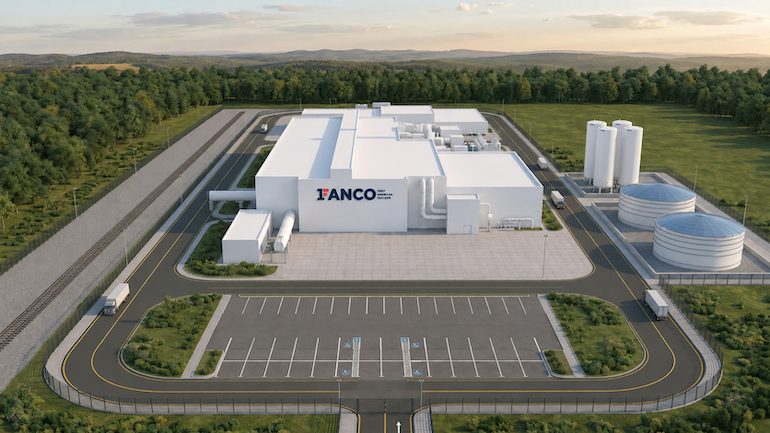
US small modular reactor (SMR) developer First American Nuclear Company (FANCO) said its Regulatory Engagement Plan (REP) has been docketed by the US Nuclear Regulatory Commission (NRC) for its proposed Category II high-assay low-enriched uranium (HALEU) deconversion and fuel fabrication facility. The Company’s fuel architecture contemplates an initial uranium dioxide fuel capability, with potential flexibility for additional fuel forms as its programme progresses.
FANCO is headquartered in Indianapolis and the wider development framework outlines that their overall $4bn project footprint is being developed within the state of Indiana. The precise property boundaries or city location for the fuel facility will be finalised and detailed as the company progresses toward submitting its licence application in late 2027.
FANCO has announced plans to create a nuclear energy park in partnership with the state of Indiana and is pursuing the construction of a next-generation nuclear cluster linking nuclear manufacturing facilities and energy complexes as well as fuel fabrication. Its EAGL-1 reactor design is a fourth-generation, liquid metal-cooled fast reactor designed to use a lead-bismuth coolant. A single reactor is designed to generate 240 MWe. The reactor is intended to use recycled used nuclear fuel to minimise long-lived radioactive waste. It also features a Bridge Power system which will enable operators to transition fossil fuel infrastructure from natural gas-fired generation to nuclear energy.
In July FANCO signed a framework agreement with Hyundai Engineering & Construction (Hyundai E&C) to cooperate on the EAGL-1 project. Hyundai E&C will participate in the early development phases including designing the balance of plant systems for the reactor. In May, FANCO and Canadian engineering firm AtkinsRéalis formed a strategic alliance to establish a scalable framework for deploying FANCO’s EAGL-1 SMR and associated fuel facilities, with AtkinsRéalis providing engineering services. FANCO had previously engaged AtkinsRéalis as primary architect-engineer for the Indiana energy park.
The REP filing advances FANCO’s planned engagement with the NRC regarding a facility intended to fabricate ceramic fuel for EAGL-1. The proposed facility is also expected to have the capability to process HALEU uranium hexafluoride into other fuel forms, subject to NRC approval and the terms of FANCO’s future licence application.
The submission follows FANCO’s letter of intent to NRC, notifying the agency of its plan to seek a licence under 10 CFR Part 70, to possess and use special nuclear material for the construction, ownership and operation of the proposed fuel fabrication facility. “This fuel facility will support the EAGL-1 lead-bismuth eutectic-cooled fast reactor and other advanced reactor customers,” the letter stated. “It is FANCO’s intent to engage with the NRC in order to obtain a licence under 10 CFR Part 70 and all other regulations applicable for the construction, ownership and operation of this facility.”
The letter added; “The proposed facility will be designed, constructed, and operated to fabricate uranium oxide fuel using licensed material within the limits and conditions requested in the application and approved by the NRC. In addition, the facility will include the capability to process uranium oxide into other fuel forms.” FANCO anticipates submitting its licence application in late 2027.
Because FANCO’s facility handles HALEU, it falls under a Category II (Moderate Strategic Significance) classification. This requires a two-step licensing approach or an integrated review process. FANCO must submit an Integrated Safety Analysis (ISA) summary identifying plant hazards. It must prove features can prevent or mitigate potential accidents Category II facilities require strict physical protection, access controls, and material accounting rules.
Licensing a nuclear fuel fabrication facility under 10 CFR Part 70 offers significant commercial, regulatory, and technical advantages for advanced reactor developers like FANCO compared with other licensing pathways. It permits building the facility and operating it under a single licence framework, avoiding a costly two-step process and uses the ISA to focus regulatory scrutiny on high-consequence hazards rather than rigid, one-size-fits-all rules.
The 10 CFR Part 70 matches security requirements strictly to the material risk, keeping Category II (HALEU) overhead lower than Category I (weapons-grade) requirements. By establishing clear, well-defined standards for Material Control and Accounting (MC&A), it streamlines international safeguards compliance. In addition, it allows operators to make minor facility modifications without prior NRC approval, provided they do not alter the baseline ISA summary.
“America’s ability to deploy advanced nuclear energy at scale depends on more than innovative reactor technology – it requires a secure, capable and American fuel supply,” said FANCO CEO Mike Reinboth. “The submission of our Regulatory Engagement Plan is an important step in building that capability. It reflects the deliberate way we are advancing FANCO’s integrated commercial strategy: pairing disciplined regulatory execution with a fuel-cycle platform designed to support our EAGL-1 programme and, over time, other advanced-reactor developers.”
FANCO’s fuel-facility initiative is part of the Company’s broader strategy to create a durable, US-based platform for advanced nuclear deployment. In May, NRC also accepted Radiant’s 10 CFR Part 70 licence application for its R-50 microreactor production facility in Oak Ridge, Tennessee using an expedited review that it is aiming to complete within eight months.
If the application is approved, it would allow Radiant to construct and operate the fuelling building of the R-50 production facility. This is a key component of the Kaleidos microreactor commercialisation programme, as it would allow fuelling as part of the manufacturing process.
FANCO’s technology has benefitted from significant Department of Energy (DOE) support. A DOE Advanced Reactor Demonstration Program (ARDP) development grant for the EAGL-1 was awarded in December 2020 to a consortium that included the designers of the technology. These awards typically ($20-30m) were for initial technical and regulatory development and required a 20% private-sector match.
This funding enabled the team to complete the pre-conceptual engineering required for the EAGL-1 reactor and begin the formal engagement process with NRC. Subsequently a formal review was conducted by the Pacific Northwest National Laboratory (PNNL) under a DOE GAIN (Gateway for Accelerated Innovation in Nuclear) programme voucher. This provided FANCO with direct access to the specialised expertise and technical facilities at PNNL to evaluate the licensability of the EAGL-1 reactor design.


