
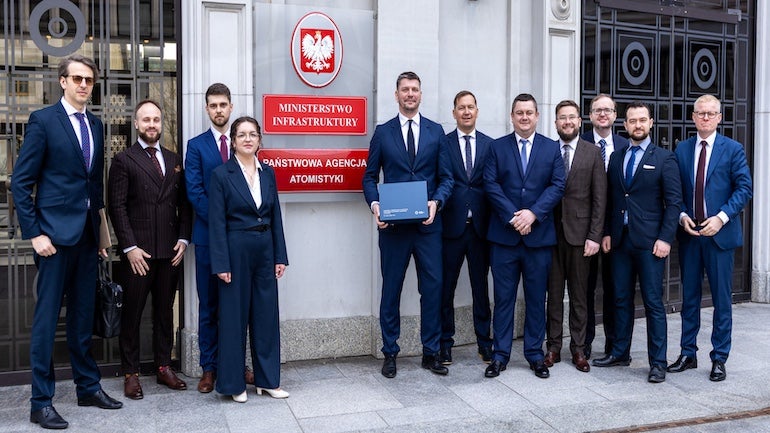
Polish state nuclear project company Polskie Elektrownie Jądrowe (PEJ) has formally applied to the National Atomic Energy Agency (PAA – Państwowej Agencji Atomistyki) for a construction licence to build Poland’s first NPP in Pomerania. in accordance with the requirements of the Atomic Law Act.
In November 2022, the then Polish government selected Westinghouse AP1000 reactor technology for a three-unit NPP, to be built at the Lubiatowo-Kopalino site in the Choczewo municipality in Pomerania. An agreement setting a plan for the delivery of the plant was signed in May 2023 by Westinghouse, Bechtel and PEJ. In September 2023, an engineering development agreement (EDA) was signed with Westinghouse and Bechtel to finalise a site-specific design for the NPP. The Ministry of Climate & Environment issued a decision-in-principle in July 2024 for PEJ to construct the plant. In December 2025, PEJ signed an amendment to the EDA to accelerate preparatory work. According to the draft update of the Polish Nuclear Energy Programme (PPEJ – Program Polskiej Energetyki Jądrowej) commercial operation of the first unit is expected to begin in 2036.
Documents submitted with the construction licence application included the Preliminary Safety Analysis Report (PSAR) providing a detailed description of the power plant design and the project site. It also includes comprehensive analyses of technical and environmental factors demonstrating that the proposed solutions meet all requirements regarding nuclear safety, physical security, radiological protection, and nuclear material safeguards applicable to facilities of this type.
The application also included: a quality assurance programme; a security classification; design of the physical security system for the nuclear facility and nuclear materials; basic information on the radiological emergency management system; and organisational documentation confirming that the investor has the necessary technical, human, and organisational resources to deliver the project.
The documentation, comprising more than 40,000 pages, was prepared by more than 200 experts from various areas, primarily nuclear safety and radiological protection. The PAA President is expected to issue the construction licence within 24 months of the submission of the application, excluding any time that may be required for the applicant to supplement the documentation.
Construction is expected to begin in the fourth quarter of 2028, starting with the pouring of first nuclear concrete. In order to begin construction in accordance with this schedule, PEJ must have both a construction licence from the PAA President and a construction permit issued by the Head of the Pomorskie Voivodeship. PEJ plans to submit the construction permit application in 2027.
“The submission of an application for a construction license for Poland’s first NPP signals our determination to deliver this project, which will ensure stable energy prices for Polish families for decades to come and serve as a driving force for modern industry,” said Wojciech Wrochna, Secretary of State at the Ministry of Energy and Government Plenipotentiary for Strategic Energy Infrastructure. “The documentation submitted with the application confirms that the planned nuclear power plant meets the most stringent global standards and will be safe for residents and the environment. There is no room for compromise here.”
Marek Woszczyk, President of the PEJ Management Board noted: “Today is one of the most important days for the project to build Poland’s first NPP. This is the first and, so far, the only such application in the post-1989 history of Poland.… The enormous amount of work carried out by the employees of Polskie Elektrownie Jądrowe … demonstrates vividly how large and complex our project is .Knowing the challenges ahead of us and the regulator regarding the efficient processing and evaluation of the application, we have been conducting an intensive pre-licensing dialogue with the PAA for a long time. I would also like to thank the PAA President and experts for the cooperation so far, which is a good sign for the construction licence application we have submitted.
PAA said that, before proceeding with a full assessment, the PAA Chairman will conduct a formal and legal review of the licence application. safety assessment of the planned station will be carried out in several stages. This will include: a detailed analysis of documentation describing, among other things, the technical solutions used in the reactor design; the organisational solutions that will be implemented during the preparation and construction of the plant; a safety analysis; and the operational limits and conditions for compliance with applicable laws. PAA will also rely, in part, on the assistance of independent, accredited laboratories and expert organisations.
“Only upon completion of this assessment, or in the event that there are formal deficiencies in the application, once they have been resolved, will we notify the commencement of this process in the PAA Public Information Bulletin. An application and a short safety report will also be published there.”


