
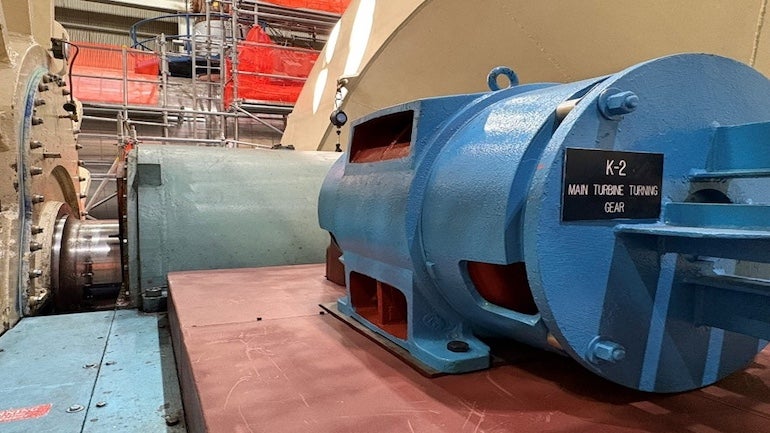
Holtec International announced that over recent weeks, the Palisades restart project reached a watershed moment as the last of the major projects were successfully closed out and the site transitioned from large-scale activities to the remaining routine maintenance, testing, inspection, and operational readiness work required before startup. While more 5,000 individual work activities remain, this transition represents an important milestone in the historic restart effort.
Palisades, an 800 MWe single-unit pressurised water reactor, ceased operations in May 2022 and was defuelled the following month, despite being licensed to operate until March 2031. The unit’s licence was transferred from operator Entergy Nuclear Operations to Holtec Decommissioning International and Holtec Palisades for decommissioning. However, in late 2023, Holtec began the process of obtaining licensing approvals to return the plant to operational status for the remainder of its licensing term.
In September 2024, the Department of Energy (DOE) finalised a $1.52bn loan guarantee to financially anchor the restoration efforts. In August 2025 the Nuclear Regulatory Commission (NRC) reinstated the site’s status from “decommissioning” back to an “operational status” licence, legally allowing the plant to receive fuel. Fresh nuclear fuel assemblies were subsequently delivered to the site and prepared for core loading. Holtec notified NRC in 2024 that it intends to apply for a second, or subsequent, licence renewal for the plant. This would extend the plant’s operating period by a further 20 years, to 2051.
Holtec said the final accomplishments in the “project phase” of restart included placement of the plant’s turbine-generator on turning gear following extensive inspections, maintenance, testing, and refurbishment activities. Another major achievement was installation and testing of a new state-of-the-art fuel handling machine, completing the upgraded fuel handling system.
Together, these projects represent the culmination of a series of major efforts carried out across the station. They mark an important transition in the Palisades restart, which included reactor vessel inspections and replacement of reactor head penetrations, primary system chemical decontamination and passivation, steam generator tube refurbishment and secondary-side cleaning, fuel receipt and inspection, operator training and requalification, and numerous equipment upgrades and modernisation projects.
“These accomplishments reflect the tremendous amount of work performed across the station throughout the restart effort,” said Enterprise Unit Head Steven Soler and Site Vice President Michael Schultheis. “We’re now focused on safely executing the remaining testing, verification, and operational readiness activities required before startup. The plant is coming back together, and the professionalism and dedication demonstrated by our workforce continue to move the project forward.”
Plant managers, superintendents, and supervisors have now shifted their focus to the remaining work through the Operations Command Center (OCC) and several dedicated coordination teams, where work is being managed around the clock to prepare the station for startup.
In recent months, the site has also welcomed continued engagement from senior NRC leadership, including Commissioners Douglas Weaver and Bradley Crowell, as well as senior staff from the agency’s Office of the Executive Director for Operations and Office of the Chief Nuclear Reactor Inspector. During their visits, NRC leaders toured the facility and received updates on ongoing restart activities.
“As we enter the final phase of this historic effort, we are grateful for the support provided by our federal, state, and community partners, whose collaboration has helped make this pioneering effort possible,” said Holtec Chairman & CEO Dr Kris Singh. “The Palisades restart will forever serve as lasting evidence of what can be accomplished when government and private industry work together to achieve an important national objective.”
To expand the site’s capacity into the 2030s, Holtec International is co-locating advanced small modular reactors (SMRs) alongside the existing baseline reactor. Two Holtec SMR-300 pressurised water units that use natural gravity-driven passive safety systems are planned. Each unit adds 300 MWe. Building the twin SMRs will inject an extra 600 MWe, almost doubling the total capacity of the Palisades site to over 1,400 MWe. Geotechnical site layout work is already underway. Holtec International and the NRC have kickstarted the licensing and preparation process for units (named Pioneer 1 and Pioneer 2), aiming for grid-synchronisation by 2030.


