

Even if demand for new nuclear was not surging and a pledge to triple global capacity by 2050 wasn’t in play, there are significant additional drivers for new nuclear fuel resources. Russia dominates the global nuclear fuel cycle and continues to do so, despite sanctions that have been placed on the country in the wake of its invasion of Ukraine.

Through its fuel arm Tenex, Russian nuclear conglomerate Rosatom supplies uranium enrichment and enriched uranium to more than 30 utilities in 16 countries. The company also claims a 16.3% global nuclear fuel market share through its fuel company TVEL, suppling nuclear fuel to 73 reactors operated in 13 countries.

The potential security of energy supplies issues this situation creates has prompted a reappraisal of the nuclear fuel cycle among many nations, not least the United States. 

The market dynamics associated with this strategic shift are reflected in uranium prices. Early this year, Reuters reported a more than US$10 uptick in the price of uranium over the previous year but a simultaneous price increase of well over 100% in the shares of leading uranium companies over the same period. Growing demand coupled with the security of supply issue is expected to see uranium prices go higher still over the coming year with Reuters suggesting prices will reach their highest level in decades this year.

With imports of Russian uranium set to be banned from 2028, the US has made securing new uranium supplies a key policy objective, particularly given over 70% of its uranium is currently sourced from overseas.

Growth in upstream capacity

The rising prices are opening up prospects across all sectors of the nuclear fuel cycle, with notable recent success in the front end of the US uranium resource. In April Uranium Energy Corp announced it has commenced production at its Burke Hollow project in southern Texas. This not only the world’s newest in-situ recovery (ISR) uranium mine but is also the first new such project in the US in over a decade. Burke Hollow is also the largest ISR uranium discovery in the United States in the past decade, with only about half of the ~20,000-acre (8,094 Ha) property explored to date. The project hosts multiple mineralised trends and horizons, supporting a phased approach to future resource expansion and providing significant long-term development potential, the company says. The site advanced from a grassroots discovery in 2012 to production in 2026. Production from Burke Hollow will be processed at the Hobson Central Processing Plant, which is licensed to produce up to 4m pounds of uranium per year. Combined with a recent capacity expansion approval at Christensen Ranch in Wyoming, the company has two active producing ISR platforms. In a statement, Amir Adnani, President and CEO stated that “with two ISR operations now producing, and our Ludeman ISR project planned for startup in 2027, we are building a scalable, multi-faceted platform supported by the largest uranium resource base in the United States”. 

Chris Wright, United States Energy Secretary noted that the recent production in Texas and Wyoming highlight the importance of uranium production as the foundation of a secure, domestic nuclear fuel cycle, saying: “The Trump Administration remains committed to strengthening this capability, which is essential to American energy dominance and our national security. As we continue rebuilding the full fuel cycle, including key downstream infrastructure, this progress shows we can build it here and lead from here.”

Other upstream prospects are also under development. Canadian-headquarterd Myriad Uranium, for example, recently filed a technical report on its Copper Mountain prospect in Fremont County, Wyoming, with details of its planned Phase II drilling programme. The company launched an initial drilling programme in November 2024, reporting strong results. As Myriad’s CEO, Thomas Lamb, commented: “We are entering Phase II with a high level of conviction. Our maiden drill programme surpassed expectations by a significant margin, confirming extensive positive disequilibrium and validating Copper Mountain as a genuinely world-class exploration address. The extraordinary Bendix assessment suggests Copper Mountain may host one of America’s largest undeveloped uranium endowments”.

Closing the fuel cycle

The back end of the fuel cycle is also receiving a boost with the US Department of Energy Office of Nuclear Energy and Office of Environmental Management issuing two new Requests for Application to advance capabilities in recycling used nuclear fuel in April. The request from the Office of Nuclear Energy (ONE) seeks proposals from industry on detailed plans to leverage its Other Transaction Agreements (OTAs) process to accelerate the design, construction and operation of nuclear fuel recycling, processing, and fuel fabrication facilities. Applicants will be responsible for all project costs, but the DOE anticipates entering commercial agreements with successful applicants. In addition, the DOE may provide resources that include access to department sites and facilities for testing and deployment, the use of DOE-owned spent fuel for testing or recycling, and access to expertise at DOE national laboratories.  

Meanwhile, the Office of Environmental Management is aiming for proposals from private industry for a commercial-scale demonstration project for recycling defence-related used nuclear fuel at the Idaho Nuclear Technology and Engineering Center (INTEC) within the Idaho National Laboratory (INL) site. INTEC was established in the 1950s as the Chemical Processing Plant to recover usable uranium in spent nuclear fuel used in government reactors. Over the years the facility recovered more than $1bn worth of highly enriched uranium, which was returned to the government fuel cycle. However, in 1992, the DOE announced that a lack of demand for highly enriched uranium made reprocessing no longer necessary. Now though, with energy independence high on the political agenda, reprocessing spent fuel is again considered viable. As ONE Assistant Secretary Ted Garrish, said in a statement: “Used nuclear fuel represents immense, untapped energy resource for the United States”. Garrish added that the DOE is “partnering with the private sector in advancing a circular nuclear economy by transforming used fuel from waste into a valuable resource. These efforts are designed to deliver reliable power, reduce waste volumes, and re-energise the commercial nuclear sector.”

Nuclear fuel
Fuel reprocessing will be explored at Idaho National Laboratory under a new Office of Environmental Management initiative (Source: INL)

The selected company will secure a long-term lease for property at INTEC and will be responsible for the full lifecycle of a dedicated recycling facility encompassing its financing, design, permitting, fabrication, commissioning, operation, maintenance, and eventual decommissioning. The Advanced Nuclear Fuel Recycling programme aims to accelerate the deployment of advanced reactors for national security under DOE authority. Both RFAs strive to leverage private capital and expertise to accelerate critical infrastructure development in support of President Trump’s executive orders EO14299, ‘Deploying Advanced Nuclear Reactor Technologies for National Security’ and EO 14302, ‘Reinvigorating the Nuclear Industrial Base’ to advance efforts to strengthen the nuclear industrial base and US energy independence. 

In a related development, ONE has also announced that it is kicking off another new initiative to secure the nation’s nuclear fuel supply chain. Through the Defense Production Act (DPA) Nuclear Fuel Cycle Consortium, the federal government will work with the domestic nuclear industry to secure enough nuclear fuel to power the current fleet as well as future advanced reactors. Comprised of representatives from more than 90 companies, the initiative will address the full fuel supply chain including milling, conversion, enrichment, deconversion, fabrication, recycling, and reprocessing, focusing on three key goals. Under the “Nuclear Dominance – 3 by 33” campaign, the Consortium aims to catalyse a secure and cost-competitive domestic fuel supply chain, accelerate advanced reactor deployment and close the fuel cycle, and explore how the DPA framework can be activated to grow and align workforce, finance, innovation and collaboration in support of nuclear build out. These three goals are targeted for 2033. The ultimate aim of the DPA Consortium is to end US reliance on foreign sources of enriched uranium and critical materials. 

“The Consortium’s work comes at a pivotal time for nuclear energy growth in our country,” said Garrish, adding that he is “looking forward to rapid progress on near-term goals to achieve a robust American-made supply of nuclear fuel.” 

Burn-up, enrichment and conversion

While DOE’s used fuel recycling programmes will be a cornerstone of a domestic fuel cycle, efforts are also underway to get more from reactor fuel in the first place. For example, the NRC recently approved a report titled “High Burnup for Pressurized Water Reactors” from Framatome. Enhancing nuclear fuel performance allows fuel cycle length extensions from 18 to 24 months for a large segment of the US light water reactor fleet. By extending fuel burnup capabilities, plant operators can further optimise fuel utilisation, reduce waste and support the continued generation, Framatome states. After nearly six years of work, the submission supports increased fuel burnup limits for Framatome’s GAIA and HTP fuel designs and forms part of the company’s Advanced Fuel Management programme, which focuses on bringing nuclear fuels with higher enrichment levels and advanced codes and methods that support higher fuel burnups for the existing US nuclear fleet. In a statement Lionel Gaiffe, Framatome’s Senior Executive Vice President, Fuel Business Unit, said the technology is now available “at a time where energy demands continue to increase and the industry needs long-term sustainability.”

The NRC also recently approved the application of the company’s suite of PWR advanced codes and methods to operating conditions with U-235 exceeding the standard 5%. Additionally, the NRC also approved a license amendment allowing Framatome to transport fresh PWR and BWR fuel assemblies within the US with up to 8% U-235.

Meanwhile, Urenco USA has completed installation and startup of its fourth new cascade of gas centrifuges in New Mexico, marking the half-way point of its current US capacity expansion programme. As the only US commercial-scale producer of enriched uranium, Urenco USA operates the National Enrichment Facility. That began operations in 2010 and has the capacity to meet approximately one-third of the enrichment needs of US commercial NPPs. 

The company’s newest cascade began producing low enriched uranium (LEU) on 30 March. All four cascades installed during the current expansion began operating ahead of schedule and are on budget. The company is installing 700,000 separative work units (SWU) of new capacity at the site between 2025-2027. Urenco USA intends to further expand the New Mexico plant’s capacity by up to 2.1m SWU in the future, based on the needs of its customers and supported by their long-term contracts.

Urenco USA also intends to refurbish existing capacity at the site starting in 2027 as part of ongoing capital investments in the plant to maintain a long-term, reliable supply of enrichment services. Since 2006, the company has invested more than $5bn of private capital in the facility to provide a secure domestic supply of enriched uranium.

“As the United States prepares to end the imports of nuclear fuel from Russia, the installation of new uranium enrichment capacity will play a critical role in ensuring US utilities have the supply they need to support the future operations of their nuclear plants,” said John Kirkpatrick, Managing Director of Urenco USA. “With our current capacity expansion programme in the US, the capacity refurbishment programmes at Urenco’s other sites, and other allied sources of supply, we are confident that the country can make this important transition away from Russian uranium imports when the ban on Russian material goes fully into effect at the end of 2027.”

Other US fuel cycle initiatives include exploring a potential new uranium conversion plant. ConverDyn has reportedly retained an unnamed engineering firm to evaluate the timeline, cost, and potential for modularity of a new uranium hexafluoride (UF6) conversion facility.

Nuclear fuel
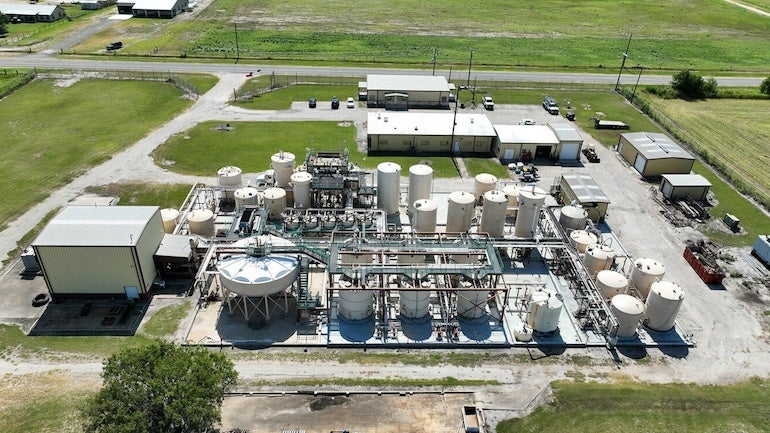
ConverDyn is exploring the potential for a new uranium hexafluoride (UF6) conversion facility at the Metropolis Works plant in Illinois (Source: ConverDyn)

ConverDyn, a partnership between Solstice Advanced Materials and General Atomics, is the exclusive marketing agent for material produced at the Metropolis Works plant in Illinois, currently the only domestic US uranium conversion facility. This plant would be in addition to existing plans by Solstice Advanced Materials to expand the capacity of the current Metropolis Works. Solstice has identified a short-term supply gap of about 3,000 tonnes of UF6. In November 2017 UF6 production at Metropolis was temporarily suspended pending an improvement in business conditions. The decision was a result of “significant challenges” faced by the nuclear industry at that time, including a worldwide oversupply of UF6. The plant was restarted in July 2023.

In February, Solstice Advanced Materials announced that its Metropolis Works is projected to produce over 10 kilotonnes (10 kt) of UF6 in 2026, which represents about a 20% increase from its planned output in 2024. 

Building fuel stability

All these recent developments across the US nuclear fuel landscape come as the World Nuclear Fuel Cycle Conference 2026 highlighted how geopolitics and the global focus on energy security and sovereignty have fundamentally reshaped how governments view nuclear energy and its supply chains. However, despite progress, conversion, enrichment and fuel fabrication providers described a sector racing to add capacity while navigating demand uncertainty. Delegates at the conference heard how new facilities are being announced and restarted, particularly in the United States and Europe, but, as one panellist summarised the situation: the industry faces “abundant ambition, but constrained commitment.” At the same time, demand growth is outpacing mine development timelines with industry leaders warning of an increasing supply gap unless investment flows into new mines, life extensions and innovative mining techniques. 

The need for secure and reliable energy in the US and elsewhere is projected to rise substantially in the coming years, driven by a range of well-known and now converging factors. The long-term success of nuclear power in meeting that demand will ultimately depend on the long-term sustainable and secure availability of fuel.