
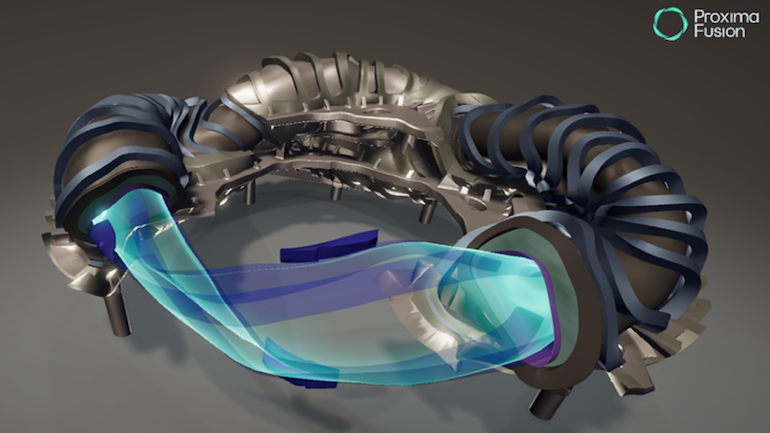
Munich-based start-up Proxima Fusion, a spin off from the Max Planck Institute for Plasma Physics (IPP), has raised €411m ($468m) in a financing round, bringing the company’s valuation to €2.4bn. The round was led by XTX Ventures and East X Ventures, with RWE and Google as strategic investors.
KfW Capital, SPRIND and Burda Principal Investments joined the round alongside returning investors including Plural, UVC Partners, Balderton, Cherry Ventures, DST Global Partners, Brevan Howard Macro Venture, Lightspeed, DTCF, redalpine, Leitmotif, Elaia, CDP Venture Capital, Bayern Kapital, and the EIC Fund.
In March, Proxima signed a memorandum of understanding (MOU) with the Free State of Bavaria, RWE, and IPP outlining a roadmap to commercial fusion in Europe. The first stage is the construction of a demonstration stellarator, Alpha, near IPP in Garching.
It is targeted to begin operation in the 2030s with the aim of being the first stellarator to demonstrate net energy gain. It will also enable Proxima and its partners to test and validate key fusion technologies under real-world conditions and in shorter development cycles. Alpha will pave the way for construction of the first commercial stellarator fusion power plant, Stellaris, planned for the site of the former Gundremmingen NPP in Bavaria, currently being decommissioned by RWE.
Proxima said Alpha and Stellaris will together create thousands of jobs and supplier contracts for European manufacturers and engineers. “The long-term aim is to make fusion an integral part of Europe’s energy system, reduce dependence on imported energy, and, for the first time, apply Europe’s fusion expertise to a grid-connected commercial project.”
The financing provides the backing needed to build the Alpha, net-energy stellarator demonstrator to validate key technologies and accelerate the development of Stellaris fusion power plant.
“Europe is racing with the United States and China to get to the first fusion power plant,” said Proxima Co-Founder & CEO Dr Francesco Sciortino. “Proxima’s financing demonstrates that Europe can not only invent breakthrough technologies, but also build globally competitive companies around them. Investors recognise both the urgency and the opportunity of what we’re doing and are backing us to develop a generational energy technology company.”
In less than three years, Proxima has secured more than €650m including €95m in public grants. The €411m financing round exceeded its target of matching Bavaria’s commitment for a €400m public funding contribution to the company’s roadmap, illustrating how targeted public investment can catalyse private capital at scale.
With this financing, Proxima’s focus will be on completing the Stellarator Model Coil, expansion of high-temperature superconducting (HTS) cable and magnet production, and continued development of the engineering and manufacturing systems required for stellarators. Proxima will be hiring across engineering, manufacturing and operations to accelerate progress.
The company is developing commercial fusion power plants based on the QI-HTS stellarator concept, building on the scientific breakthroughs of the Wendelstein 7-X programme at IPP. The roadmap from Alpha to Stellaris is supported by the Alpha Alliance, a consortium of more than 50 industrial partners, and a distinguished Industrial Development Board.
Fusion is drawing increased interest as tech companies seeking future sources to power data centres. In 2025, Google agreed to purchase 200 MWe from US Commonwealth Fusion Systems (CFS). While Google joined as a strategic investor in Proxima Fusion, the companies have no set plans around data centres, according to Sciortino. He declined to say how much Google invested but said around €150m of the newest financing round came from its two investment leads. As a Proxima press release said RWE invested €25m, it seems that Google’s contribution was €125m.
While Proxima is the best-funded fusion startup in Europe, US fusion companies have raised significantly more. CFS raised $863m million in August 2025, taking its total funding to $2.9bn Sam Altman-backed Helion Energy raised $465m in June, with total funding at $1.5bn.
“Fusion holds huge potential as an energy source of the future: it’s clean, abundant and inherently safe, and it can be built just about anywhere,” Google said in a blog post last year. However, it added that while fusion could change the world, commercialising it is “immensely challenging, and success is not guaranteed”.


