
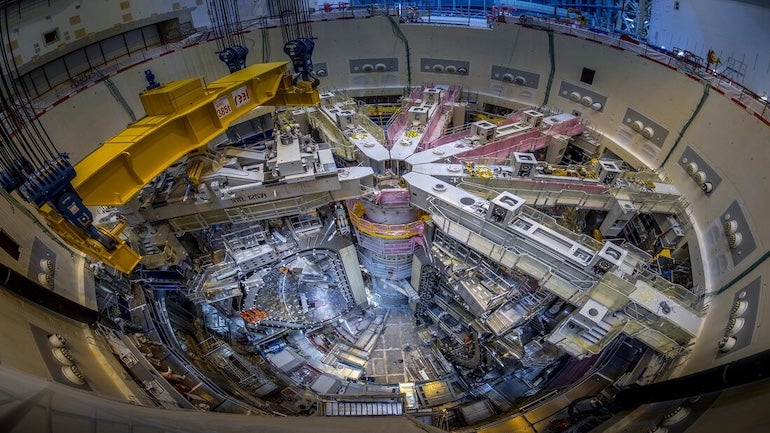
The ITER Organisation has installed the sixth of nine tokamak sector modules in the tokamak pit, almost six months ahead of schedule, bringing two-thirds of the machine’s torus-shaped core into place. The approximately 1,100-tonne sector module was transferred from the Assembly Hall and lowered into the pit in a carefully coordinated lifting operation, which took 30 hours. Together with its lifting rig, the suspended load weighed nearly 1,400 tonnes.
The International Thermonuclear Experimental Reactor (ITER), under construction in Saint-Paul-lez-Durance, in the south of France, is designed to demonstrate the scientific and technological feasibility of fusion power. ITER is a first-of-a-kind global collaboration. As the host, Europe contributes almost half of the costs of its construction (45.6%), while the other six members of this joint international venture (China, India, Japan, South Korea, Russia and the US), contribute equally for the remaining expenses (9.1% each). However, in practice, the members deliver little monetary contribution to the project, instead providing ‘in-kind’ contributions of components, systems or buildings.
The ITER assembly teams have been installing progressively the sector modules that form the machine’s core since April 2025 and are on track to position the final module in 2027. ITER said experience gained from each successive module assembly and lifting operation has increased the pace, efficiency and predictability of the work.
“This latest achievement is a visible marker of the progress being made through our accelerated approach to machine assembly,” said ITER Director-General Pietro Barabaschi. “The teams have translated lessons learned from each operation into greater efficiency, stronger coordination and a more predictable assembly sequence. With six modules now in place, we are demonstrating that this technical approach is delivering tangible results on the project’s critical path.”
The sixth module is built around vacuum vessel sector #1, which is the fourth and final sector manufactured in the Republic of Korea. Its installation follows ITER Korean Fusion Day on 22 July, when Korean senior government officials, diplomats, industrial leaders and ITER representatives gathered to celebrate the successful completion of Korea’s vacuum vessel sector program and its broader contribution to ITER. Four of the nine sectors that form the ITER vacuum vessel were produced in Korea, with Europe responsible for the other five.
Deputy Minister of Korea’s Ministry of Science and ICT, Sung Soo Kim, speaking at the ceremony, stated, “Through participation in ITER, Korea has accumulated advanced manufacturing technologies and valuable experience in large-scale international collaboration, laying the foundation for future fusion industries.” Korea’s Ambassador to France, Hyuk-Woon Kwon, noted: “The road toward fusion energy is long. It is difficult. It demands patience, consistency and cooperation across generations. But today’s achievement demonstrates one very important fact: steady progress is being made.”
The ITER vacuum vessel is one of the most technically demanding components of the tokamak. Its nine double-walled stainless-steel sectors will form the ultra-high-vacuum chamber in which fusion reactions take place and will support many of the systems needed to operate the machine. Before the final lifting and installation operation, each 440-tonne vacuum vessel sector is carefully integrated with thermal shield panels and two approximately 310-tonne toroidal field coils to form a complete sector module. Module components must be aligned and positioned to millimetre-level tolerances.
Once all nine sector modules are positioned in the pit, teams will proceed with the complex work of joining the sectors to complete the torus. Improvements in assembly sequencing and execution have advanced the anticipated installation of the final sector module from December 2027 to mid-2027, with teams continuing to identify opportunities for further schedule optimisation.
“Installing six sector modules is not simply a question of repeating the same operation six times,” said Sergio Orlandi, Head of the ITER Construction Project. “Each module requires the precise integration and positioning of some of the largest and most complex components ever manufactured for a fusion machine. The increasing efficiency of the assembly sequence reflects the experience, discipline, organization and close cooperation of the ITER Organisation, the Domestic Agencies and our industrial partners. We are now focused on maintaining this momentum and positioning the final sector module by mid-2027, or sooner if conditions allow.”


