
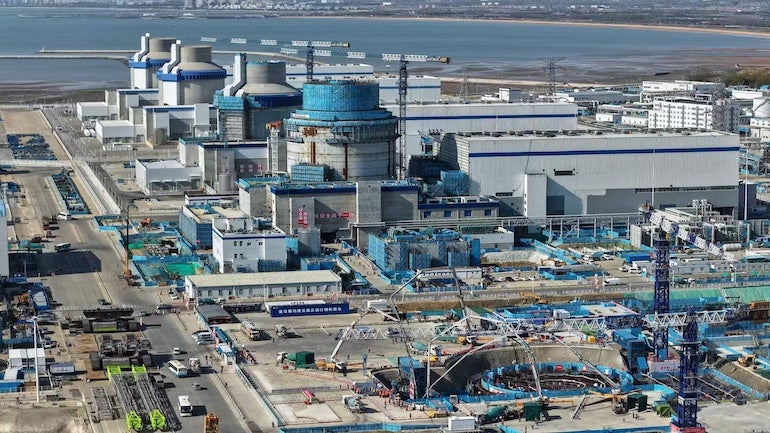
First concrete has been poured for the reactor building of unit 5 at China’s Haiyang NPP in Shandong province. It is the fifth of six large pressurised water reactors planned for the site and the first unit of Phase III. The concrete pour required some 6,626 cubic metres of concrete and took around 62 hours.
China National Nuclear Corporation (CNNC) subsidiary China Nuclear Industry 24 Construction Co Ltd (CNNC 24) has been contracted by State Power Investment Corporation (SPIC) to conduct the civil construction of the Phase III (units 5&6) nuclear islands.
The Haiyang NPP hosts two AP1000 reactors (units 1&2), which entered commercial operation in 2018 and 2019 as Phase I. Two CAP1000 reactors (units 3&4) – the Chinese version of the Westinghouse AP1000 are under construction as Phase II. Construction of units 5&6 with CAP1000 reactors received official approval in April 2025 as Phase III and they have already received construction permits.
The CAP1000 reactor design uses modular construction techniques, enabling large structural modules to be built at factories and then installed at the site. This means that several construction activities can take place at the same time, reducing the time taken to build the plant as well as offering economic and quality control benefits.
In November 2025, the city of Rongcheng became the third settlement in Shandong to be connected to the district heating network from the Haiyang NPP. The first commercial heat supply using steam extraction from the second circuit began in 2019. In the winter of 2020/2021, Haiyang city was, for the first time supplied with heat from the Warm Core No 1 district heating project. Rushan’s heating system was connected to the station in 2021, bringing the population benefitting from the technology to 1m.
After the completion and commissioning of units 5&6, the Haiyang plant’s clean electricity and centralised heating supply capacity will be further expanded. With all six units in operation, the plant will have an annual power generation capacity of 60.9 TWh, capable of meeting the annual electricity needs of 54m residents, saving approximately 18.56m tonnes of standard coal and reducing carbon dioxide emissions by 48.63m tonnes a year. Its heating capacity will exceed 150m square metres, covering 25 county-level cities.


