
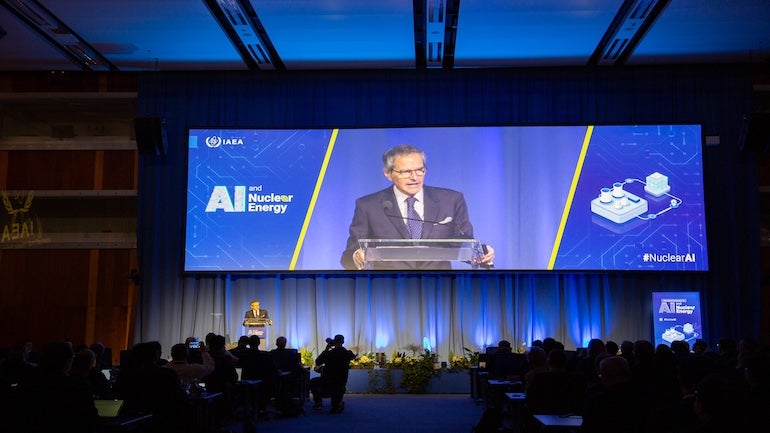
The International Atomic Energy Agency’s (IAEA’s) first ever International Symposium on Artificial Intelligence (AI) and Nuclear Energy brought together senior representatives from government ministries, international organisations, the nuclear industry and major tech firms, including Google and Oracle.
Representatives of 252 different organisations registered for the symposium including: 23 nuclear operators; 13 state corporations; 13 AI and technology companies; 25 nuclear suppliers; 11 small modular and advanced reactor developers; eight national laboratories; 19 research institutions; 28 universities; 29 regulatory bodies; 15 government agencies and ministries; five intergovernmental organisations; 10 industry associations, eight NGOs; 21 consulting and engineering firms; seven waste management and decommissioning companies; seven financial and legal firms; and 10 in other categories.
The symposium looked at how nuclear energy can help meet the surging electricity demand of AI data centres, and how AI can support nuclear technology development.
According to the International Energy Agency, data centres accounted for 1.5% of worldwide electricity demand in 2024 and this is expected to double by 2030. Nuclear power is increasingly seen as a solution to meet this demand. On the other hand, AI offers powerful tools to optimise reactor performance, streamline construction and enhance operational efficiency enabling nuclear energy to reach its full potential while maintaining the highest standards of safety, security and safeguards.
Addressing the opening ceremony, IAEA Director General Rafaek Grossi noted: “Two forces are reshaping humanity’s horizon at an unprecedented pace: the rise of artificial intelligence and the global transition towards clean, reliable energy. The world’s energy map is being redrawn before our eyes.”
He added: “We can now say with clarity: the AI revolution, through its scale and speed, was always going to choose nuclear energy as a partner. The only question was ‘when?’. Today, we know that the answer is ‘now’.”
He explained that customers want AI to be fast and available while investors want new and better data products. Innovation requires a lot of computing power. Providing what customers and investors want is an existential assignment for any corporation. “There is only one energy source that can meet combined demands of low-carbon generation, 24/7 reliability, massive power density, grid stability and genuine scalability: nuclear energy. This is why I call it not just a partnership, but a structural alliance: ‘Atoms for Algorithms’.”
Artificial intelligence is not only powered by nuclear energy but is also improving it. Grossi gave four examples:
- In nuclear power operations, AI supports predictive maintenance, anomaly detection, and optimisation of thermal performance.
- In design, it supports accelerated reactor modelling, fuel-cycle simulation, and materials development.
- In safety, AI supports accident simulation, response analysis, and the development of emergency procedures.
- In safeguards it provides analysis of hours of surveillance footage, satellite imagery, and offers important pattern recognition tools.
“This is happening right now in IAEA laboratories and across our work with member states on all continents.” However, “AI still needs a human to make sure it is right and impartial, and to understand the politics behind a safeguards footnote.”
He said: “AI may live in the cloud, but it runs on electricity” pointing to a role for small modular reactors (SMRs). “We have a huge opportunity to make sure our digital future runs on clean energy. This is where small modular reactors become especially relevant. They work particularly well for data centres because they are designed to be built in segmental units, making phased deployment possible. As an AI cluster expands, so can its nuclear power source.”
He added: “The smaller footprint of SMRs and their enhanced safety systems mean they can operate close to industrial zones, including data-centre campuses. With SMRs, tech companies can avoid dependence on constrained regional electricity grids and reduce transmission losses. This becomes decisive in places where grid upgrades are slow, and interconnection queues already stretch far into the future.”
According to Grossi, more than 30 newcomer countries are looking to introduce nuclear energy, including SMRs. Many of these same countries are also exploring how AI can support their development and economic modernisation. “The two go hand in hand.”
Currently, AI-driven data centres are concentrated in a limited number of hubs. “But that map is changing. A rapid global response to the surge in AI and cloud computing could see as much as $7,000bn spent on data centres around the world by 2030. New digital corridors will emerge, including in Asia, Latin America and Africa. All of them will require reliable energy sources. And all of them will require local knowledge, trusted partners, and long-term cooperation focused on technology and economic growth.”
He concluded: “Let’s work for a future where AI expands human creativity, data centres run on clean, reliable power, nuclear anchors a sustainable digital age, and every region benefits. If we get this right, we will shape a century worthy of our highest aspirations. As Niels Bohr is said to have quipped: ‘Prediction is very difficult, especially about the future’. Then, let’s not predict the future, let’s build it. If we succeed, one day, in whatever language AI invents, it will say this: ‘They understood the challenge and they did what was needed’.”


