
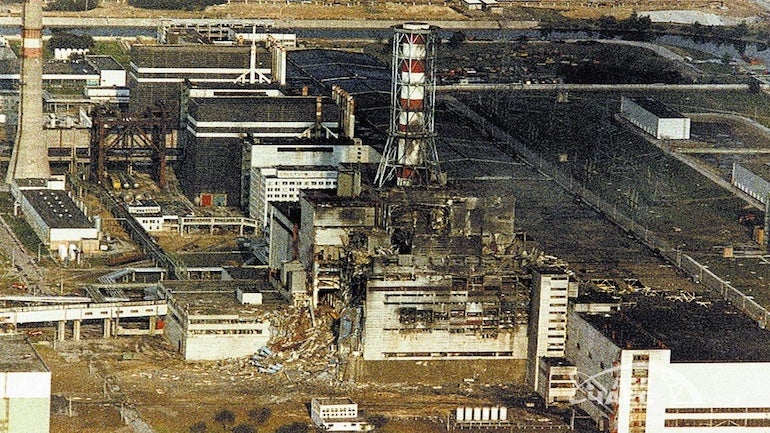
It is 40 years since the world’s worst nuclear accident at unit 4 of the Chornobyl NPP in the Soviet Union on 26 April 1986. Work to eliminate the consequences of the accident began within hours and is expected to continue for up to 100 years. The first task was to put out fires on the roof of the turbine building. The firefighters and others who took part are among the many who have been recognised since, and at every anniversary, for their heroism. These include 134 who died within a short period from radiation exposure.
In total, about 200,000 people – known as liquidators – were involved in the recovery and clean-up during 1986 and 1987, with that number eventually increasing to 600,000. They came from all over the USSR. The urgent work included building a structure around the wreckage of unit 4 to provide a shield from further radioactive release. This also allowed the other three operating units at Chornobyl to operate, the last unit closing in 2000.
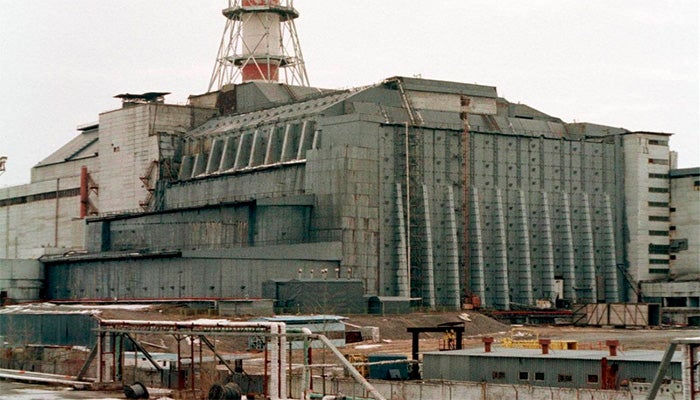
The shelter structure or sarcophagus was completed in just 206 days. It contains the molten core of the reactor and an estimated 200 tonnes of highly radioactive material. It was a hugely impressive achievement in the circumstances and was never intended to be a long-term solution. Further work was carried out from 2004 to 2008 to stabilise it which gave it a design life to 2023.
Scientists and experts from specialist nuclear institutes continued to regularly visit the sarcophagus to investigate and better understand how and why the accident happened and to investigate the effects. Professor Vladimir Asmolov, Adviser to the Rosatom Director General Alexei Likhachev, was the head engineer of the Chornobyl station after the accident and took part in the liquidation efforts and was the scientific director of the sarcophagus project. Investigations by Russian experts continued even after the USSR collapsed in 1991. Even so, by 2011, only 60% of the premises had been investigated. The rest remained inaccessible due to the high level of radiation or impenetrable barriers.
Valery Legasov was the chief scientific advisor during the Chornobyl disaster response. He was the scientist tasked with solving the immediate, unprecedented technical nightmare of an exposed reactor core. He made the critical decision to drop a mixture of sand, boron, and lead from helicopters into the burning reactor. This was intended to extinguish the graphite fire and absorb neutrons to prevent further chain reactions.
Legasov spent an unprecedented four months at the site (the legal limit was two weeks), receiving roughly four times the maximum allowed radiation dose. By 1988, he was suffering from severe radiation sickness. He committed suicide but before his death, he recorded several audio tapes (or left detailed journals) exposing the systemic failures, reactor design flaws, and government cover-ups he had been failed to disclose.
Evgeny Velikhov a prominent Russian physicist and scientific leader known for his work in plasma physics and controlled nuclear fusion, personally oversaw the cleanup efforts following the nuclear disaster at Chornobyl. Velikhov was the main advocate for the urgent mission to build a cooling slab beneath the reactor. He feared that the molten core (corium) could burn through the concrete floor and reach the water table, causing a massive steam explosion that might have destroyed the other three reactors.
Like Legasov, Velikhov personally flew in helicopters over the burning unit 4 to determine the condition of the core. During these missions, he accumulated a high radiation dose, estimated at over 70 rems (the typical annual safety limit for a nuclear worker at the time was 5 rems). He died in 2024.
Dr Yevgeny Adamov was the director of the NA Dollezhal Research and Development Institute of Power Engineering (Nikiet) from 1986 to 1998, which was responsible for the design of the RBMK (Reaktor Bolshoy Moshchnosti Kanalnyy) reactors used at Chernobyl. Following the 1986 explosion, Adamov was involved in studying the causes of the accident, with Nikiet conducting reviews and studies over the following decade. He later became the Russian Atomic Energy Minister (1998-2001) and was a major figure in the post-Soviet Russian nuclear sector. He was central to the efforts to upgrade the safety of RBMKs across the Soviet Union to prevent another disaster.
There is no doubt that Chornobyl fundamentally changed the nuclear industry worldwide. After a period in which very little progress was made and many projects were cancelled worldwide, massive improvements in safety and transparency have transformed the industry.
The Chornobyl disaster was caused by primary design flaws in the RBMK reactor that created a “perfect storm” when the operators pushed the plant into an unstable, low-power state.
Following the Chornobyl disaster, the Soviet Union (and later Russia) implemented a series of rapid and extensive technical modifications to the remaining RBMK reactors to ensure the fatal sequence of 1986 could never happen again. Russia not only learned lessons but also turned them into the safety standards of the future.
A large-scale phased modernisation of RBMK-type reactors began, providing for a whole range of measures and activities including: installation of additional absorbers and increase of the operational reactivity margin to 43–48 control rods; switching to uranium-erbium fuel, which increased efficiency; implementation of a new independent high-speed emergency protection with a full rod insertion speed of 2.5 seconds; increasing the number of in-reactor neutron flux sensors with increasing reliability of monitoring the neutron-physical characteristics of the reactor; implementing advanced automation algorithms; upgrading of reactor emergency cooling system equipment; implementing an emergency power supply system; and providing mobile emergency equipment.
RBMKs continue to operate at Smolensk, Kursk and Leningrad NPPs but are being replaced by modern generation 3+ reactors, such as VVER‑1200 and VVER‑TOI, equipped with fundamentally new safety systems. These include melt traps that localise the fuel melt and prevent it from leaving the containment shell; passive safety systems that do not require external power supply or human intervention; the reactor automatically stops in emergency situations; and multi-level barrier system – fuel matrix, fuel cell shell, main circulation circuit, protective shell preventing the release of radioactive substances into the environment.
In the summer of 1986, the USSR submitted a report to the IAEA on the causes and possible consequences of the accident, but many materials remained classified. It wasn’t until 1988, at a conference in Obninsk, that a more open discussion of the Chornobyl lessons began. The new approach to safety that emerged from this experience, along with the multi-level system of protection and emergency response, led to a revision of the standards for operating NPPs ensuring there would be no repeat of the disaster.
A key element of the post Chornobyl reforms was strengthening of the safety culture and increased transparency. The main measures include:
- Education and training: all NPPs with RBMK,VVER and fast reactors have full-scale simulators for personnel.
- Psychophysiological support: laboratories for psychophysiological support have been established to monitor workers.
- Strict qualification requirements: only those with specialised education, at least three years of experience and a Rostechnadzor licence are allowed to operate reactors.
- Transparency and exchange of experience: participation in international projects is encouraged as well as implementation of world best practices.
After Chornobyl, security requirements were tightened as much as possible and government control was strengthened. Measures included:
- Revision of regulatory documents governing the safety of nuclear power plants;
- Accident probability limits: for modern reactors, the estimated probability of a large emergency release should not exceed 10 to the minus seventh power a year (one case per ten million reactor‑years);
- State supervision: strengthened control by Rostechnadzor and other regulatory bodies.
Thanks to these measures over the past few decades, there have been no serious safety violations has been recorded above the first level on the International Nuclear Event Scale (INES).
Safety at Russian NPPs is constantly being improved, not only at the level of technical characteristics of reactor plants, but also by developing new types of fuel. Fuel with a burnable absorber is used almost everywhere, equalising energy release and avoiding sudden bursts to improve fuel burnup. Accident tolerant fuel is being developed as well as new types of fuel or fast reactors.
Events were held all over Russia marking the anniversary of Chornobyl, which remains a personal memory for thousands. For example, in Voronezh, an exhibition, ‘The Feat of Chernobyl Victims in Our Memory’ in Diorama Museum was prepared by the trade union organisation of the Novovoronezh NPP and the Novovoronezh branch of the trade union organisation Atomenergoremont.
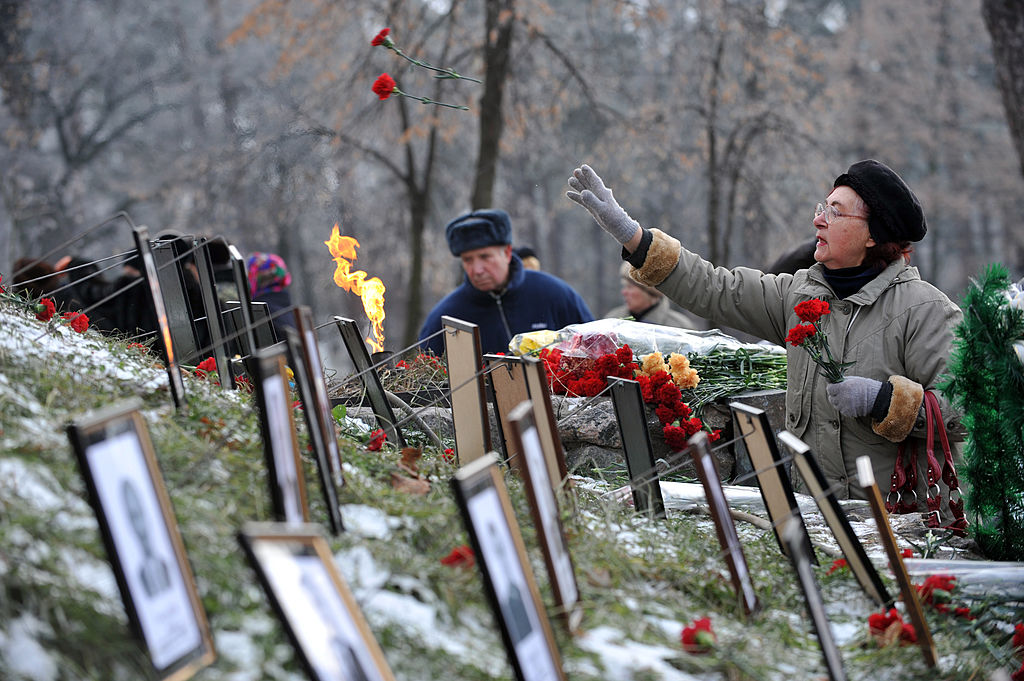
The exhibition presents documents, photographs from the personal archives of the liquidators and various items related to the events of those days. Nikolai Sachkov, Chairman of the Novovoronezh city public organisation of disabled people from Chornobyl, spoke at the opening of the exhibition. He recalled that more than 800 Novovoronezh residents participated in eliminating the consequences of the accident. Many of them received state awards.
Chornobyl also had wider effects: Following the accident, the international community established several frameworks and technical improvements to prevent a recurrence.
In 1986, the IAEA Early Notification Convention was established, requiring states to promptly notify others of any nuclear accident. A second convention was created to coordinate international assistance during such emergencies. A second convention established in 1986 is the Convention on Assistance in the Case of a Nuclear Accident or Radiological Emergency (often simply called the Assistance Convention). The IAEA acts as the central coordinator, matching requests for help with countries that have the right experts and equipment.
The World Association of Nuclear Operators (WANO) was formed in 1989, enabling every commercial nuclear operator in the world to participate in peer reviews and share operating experiences to improve safety globally.
In 1990, the International Nuclear Event Scale (INES), developed by the International Atomic Energy Agency (IAEA) and the Nuclear Energy Agency (NEA) was introduced to communicate the safety significance of nuclear incidents to the public clearly. In 1994 its scope was extended beyond power plants to include other nuclear facilities, and it was further extended in 2008.
The Convention on Nuclear Safety was introduced in 1994. This legally binding treaty established international benchmarks for the safe operation of land-based nuclear plants and introduced a system of mutual accountability.
Soon after the accident, the IAEA provided immediate support to the Soviet Union in the area of environmental remediation, decommissioning and management of radioactive waste, to strengthen the safety levels at the plant. The IAEA worked closely with other United Nations organisations and provided an assessment of the radiological consequences of the accident and evaluated protective measures. In 2003, the Chornobyl Forum was established by the IAEA in cooperation with the governments of the most affected countries – Belarus, Russia and Ukraine – as well as with relevant international organisations to address recovery operations and to carry out radiological assessments of the affected areas.


