
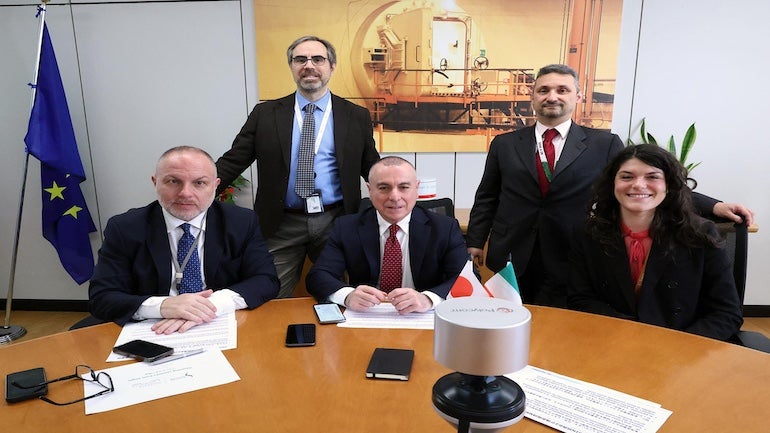
Società Gestione Impianti Nucleari (Sogin), Italy’s state-owned company responsible for the decommissioning of nuclear facilities and for the safe management of radioactive waste, and Japan Atomic Power Company (JAPC) have signed a memorandum of understanding (MOU) to launch a joint study on methods for decommissioning graphite-moderated nuclear reactors.
JAPC is seeking to integrate the experience gained at its Tokai-1 reactor with the expertise developed by Sogin in decommissioning the graphite-moderated reactor of the Latina NPP. This project is internationally recognised as a reference case for the decommissioning of this specific type of nuclear installation due to the technical challenges of handling large quantities of irradiated graphite.
Since its establishment in 1999, Sogin (Società Gestione Impianti Nucleari) has been responsible for the decommissioning of the Latina NPP, which houses a Magnox graphite-moderated reactor. The Latina plant was built between 1958 and 1962, it was the first commercial nuclear plant in Italy with a gross capacity of 210 MWe. The plant was a product of Italian-British cooperation, based on the British Magnox design similar to the Bradwell station in the UK.
It featured a single natural uranium, graphite-moderated reactor cooled by carbon dioxide gas. Following the 1986 Chornobyl disaster, Italy held a national referendum in 1987 that led to the decision to phase out nuclear energy. The Latina plant was officially shut down in December 1987. By the early 1990s, all nuclear fuel had been removed from the site and sent abroad for reprocessing.
Sogin’s decommissioning plan for Latina is split into two primary phases. Phase 1 (Ongoing, estimated completion 2027) focuses on dismantling auxiliary systems and structures to reduce environmental impact. Sogin completed the demolition of the six reinforced concrete shields that insulated the upper pipes. Work continues to dismantle six boilers weighing over 3,600 tonnes. All radioactive waste generated is stored safely on-site in temporary facilities until the National Repository is available.
Phase 2 involves the complex task of dismantling the graphite gas reactor itself. Irradiated graphite will be extracted layer-by-layer using dedicated, remote-controlled handling systems. Once all waste is moved to the National Repository, the site will be returned to the community for reuse without radiological restrictions.
The decommissioning of the Tokai-1 plant, Japan’s first commercial power reactor, is a pioneering project that serves as a technical benchmark for future nuclear phase-outs. Like the Latina NPP, it features a British-designed Magnox graphite-moderated reactor, making their decommissioning processes technologically linked.
Decommissioning, which began in December 2001 was originally planned as a 17- to 20-year undertaking but has faced significant delays. Phase 1 (2001–2006) focused on preparatory work, including the removal of conventional facilities like turbines and the cleaning of the spent fuel cooling pond. Phase 2 (2006–2011) involved the dismantling of Steam Raising Units (SRUs) and other auxiliary equipment. Phase 3 (Ongoing) is the final and most complex stage This involves dismantling the reactor core, including the removal of approximately 1,600 tonnes of irradiated graphite blocks. While initially planned to conclude by 2017, completion is now expected around 2030.
The core difficulty lies in handling the irradiated graphite moderator, which significantly inflates both the technical complexity and the cost. Because of high radiation levels, JAPC is developing specialised remote-controlled robots for gripping, cutting, and extracting the graphite blocks from within the reactor pressure vessel.
The project generates approximately 177,000 tonnes of waste. JAPC has implemented a clearance system to recycle “extremely low-level” radioactive metals into everyday items like bench legs and pavement bricks to promote public acceptance of recycling nuclear materials. The total cost is estimated at JPY93bn ($1.04bn), with more than half allocated to waste treatment and disposal.
The Sogin-JAPC collaboration follows the agreement signed by Sogin in January with GraphiCore, an Italian company specialised in the handling of irradiated graphite. The agreement aims at the development and testing of equipment for the extraction and handling of irradiated graphite from reactors, as well as joint participation in research programmes related to the decommissioning of graphite-moderated reactors.


