
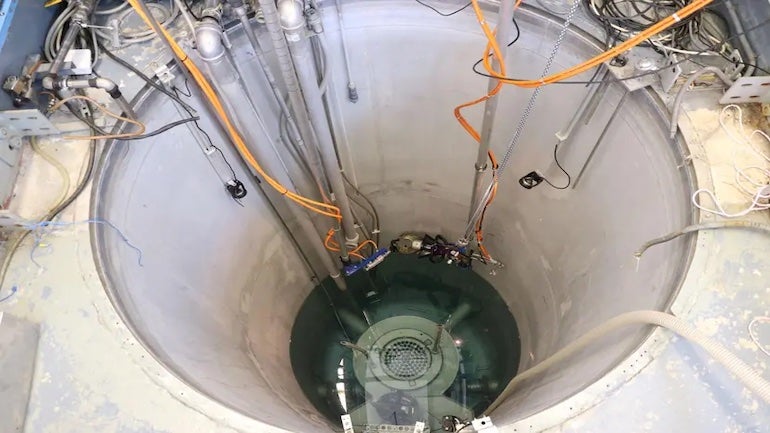
Finland’s first nuclear reactor the Finnish Reactor 1 (FiR 1) and the adjacent OK3 Laboratory (Nuclear Power Plant Structural Materials Research Laboratory) have been released from regulatory control by the Radiation and Nuclear Safety Authority (STUK – Säteilyturvakeskus). The site has been cleared for unrestricted use.
The research reactor, which operated in Otaniemi, Espoo, from 1962 to 2015, was initially owned by the Helsinki University of Technology and, from 1971 by the state-owned VTT Technical Research Centre of Finland. The dismantling of the facilities and the management of nuclear waste were carried out by VTT in cooperation with Fortum between 2023 and 2025.The two facilities were decommissioned in parallel but under different regulatory frameworks.
FiR 1 was regulated by the Nuclear Energy Act. As a nuclear facility, it required a formal decommissioning licence from the Finnish Government, which was granted to VTT in June 2021. The OK3 Laboratory was regulated by the Radiation Act. Although the laboratory housed hot cells for testing radioactive materials, it was not classified as a nuclear facility, allowing for a different licensing and oversight.
The dismantling of the laboratory began in parallel with the reactor preparations and was scheduled to be completed by spring 2023, serving as a pilot for the reactor’s own dismantling. The entire FiR 1 site dismantling was completed in May 2024. Although governed by different laws, the radioactive waste from both was handled by Fortum under a single partnership agreement. Waste from both facilities was delivered to the Loviisa nuclear power plant repository for final disposal.
Before the laboratory premises could be released from regulatory oversight, STUK performed measurements to confirm the area was free of radioactive contamination. The lessons learned from the OK3 laboratory’s decontamination, particularly in handling “difficult-to-measure” radionuclides, were directly applied to the more complex dismantling of the reactor, which was released from regulatory control in December 2025. Later in 2026, inspectors from the European Commission and the International Atomic Energy Agency (IAEA) will verify the situation.
Kai Hämäläinen, a principal advisor at STUK, noted that because the decommissioning of the Otaniemi nuclear reactor was the first of its kind in Finland, it also provided an important opportunity for the authority to learn and gain experience. Although the Otaniemi reactor was not a nuclear power plant, the same radiation and nuclear safety factors applied. The decommissioning of Finland’s NPPs in Loviisa and Olkiluoto are not expected in Finland in the immediate future, but preparations must still be made. Finland is currently reforming its nuclear energy legislation and the complementary STUK regulations.
According to Hämäläinen, the lessons learned from dismantling the Otaniemi research reactor and supervising the process have been valuable in this work. “Until now, the law and regulations have not described the final stages of a nuclear facility’s life cycle and the technical requirements for decommissioning in much detail. The experience gained has now been used in drafting the new law and in writing STUK’s regulations.”
FiR1 was a water-cooled, pool-type TRIGA Mark II research reactor built for research and education and was later also used for isotope production and radiotherapy. Although licensed to operate until 2023, VTT decided to close the facility in 2012 for financial reasons. The reactor – with a thermal capacity of 250 kW – ran for the last time on 30 June 2015. In 2017, VTT applied to the Council of State for permission to decommission the reactor, which was granted in 2021.
Partially used irradiated fuel from the reactor was transported to the USA for use in a TRIGA Mark I research reactor operated by the US Geological Survey (USGS) in Denver, Colorado. By sending the fuel to USGS, VTT avoided the long-term burden of disposing of it as reactor with the fuel needed to continue its mission of providing neutron activation analysis and isotope production, which had been threatened by the global shortage of TRIGA fuel. While the usable fuel went to the Denver Federal Center for the USGS reactor, any unusable portions were managed by the Idaho National Laboratory.
“The FiR1 decommissioning project is the first of its kind in Finland,” said Fortum’s leading decommissioning specialist Matti Kaisanlahti. “During the project, the authority has not had existing procedures for such projects, and planning documentation has never been taken this far before. Flexibility was also learned during the project, as support was needed from other organisations, and help has been available in both directions.”
Markus Airila, Customer-side Project Manager at VTT noted: “The dismantling phase was very swift, thanks to thorough planning and preparatory work. Additionally, it was crucial that we could leverage the strong nuclear safety culture and expertise from Fortum’s Loviisa nuclear power plant. Fortum handled everything safely, efficiently, and on schedule without significant delays.”


