
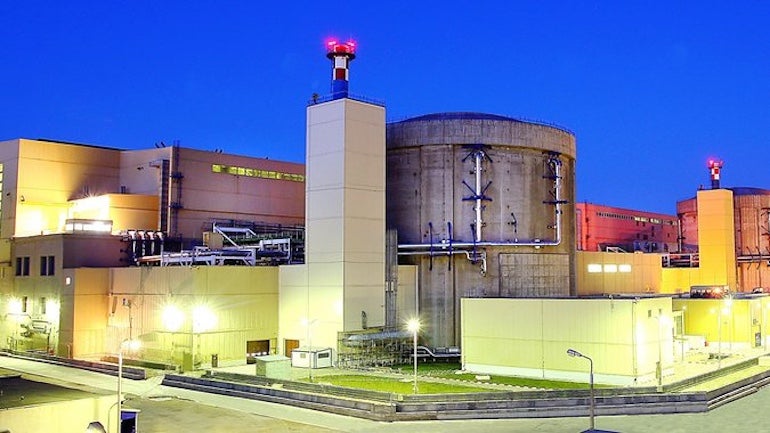
The European Commission (EC) has opened an in-depth investigation to assess whether Romania’s plans to grant public support for the refurbishment and lifetime extension of unit 1 of the Cernavodă NPP is in line with EU State aid rules.
Romania’s two 650 MWe Candu pressurised heavy water reactors at the Cernavodă NPP began operation in 1996 and 2007 with a 30-year design life. A further 30 years of operation is possible following refurbishment. Work to extend unit 1 began in 2017 and is currently in the second of three phases, expected to be completed in 2026. This involves preparatory measures. The third phase, scheduled for 2027 to 2029 will see the unit shutdown for refurbishment.
In January, Romania notified the EC of its plan to support the refurbishment of Cernavodă 1 while maintaining the same electricity generation capacity of 706 MWe, so it can operate for another 30 years. It currently supplies approximately 10% of Romania’s electricity. As the estimated lifetime of the reactor expires in 2027, the extension of its operating life is crucial to ensure the long-term availability of low-carbon electricity.
The beneficiary of the proposed support for the Cernavodă 1 extension is plant owner/operator nuclear utility SN Nuclearelectrica (SNN). The estimated nominal value of the project is €3.2bn ($3.76bn).
Romania plans to support the refurbishment through four measures:
- A grant of €600m;
- State guarantees for loans taken to finance the investment;
- A two-way contract for difference (CfD) running for 30 years to provide stable revenues to the plant, and;
- A protection mechanism for regulatory changes during construction and operation.
At this stage, based on its preliminary assessment, the EC says it has found the project necessary and considers that the aid facilitates the development of an economic activity. Nevertheless, the Commission doubts whether the measure is fully in line with EU State aid rules and so has decided to open an in-depth investigation.
This is in relation to the appropriateness and proportionality of the aid package; the impact of the measure on competition in the market and whether this is kept to the minimum; and compliance with other provisions of EU law.
Since there are several aid measures that together can limit the risk for the beneficiary, it is important to ensure that no more aid than necessary is ultimately granted. In particular, the EC doubts whether the proposed package “achieves an appropriate balance between reducing risks to enable the investment and maintaining incentives for efficient behaviour, while avoiding excessive risk transfer to the State”.
In particular, the Commission “has concerns that several essential design elements of the CfD do not provide efficient operational and maintenance incentives”. The Commission “cannot conclude at the current stage that there are sufficient safeguards to prevent that aid is transferred to consumers or specific market participants”.
The compliance with other provisions of EU law, in particular with the design principles set out in Article 19d of the Electricity Regulation as regards the CfD.
The Commission will now investigate further to determine whether these initial concerns are confirmed.


