
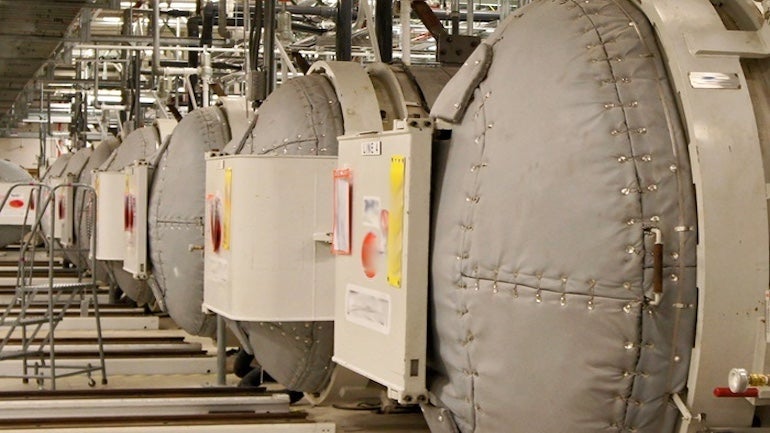
Decades of uranium enrichment operations at two former US gaseous diffusion plants yielded thousands of cylinders of depleted uranium hexafluoride (DUF6) that accumulated in storage yards. Now, with a nuclear renaissance underway, opportunities to reuse that material are on the horizon.
The two facilities that produced the thousands of cylinders of DUF6 are the former Portsmouth and Paducah Gaseous Diffusion Plants. managed by the Department of Energy’s (DOE) Portsmouth/Paducah Project Office (PPPO). The material at Paducah and Portsmouth, represent one of the largest “stockpiles” of nuclear material in the world.
The Paducah Gaseous Diffusion Plant in western McCracken County, Kentucky, about 10 miles west of the city of Paducah, operated for over 60 years and ceased production in 2013. Initially, Paducah served as a “feed facility,” producing low-enriched uranium (LEU) that was then sent to sister plants in Oak Ridge in Tennessee and Portsmouth in Ohio to be further enriched for nuclear weapons and military reactors. The site spans approximately 3,556 acres and currently houses the largest portion of the DUF6 inventory, which is expected to take about 30 years to process.
The Portsmouth Gaseous Diffusion Plant in Pike County, Ohio, near the town of Piketon, was constructed between 1952 and 1956. The 3,777-acre site initially produced highly enriched uranium for the nuclear weapons programme and later LEU for commercial reactors before ending operations in 2001. Its DUF6 inventory is estimated to be fully processed by approximately 2038.
Today, specialised DUF6 Conversion Facilities operate at both sites, managed by Mid-America Conversion Services (MCS) – a joint venture of Atkins, Fluor, and Westinghouse. These plants convert the volatile DUF6 into a more stable uranium oxide for potential reuse and hydrofluoric acid, which is sold for industrial applications.
“We’ve been looking at this for more than decade because we know DUF6 is a valuable material and this focus on nuclear revitalisation helps us get there,” said PPPO Operations and Site Mission Support Acting Lead Chris Richards. “Our ultimate goal is to decrease inventory, but we must be strategic in how we do that.”
The inventory is reduced as cylinders are processed through conversion facilities at Portsmouth and Paducah or reused by other DOE organisations, such as the National Nuclear Security Administration (NNSA), and private sector entities.
For this, the cylinder management database is critical. Records kept from decades of uranium enrichment operations provide valuable information about the more than 67,000 cylinders stored at the sites, such as their size and the assay of the material inside them. Assay is the concentration of a specific isotope within a material. In this case, it’s the percentage of uranium-235, the isotope needed for fission in nuclear reactors.
“There’s a delicate balance we go through,” Richards said. “We want to be good stewards of the taxpayer dollars and work in the best interests of the government and support the local communities. We need to ensure we have an inventory of cylinders to process through the conversion plants.”
A team from contractor Mission Conversion Services Alliance manages the database. Team members look for a specific type of cylinder, based on the material or quantity of material inside the cylinder, to be processed in the conversion plants. Next, they dig through the records to provide characterisation of the cylinders.
General Matter and Global Laser Enrichment (GLE) are interested in reusing a portion of the cylinders. PPPO teams worked with the companies to determine their needs. “The database became a one-stop shop,” Richards said. “We filtered out criteria to identify what cylinders could be made available to General Matter and Global Laser Enrichment based on their requests.” Both General Matter and GLE have established significant footprints at the Paducah Site in Kentucky.
General Matter is a California-based startup that emerged as a major player in domestic uranium enrichment in late 2024 and 2025. In 2024 it was once of four companies selected by DOE to provide enrichment services to help establish a US supply of high-assay low-enriched uranium (HALEU) under a $2-4.7bn 10-year contract.
In August 2025, the company signed a lease with the DOE for a 100-acre parcel directly on the former Paducah Gaseous Diffusion Plant site. Their lease includes access to a minimum of 7,600 cylinders of existing DUF6. Initial land clearing began in early 2026, with full construction expected to start later that year.
Enrichment operations are projected to begin by the end of the decade. The planned $1.5bn facility aims to produce both LEU for current reactors and HALEU for advanced reactors. In early 2026, General Matter was awarded a $900m DOE contract to support this domestic HALEU production.
Global Laser Enrichment is a joint venture between Silex Systems (51%) and Cameco (49%) commercialising the Australian-developed SILEX laser technology. GLE acquired a 665-to-700-acre site in November 2024 is adjacent to the Paducah former enrichment plant.
GLE has a long-term agreement (dating back to 2016) to purchase and re-enrich over 200,000 tonnes of high-assay depleted uranium tails currently stored at Paducah. It planned $1.76bn Paducah Laser Enrichment Facility (PLEF) is designed to re-enrich DUF6 into natural-grade uranium equivalent (containing 0.7% U-235) for sale in the global market.
The project achieved Technology Readiness Level 6 (TRL-6) in late 2025. Commercial operations are targeted for 2030. GLE is also exploring using the PLEF to produce LEU and HALEU to supply next-generation small modular reactors (SMRs). PPPO plans to provide approximately 25,000 cylinders of DUF6 to GLE as feedstock for PLEF.
Richards said such partnerships are a perfect example of transitioning from nuclear remediation to nuclear revitalisation, a key priority for DOE’s Office of Environmental Management.


