
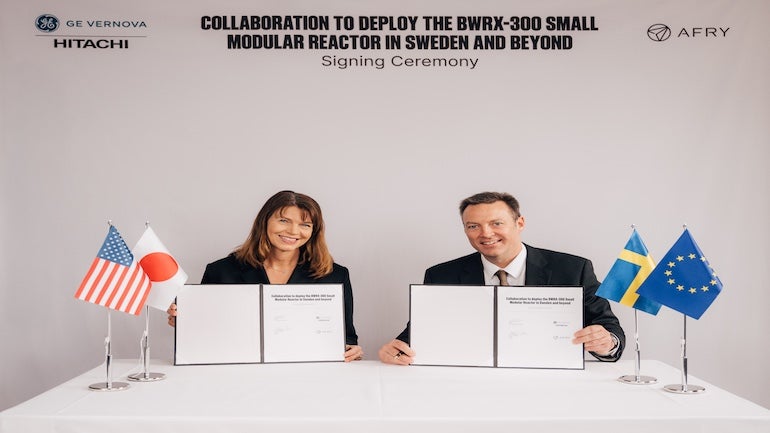
GE Vernova Hitachi Nuclear Energy (GVH) has entered into a non-exclusive Main Services Agreement (MSA) with Swedish engineering company AFRY to support the deployment of the BWRX-300 small modular reactor (SMR) technology in Sweden and beyond.
An MSA is a foundational contract that establishes the general terms and conditions governing an ongoing business relationship. It acts as an “umbrella” or framework, allowing companies to work together on multiple future projects without renegotiating basic legal terms every time.
The BWRX-300 is a 300 MWe water-cooled, natural circulation SMR with passive safety systems that leverages the design and licensing basis of the US Nuclear Regulatory Commission-certified ESBWR boiling water reactor design and its existing, licensed GNF2 fuel design. GVH’s first BWRX-300 is under construction at Ontario Power Generation’s Darlington site in Canada, with completion expected by 2030.
By combining GVH’s proven BWRX-300 technology and global project experience with AFRY’s sector-engineering strength, the collaboration is designed to support efficient, repeatable, and scalable deployment across multiple projects in Europe. In addition to engineering work, AFRY will also support GVH in the development of a licence application for the BWRX-300 to the Swedish Radiation Safety Authority (SSM – Strålsäkerhetsmyndigheten).
AFRY will deliver engineering and advisory services that leverage its deep sector knowledge, regional expertise and extensive European footprint to provide critical project management and technical support. The partnership aims to establish Sweden as a key player for the SMR value chain, supporting a regional ecosystem capable of efficient, repeatable project delivery across Europe.
“This agreement reflects our commitment to building a strong Swedish and European industrial ecosystem around the BWRX-300, going beyond reactor technology to enable long-term collaboration, local capability development and regional value creation,” said GVH CEO Jason Cooper. “Sweden has a strong industrial base and world-class engineering capabilities, and by working with AFRY we are reinforcing our ability to deliver the BWRX-300 while enabling local industry to play a meaningful role in Europe’s energy transition.”
Elon Hägg, Executive Vice President and Head of Global Division Energy at AFRY, noted: “Through the collaboration with GE Vernova Hitachi, we aim to help position Sweden as a key hub in the future SMR value chain as well as advancing Sweden’s nuclear power programme. “This collaboration connects local expertise with international reach and supports the delivery of reliable, low-carbon energy solutions.”
In 2025, Vattenfall said it had chosen small modular reactors (SMRs) for new nuclear capacity at the existing Ringhals NPP in Sweden. It shortlisted the BWRX-300 and the Rolls-Royce SMR as the preferred technologies. The design is currently undergoing the Generic Design Assessment (GDA) process in the UK.
To date, several countries have made formal commitments to deploy the BWRX-300. The global reference project is in Canada at the Darlington New Nuclear Project in Ontario. Full-scale construction of the first unit is underway with completion expected by 2029. A total of four units are planned for the site. Additionally, SaskPower has selected the technology for potential deployment in Saskatchewan by the mid-2030s.
In Poland, Orlen Synthos Green Energy (OSGE) is planning a fleet of up to 24 reactors. In February, a Generic Design Agreement was signed to adapt the reactor to Polish regulations. The first unit, located near Włocławek, is targeted for completion by 2032.
The Tennessee Valley Authority (TVA) is preparing to construct the first US BWRX-300 at the Clinch River site in Tennessee. In December 2025, the Department of Energy allocated a $400m grant to support this project.
In Estonia, Fermi Energia officially selected the BWRX-300 in 2023. The company is focused on site selection and regulatory framework development, aiming for operations by the mid-2030s. In February, Lithuania signed a memorandum of understanding (MOU) to assess the technical and economic feasibility of implementing the BWRX-300 as part of its 2050 energy strategy. Other states with active MOUs or feasibility assessments include Finland, the Czech Republic, Hungary, and Romania.


