
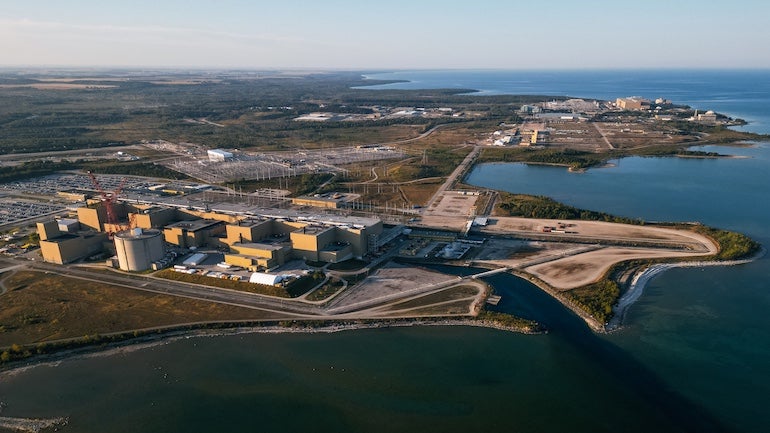
Bruce Power has signed a memorandum of understanding (MOU) with SaskPower to share its expertise in nuclear generation, project development, and long-term operations as Saskatchewan evaluates large nuclear technologies for potential use in the province. Bruce Power has also entered into a Collaboration Agreement with Energy Alberta, a private sector developer advancing the first major nuclear energy project in Alberta.
In January, the Government of Saskatchewan and SaskPower announced plans to formally evaluate large nuclear reactor technologies, a process that will proceed in parallel with the existing SMR project. “Collaboration is key to ensure we make informed, future-focused decisions that benefit our provinces and our country,” said Jeremy Harrison, Minister Responsible for SaskPower.
With most of Canada’s nuclear industry and supply chain focused in Ontario, the MOU with Bruce Power will formalise information-sharing, enable alignment on federal and provincial nuclear strategy, and leverage Bruce Power’s national leadership in nuclear expertise. James Scongack, Bruce Power’s Chief Operating Officer and Executive Vice-President noted: “We’re uniquely positioned to collaborate with SaskPower as it explores new nuclear…. We will share what we’ve learned in 25 years of operating the Bruce site and in planning projects and planning for new nuclear.”
SaskPower will also benefit from lessons learned through Bruce Power’s proposed Bruce C Project, the first new nuclear development in Canada to enter the federal Impact Assessment process. The Bruce Power site was home to Canada’s first commercial reactor, Douglas Point, which operated from 1967 to 1984, and its current fleet of eight Candu pressurised heavy water reactors are being refurbished to operate for several decades to come. Bruce Power is also exploring the option for the Bruce C project for up to 4,800 MWe of new nuclear on its site.
Bruce Power’s Collaboration Agreement with Energy Alberta, a private-sector developer, reflects a shared interest in understanding how an expanded, Canadian nuclear energy sector could play an important role as Canada faces a surge in electricity demand. The agreement is focused on Bruce Power sharing its experience, high‑level frameworks and lessons learned.
It builds on the Canada-Alberta Memorandum of Understanding signed in November 2025 which includes a commitment to collaborate to develop a nuclear generation strategy to build and operate competitive nuclear power that can serve the Alberta and inter-connected markets by 2050. “Nuclear energy’s potential to enhance energy security for all Canadians makes it an attractive solution to meet growing electricity demand,” said Nathan Neudorf, Minister of Affordability and Utilities for Alberta’s government.
Fifteen years ago, Bruce Power undertook extensive feasibility studies to evaluate options for new nuclear development in Alberta. That experience, alongside more recent planning for its Bruce C Project, provides valuable perspective for Energy Alberta as it advances licensing for a four-unit, 4,800 MWe facility north of Peace River. Bruce Power had previously proposed a plant in the Peace River region in 2008 but shelved the project in 2011 due to changing market condition. The proposed Peace River Nuclear Power Project is now in the planning phase of the regulatory process, and the company expects the first phase of the Project to be in operation by 2035.
The collaboration does not include a commitment to development, timelines or specific technologies. It reflects growing interprovincial interest in how nuclear energy expertise can be applied across different market structures and policy environments, including Alberta’s competitive electricity market.
In Ontario, Bruce Power and Ontario Power Generation are both working on choosing reactors for their respective Bruce C and Wesleyville projects. Saskatchewan will almost certainly follow the lead of either Bruce Power or OPG, so that there will be advantage of a “fleet buy,” in everything from supply chain to training and operations. There’s even a possibility all three, and perhaps Energy Alberta, may choose the same design.
The leading contenders are the Candu Monark, an updated version of a previous Candu design and the Westinghouse AP1000. In April 2025, Alberta Energy’s initial project description submitted to federal regulators for Peace River Nuclear Power Project planned to use Candu Monark reactors. These use natural uranium, which does not require enrichment. This allows for a “home-grown” supply chain using uranium mined in Saskatchewan. However, in October 2025, Energy Alberta also signed a MOU with Westinghouse to explore deploying AP1000 pressurised water reactors (PWRs).
Energy Alberta and its partners use a specific set of strategic and technical criteria to determine which reactor actually makes it to the construction phase.
The evaluation focuses on these five key areas:
Fuel Supply and Security: A major factor is whether the technology can leverage Canadian resources. Because Candu reactors use natural (unenriched) uranium, they can be fuelled directly by Saskatchewan’s mines. The AP1000 requires enriched uranium, which Canada currently does not produce, potentially creating a dependency on international fuel processing.
Grid and Industrial Compatibility: The technology must fit the province’s specific needs. The reactor must be able to provide steady “baseload” power but also have the flexibility to adjust output when wind and solar generation fluctuate. Energy Alberta is assessing if the reactors can provide high-temperature steam for industrial processes (like oil sands extraction or hydrogen production) alongside electricity.
Design track record: To manage financial risk, developers look at the track record of the design. Preference is given to designs that have already been built and operated elsewhere. This reduces the risk of the massive cost overruns and delays often seen with “first-of-a-kind” (FOAK) nuclear projects. Technologies that are already undergoing or have completed the Canadian Nuclear Safety Commission (CNSC) pre-licensing vendor design review (VDR) are prioritised.
Local Supply Chain & Economic Value: The project aims to create a long-term industry in Alberta. The selection depends on how much of the reactor’s components can be manufactured in Alberta or Ontario. The technology must align with the skills of the existing Canadian nuclear workforce to ensure a smooth transition and long-term maintenance.
Environmental and Safety Standards: Modern Generation III+ designs are required. This means the reactor must be able to shut down and cool itself without human intervention or external power in the event of an emergency. The technology must be compatible with the water availability from the Peace River, ensuring minimal impact on the local ecosystem.
Neither Monark not AP1000 have completed the VDR. Westinghouse engaged in a “Phase 1” VDR years ago but did not complete the full Canadian process for the current version. AtkinsRéalis is pushing to have the Monark through the most critical VDR phases by 2027. It benefits from decades of “Candu-specific” CNSC regulatory history.
While Westinghouse argues that the AP1000 has operating plants in the US and China, the Monark, has yet to be built anywhere. However, the AP1000s at Vogtle in the US were significantly delayed and massively over budget. The Chinese AP1000s were also delayed and the projects faced design changes mid-construction and cooling pump failures. Chinese state companies took over a significant portion of the project management and supply chain to get them across the finish line. Monark, on the other hand is an upgrade of the well-established Candu reactor. The Candu refurbishments currently happening at Darlington and Bruce Power in Ontario are tracking on time and on or under budget.
Moreover, thousands of Canadian engineers and tradespeople already have experience of the Candu. Switching to the AP1000 would essentially mean importing a foreign workforce and supply chain for the most critical components.
Alberta has committed to collaborating with the federal government to develop a formal nuclear generation strategy, which is set to be finalised on or before 1 January 2027. The final technology selection for Peace River is expected to align with this strategy.
Similarly, SaskPower began its formal evaluation of large reactor technologies in January 2026. While its SMR program is more advanced (targeting a 2029 construction decision), its assessment of large-scale units is expected to follow a similar multi-year regulatory path, heavily informed by the recent collaboration with Bruce Power.


