
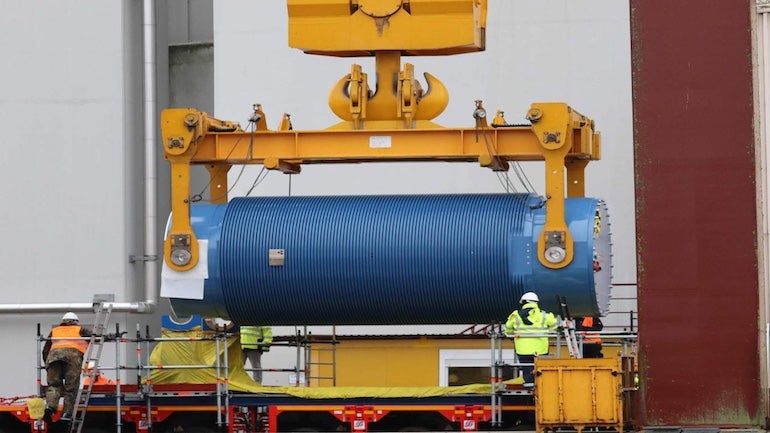
All the fuel has now been removed from Germany’s Brokdorf NPP in Schleswig-Holstein. The single unit Brokdorf NPP (KBR – Kernkraftwerk Brokdorf) was shut down in December 2021 in line with the German nuclear phase-out plan. The plant began operation in October 1986. It was owned by PreussenElektra GmbH (80%) and Vattenfall Europe Nuclear Energy GmbH (20%). The 1,440 MWe Siemens pressurised water reactor used both conventional and mox fuel.
The Schleswig-Holstein Ministry for Energy Transition, Climate Protection, Environment & Nature granted approval for decommissioning and dismantling (dismantling phase 1) of Brokdorf to the operating companies, PreussenElektra GmbH and Brokdorf nuclear power plant GmbH in October 2024.
The approval notice for dismantling phase 1 covered the decommissioning and dismantling of the parts of the plant that are no longer required and are subject to nuclear surveillance, with the exception of the reactor pressure vessel (RPV) and the biological shield. For the dismantling of the RPV and the biological shield, a 2nd permit is needed and required the removal of all fuel elements and special fuel rods,
PreussenElektra said a total of 764 fuel elements have now been loaded from the storage basin into CASTOR containers since 2023. “This means that the radioactive core of the plant has been completely removed – and with it, over 99% of the radioactivity,” the company noted.
“The removal of nuclear fuel is an important milestone in the decommissioning of our plant, as it creates the conditions for further technical and organisational adjustments,” explains plant manager Tammo Kammrath. “We can now shut down additional systems and reduce the size of the shift crew. Their valuable expertise is urgently needed elsewhere, for example for the dismantling of the reactor pressure vessel internals, which is scheduled to begin in the spring of next year.”
PreussenElektra explained that before phase 2 dismantling can begin various components and plant parts must first be removed from the area of the now-empty used fuel pool in order to create the necessary storage, handling, dismantling, and packaging areas. “A further prerequisite for starting this work is the still-pending official permit for the use of the transport preparation hall for radioactive waste, which is currently under construction.”
Brokdorf was the last German nuclear power plant to receive approval to begin dismantling. Germany’s decision to phase out nuclear power was taken in the wake of the 2011 Fukushima accident in Japan. Eight nuclear units were permanently shut down in 2012. These included EnBW’s Phillipsburg unit 1 and Neckarwestheim unit1; E.ON’s Isar unit 1 and Unterweser; RWE’s Biblis A&B and Vattenfall’s Brunsbüttel and Krümmel (both already closed). The remaining nine reactors were to close by the end of 2022. E.ON’s Grafenrheinfeld closed in 2015; RWE’s Grundremmingen B in 2017; EnBW’s Phillippsburg unit 2 in 2019; Brokdorf, E.ON’s Grohnde and RWE’s Gundremmingen C in 2021; and E.ON’s Isar 2, EnBW’s Neckarwestheim 2 and RWE’s Emsland in April 2023. Two older reactors – E.ON’s Stade NPP and ENBW’s Obrigheim had already been shut down in 2003 and 2005.


