
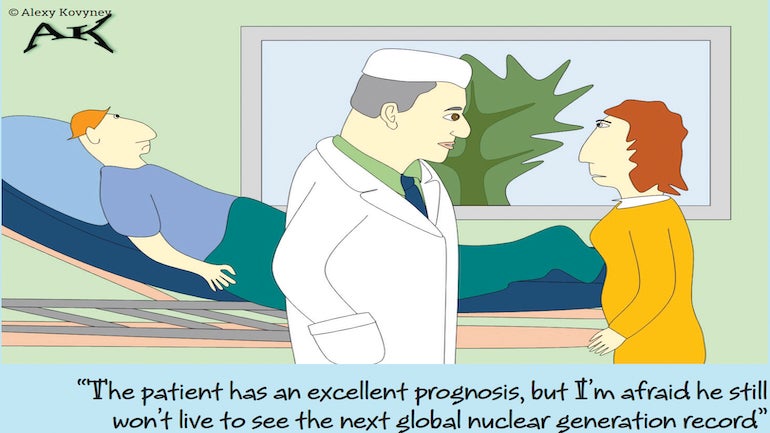
The nuclear industry will probably celebrate 2025 as a milestone, but it will be a bittersweet occasion. This year it is broadly expected that global nuclear generation will hit an all-time high, finally eclipsing the previous record that, according to IAEA figures at least, was set back in 2006. One hopes that the breaking of this milestone becomes an annual occurrence, or at the very least that we will not have to wait half a career for it to happen again. Many of us do not have half a career left.
As of writing Belgium has just repealed its nuclear phase out law and even Denmark has announced plans to reconsider nuclear energy. Yet for all the enthusiasm that surrounds nuclear energy today the numbers tell a different story. Global nuclear electricity generation has been flat overall for decades. In fact, it stopped growing even before the accident struck at Fukushima Daiichi.
The idling of the entire fleet of Japanese reactors following the accident caused a dip of about 300 TWh from 2011 to 2012. This took the global nuclear industry about nine years to recover from – mostly achieved not by Japanese reactor restarts (which have proceeded at a snail’s pace) but the steady growth in nuclear plants led mainly by China. Since about 2019 nuclear output has oscillated, but it has not yet officially broken through the 2006 ceiling.
This is the kind of statistic that anti-nukers and opponents love to stick in our faces. They are not exactly wrong, but they are not right either. It is obvious that growth in nuclear capacity will lag the initial excitement by 15, 20 years or more. This is the average time taken today for excitement to turn into policy and for policy to transform into real generating projects – at least in Western countries.
If the global nuclear generation stats look average then the nuclear as a share of electricity statistic is downright depressing. The nuclear share has been shrinking and has now certainly fallen beneath 10% of global production as electricity demand has risen worldwide while nuclear has flatlined over the same period. The WNA has the nuclear share pegged at 9% (2023 data). It will have been overtaken by wind energy in the last year or so, and solar power won’t be far behind. While the phrase ‘alternative energy’ has always struck as being arbitrarily defined, it would seem to apply to nuclear now. Nuclear is no longer mainstream – it is the fringe.
While it’s uplifting to live in a period of unprecedented excitement for nuclear energy, the fact is that for those of us in these countries, the longed-for kilowatthours may be destined for our children to enjoy. Have you ever considered that when we talk about generations of nuclear technology we are also in effect talking about generations of people? If Gen III was for Gen X, then it seems that Gen IV will help to power Gen Z/alpha.
Sadly, the reverse is not true. The premature closure of nuclear plants can happen in weeks to months rather than decades. Or in even less time whenever a nuclear incident is involved. And as Germany proved, an incident need not even take place in one’s own country for a sizable chunk of the national nuclear fleet to receive a shut down order that becomes all too final.
These are the timescales of nuclear energy today and frankly they suck. The nuclear industry is not alone in the bucket of ponderously slow infrastructure developments, but nuclear facilities are perhaps uniquely threatened by the possibility of a collective and sudden undignified stop.
A frustrating fact is that nuclear energy development is often slower than the problems it aims to solve. Ok, that is not quite right. More accurate is to say that the timescales of nuclear energy sit uncomfortably with human decision making and political processes. Attention spans are just not that long. Political will begins to wander.
For instance, energy security has not stopped being an issue, but the public memory of the recent energy crisis and cost spike is already beginning to fade. Nor evidently is climate change solved but after three decades the global political appetite for climate action seems to have waned recently too. And where nuclear projects have received political approval, can we really count on that approval holding if two elections later no ground has been broken?
There is a direct connection between the time taken on nuclear projects and the sensitivity of our industry to political risks. Progress is what dissuades cancellation. Put simply, the nuclear sector needs to move faster.
If a genie appeared and offered to make nuclear energy cost half as much or for nuclear projects to take half as long, the clear choice would be to select the latter. Fortunately, this is not actually an either-or choice. We know that completing nuclear plants more quickly will make them much cheaper, but please no one tell the genie.
To be fair, some of this is a reflection upon society rather than the nuclear industry. We now live an age where the videos people mostly watch are less than 30 seconds long. The pace of life just seems to grow ever faster, and expectations of immediacy are intensifying. This hardly seems healthy, but it is reality of modern life.
Amazon does same-day delivery. So where is that nuclear plant already? It must be hard for a young person to relate to things that are expected to materialise only 15 – 20 years from now. How does that translate into a life plan exactly? The timescales of nuclear energy are marginalising the technology and pushing it towards irrelevancy.
Donald Trump will (allegedly) enact executive orders to speed up the construction of nuclear power. As with so many Trump actions it is hard to know exactly how to feel about this, but it is easy to see where the desire has come from. Can the various appendages of the nuclear industry really be ordered into urgent action or is this a case of King Canute shouting at the tide.
It is akin to being asked to change one’s cultural beliefs. Established nuclear industry culture is risk averse and lends itself to extensive consultation and study, strict regulatory compliance and even going beyond regulatory requirements in many cases. Clearly there are many individuals, companies and organisations in the industry that are ok with the slow pace of progress. To be fair to them this culture been shown to work and ensures a high degree of public safety and nuclear security.
Can we maintain the same standard of protection if we cut the red tape and begin to move at speed? The answer had better be yes. Legal and regulatory reforms were always going to be a necessity on the journey of tripling nuclear energy globally. It seems we are just getting to that point sooner than we expected. Perhaps, as with the already notorious import tariffs, the Trump Executive Orders will trigger a wave of response across Europe and beyond. After all, who wants to be left behind?
The upshot is that the industry needs to embrace this acceleration and not fight it. Nuclear is demonstrably safe, but there’s really no point in being safe if nuclear remains irrelevant to the lives of people it hopes to serve.
Eclipsing the previous nuclear generation record needs to be more than just a symbolic milestone, it has to happen year after year. It also needs to herald the
birth of a more nimble and agile nuclear sector that is actually serious about hitting its own 3X aspirational goals. A strong vision is admirable, but it begins to look a bit
silly if year after year you fail to take meaningful steps towards it.


