
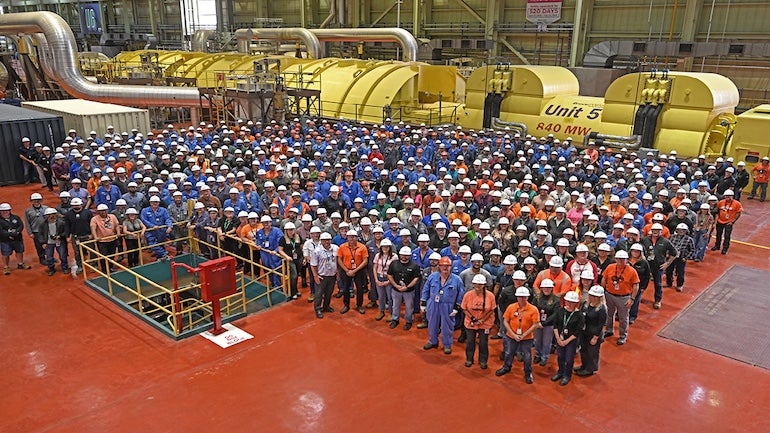
Canada’s Bruce Power has begun its unit 5 Major Component Replacement (MCR) outage. This marks the formal midway point of the utility’s ambitious, privately financed multi-billion-dollar Life-Extension Programme designed to modernise units 3-8 by 2033.
The eight pressurised heavy-water Candu reactor units at the Bruce site in Ontario (Bruce A – units 1-4, and Bruce B – units 4-8) began commercial operation between 1977 and 1987. Bruce Power’s CAD13bn ($10bn) Life Extension Programme, which includes Asset Management and MCR, began in 2016. MCR, which began with unit 6 and also includes units 3-8, will extend the life of the site until 2064.
During the outage, skilled tradespeople will strip out and replace 480 calandria tubes, 480 pressurised fuel channels, and 960 feeder tubes, while also installing new steam generators. The core rebuild will extend the operational life of the reactor by 30-35 years, ensuring it can continue to provide low-carbon baseload electricity and medical isotopes.
Unit 5 is the fourth reactor to undergo refurbishment. It benefits from compounding efficiencies and lessons learned from previous units. Unit 6 returned to service in 2023 ahead of schedule, Unit 3 came back online in June 2026 over seven months early. Unit 4’s MCR outage began in 2025 and is tracking ahead of the unit 3 MCR, which was the first to employ innovative robotics on a nuclear reactor face for the first time.
Overlapping reactor outages will be continuous at the site for the next seven years to meet long-term clean energy targets, with unit 7 scheduled for 2028 and unit 8 following in 2030.
“Our performance gets better with each MCR outage and we’re committed to delivering these projects safely with high quality and on time to return reliable units to power Ontario forward,” said Eric Chassard, Bruce Power’s President & CEO. “Along with our partners and skilled workforce, we are securing the future of the Bruce site, sustaining surrounding communities, driving the economy, and producing cancer-fighting medical isotopes for patients around the world.”
According to Bruce Power, 95% of the programme’s overall spending remains within Canada. The ongoing site operations and life-extension projects collectively sustain 22,000 direct and indirect jobs annually while injecting approximately CAD4bn into Ontario’s economy every year.
“Ontario’s nuclear advantage is powered by the best workers, engineers and skilled tradespeople in the world and the start of Unit 5’s refurbishment is yet another example of nuclear expertise that few jurisdictions can match,” said Stephen Lecce, Ontario Minister of Energy & Mines. “Extending the life of this critical asset will deliver reliable, affordable electricity, while strengthening Ontario’s position as a global energy superpower that can refurbish nuclear plants on time and on budget.”


