
Nuclear power plants operate thousands of electrical and mechanical assets that must perform reliably over decades of service. A single unexpected failure in a critical motor, transformer, pump, or switchgear assembly can trigger costly generation losses and introduce complex maintenance activities during periods of high operational demand. While traditional preventive maintenance programs remain an essential part of plant operations, fixed inspection intervals do not always identify degradation at the stage where corrective action is most effective. Plant operators increasingly rely on online condition monitoring systems that provide continuous visibility into equipment health. At the centre of many of these systems are current sensors that convert electrical behaviour into measurable diagnostic information.
Current measurements reveal changes in load, mechanical condition, insulation health, and equipment performance long before failure becomes apparent through routine inspections. When integrated with plant monitoring infrastructure, current sensing technologies provide the data foundation for predictive maintenance programs that identify developing faults and support risk informed maintenance decisions.
Current sensing in nuclear facilities
Current sensors serve as the primary interface between electrical equipment and plant monitoring systems. Their role is straightforward. They measure current flowing through conductors and convert that measurement into a form suitable for protection, control, diagnostics, and long-term trending. In nuclear power plants, these measurements support monitoring of motors, transformers, switchgear, busbars, generators, pumps, fans, and numerous balance of plant systems.
The most common technology remains the current transformer. Current transformers step down high primary currents to standardized secondary values, typically 1A or 5A, allowing protection relays, monitoring systems, and instrumentation equipment to operate safely and accurately. The isolation provided by CTs enables measurement of large currents without direct electrical connection to high energy circuits. CT outputs feed protection systems as well as diagnostic applications that evaluate equipment condition over time.
Rogowski coil sensors provide a different approach. These devices operate using electromagnetic induction and measure the rate of change of current flowing through a conductor. Unlike conventional current transformers, Rogowski coils contain no iron core. The absence of a magnetic core eliminates saturation effects that can occur during transient conditions or high fault currents. Flexible coil construction also allows installation around existing conductors and busbars where conventional sensors may be difficult to fit. This characteristic is particularly useful during retrofit projects where plant modifications must minimize outage duration and physical intrusion into existing equipment arrangements.
Measured signals are typically transmitted to supervisory control and data acquisition systems, distributed control systems, and specialised analysis platforms. Data may be used directly for operational monitoring or supplied to motor current signature analysis equipment and other diagnostic systems. Modern plants often combine electrical measurements with vibration, acoustic, thermal, and process data to create a more complete picture of equipment condition.
Nuclear environments introduce additional requirements that are not encountered in conventional industrial facilities. Sensor electronics located near radiation sources must continue operating under extended exposure conditions. Radiation hardened designs are developed to maintain measurement accuracy and functional performance through gamma radiation exposure levels reaching approximately 1.0 mrad (SiO2). Material selection, circuit design, shielding methods, and component qualification become critical considerations when specifying instrumentation for safety related and harsh environment applications.
Current sensor applications
Motor current signature analysis has been used in nuclear facilities for more than two decades as a practical method of assessing motor driven equipment without intrusive inspections. The technique relies on measuring motor current and evaluating characteristic frequency components that correspond to mechanical and electrical operating conditions. Clamp on current sensors installed around motor feeders provide the required data while avoiding modifications to existing motor circuits.
Changes in motor current often reveal developing faults before traditional maintenance inspections detect them. Analysts can identify rotor bar defects, air gap eccentricity, bearing related abnormalities, and driven equipment problems through characteristic signatures present in current waveforms. Valve operated systems are particularly suitable candidates because electrical behaviour changes as mechanical loading conditions evolve throughout valve movement.
One limitation encountered in many applications involves lightly loaded motors. Current changes associated with load variations below approximately 50% of total load are not always easily detectable through routine monitoring techniques. Motor power signature analysis addresses this challenge by incorporating power measurements that respond more effectively to changing loads during valve cycling and other transient operating conditions. MPSA can provide greater sensitivity when evaluating motor operated valves and similar equipment where mechanical loading varies significantly throughout the operating cycle.
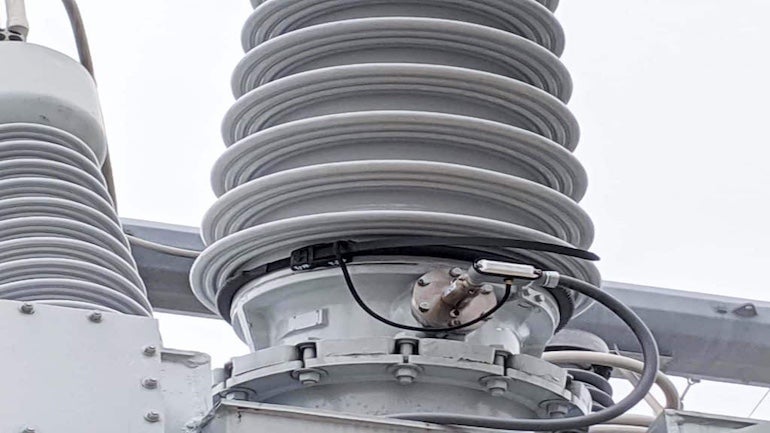
Partial discharge monitoring represents another important application for current sensing technology. Rogowski coils installed on high voltage transformer bushings and switchgear assemblies detect high frequency current pulses generated by insulation defects. Partial discharge activity often precedes insulation breakdown and therefore serves as an early indicator of deterioration within transformers, cables, and switchgear systems.
Successful PD monitoring requires careful treatment of electrical noise. Nuclear plants contain numerous sources of electromagnetic interference that can obscure discharge signals. Advanced filtering techniques are used to separate discharge pulses from background noise. Pulse polarity comparison methods help determine signal direction and assist analysts in distinguishing internal discharge sources from external interference. Accurate interpretation depends on understanding both signal characteristics and equipment operating conditions.
Vibration monitoring programmes increasingly integrate electrical measurements with mechanical sensor data. Reactor coolant pumps provide a good example. Accelerometers mounted on pump structures measure mechanical vibration while current sensors monitor electrical loading and motor behaviour. Combining these datasets improves fault discrimination and helps engineers identify the root cause of abnormal operating conditions. Radiation exposure remains one of the most significant challenges for instrumentation installed near reactor coolant systems because gamma radiation gradually degrades sensor performance and electronic components.
Current monitoring is also widely applied to rotating equipment throughout the balance of plant. Forced draft fans, induced draft fans, cooling fans, circulating water systems, and auxiliary pumps all generate electrical signatures that reflect mechanical condition. Trending these signatures over time allows maintenance personnel to identify developing problems and prioritize inspections before equipment reliability is affected.
Online condition monitoring systems collect this information continuously rather than relying solely on periodic measurements. The result is a much richer dataset capable of revealing degradation trends that may be invisible during routine inspection intervals.
Implementing predictive maintenance programmes
The shift from time-based maintenance to predictive maintenance begins with data acquisition. Nuclear facilities already operate extensive instrumentation networks that continuously collect operational information. Historically, much of this data supported plant operation, protection functions, or regulatory compliance rather than long term reliability analysis. Predictive maintenance programs seek to extract additional value from existing measurement infrastructure.
Online monitoring changes maintenance planning by directing attention toward equipment that exhibits signs of degradation rather than treating all components identically. Components with stable performance can remain in service longer between inspections, while assets displaying abnormal behaviour receive additional attention before failure occurs. This approach improves maintenance efficiency and allows resources to be concentrated where risk is greatest.
Machine learning techniques are increasingly applied to condition monitoring datasets. Supervised learning methods correlate historical failure events with historical sensor readings to identify patterns associated with degradation mechanisms. Once trained, these models evaluate incoming data and estimate future failure probability. Unsupervised methods operate differently. They identify unusual behavior without requiring labeled failure examples and are often used for anomaly detection in complex systems where failure datasets may be limited.
The analytical techniques span a wide range of complexity. Traditional clustering approaches identify operating states and deviations from expected behaviour. More advanced implementations use deep learning algorithms capable of processing large volumes of multidimensional plant data. Regardless of methodology, the objective remains the same. Engineers seek reliable indicators that predict equipment condition before functional failure occurs.
A significant opportunity exists in the use of online monitoring data already being collected throughout nuclear facilities. OLM datasets frequently support calibration verification, performance assessment, and operational monitoring. In many plants this information has not historically been trended for long term predictive purposes. When archived and analyzed systematically, the same data can become a valuable predictive maintenance resource.
Implementation generally progresses through three phases. The first phase focuses on collecting plant data from existing instrumentation including current sensors, vibration sensors, process transmitters, and protection systems. The second phase establishes secure data storage and communication pathways. Industrial networks commonly use OPC communication protocols to transfer information between plant systems, historians, and analytical platforms. The third phase performs data analysis and presents actionable results to plant personnel.
Analytical platforms employ pattern recognition techniques such as neural networks, fuzzy classification methods, and multivariate state estimation algorithms. These tools compare current equipment behaviour with established baseline conditions and identify statistically significant deviations. Engineers can then evaluate the findings and determine appropriate maintenance actions.
Regulatory acceptance of these approaches has expanded steadily. Both the United States and the United Kingdom have approved methods that use online monitoring techniques to extend calibration intervals for selected safety related transmitters. US NRC generic approvals and UK regulatory approvals demonstrated that properly implemented condition monitoring programs can maintain confidence in instrument performance while reducing unnecessary maintenance activities.
Nuclear specific monitoring challenges
Condition monitoring in nuclear facilities involves environmental conditions rarely encountered elsewhere in industry. Radiation exposure remains one of the most demanding factors affecting instrumentation performance. High level radiation released during accident scenarios or accumulated during long term operation can degrade electronic components through several mechanisms. Threshold voltage shifts, changes in leakage current, and increased electronic noise all influence circuit performance and measurement accuracy.
Sensor interface electronics must therefore be designed to tolerate these effects. Radiation hardened circuits often employ charge sensitive amplifiers configured in dual signal paths. By comparing outputs from parallel paths, the system can compensate for distortion introduced by radiation related degradation and maintain measurement integrity over extended operating periods.
Some monitoring applications make direct use of radiation measurements. Nitrogen 16 monitoring provides information relevant to reactor coolant pump performance and primary system conditions. Because nitrogen 16 is produced within the reactor coolant system, associated radiation measurements can reveal flow related characteristics and support operational assessments.
Loose parts monitoring represents another established diagnostic technique. Accelerometers installed on the reactor vessel, steam generators, and reactor coolant pumps continuously detect impact related acoustic signals. Sensors are commonly located at the top and bottom of major components to maximize coverage. When a component becomes loose and begins striking surrounding structures, the resulting acoustic energy produces alarms and initiates further analysis. Engineers compare accelerometer output against calibrated hammer baseline measurements to estimate loose part size and determine probable location.
Reactor noise analysis extends monitoring into the neutron domain. In core flux detectors, particularly self-powered neutron detectors, and ex core ionisation chambers measure neutron flux fluctuations that contain information about reactor dynamics. Analysis of these fluctuations can identify reactor vessel vibration, core flow anomalies, and other process related phenomena. When integrated with mechanical and electrical measurements, reactor noise data contributes to a comprehensive understanding of plant condition and equipment performance.
Economic and safety benefits
The value of current sensor-based monitoring extends beyond maintenance efficiency. Early identification of degradation helps prevent failures that could result in extended generation losses, equipment damage, or personnel safety concerns. Detecting abnormal electrical signatures months before failure provides maintenance planners with time to evaluate corrective actions and coordinate repairs during scheduled outages.
Condition based maintenance also reduces unnecessary work. Traditional preventive maintenance programs may require inspection or replacement of components that remain in satisfactory condition. By focusing attention on equipment with measurable signs of degradation, plants reduce maintenance burden while maintaining confidence in equipment reliability.
For nuclear facilities, reduced maintenance activity has a direct safety benefit. Fewer unnecessary inspections mean lower cumulative radiation exposure for maintenance personnel. Targeted maintenance strategies also reduce opportunities for maintenance induced errors that can occur whenever equipment is disassembled, adjusted, or recalibrated.
Online monitoring supports long periods of continuous reactor operation by enabling maintenance activities to be scheduled during planned outage windows. Predictive models further refine this process by reducing inspection frequency for components with low predicted failure probability while increasing surveillance of higher risk assets. The result is a maintenance program aligned more closely with actual equipment condition than with predetermined calendar intervals.
Future trends
The next generation of condition monitoring systems is moving toward integrated diagnostic platforms that combine multiple data sources into unified equipment health assessments. Hybrid monitoring approaches already combine vibration measurements, acoustic loose parts monitoring, motor electrical signature analysis, process data, and equipment modelling techniques. These systems provide a more complete representation of asset condition than any single measurement technology alone.
Advances in data communication infrastructure are expanding monitoring capabilities throughout nuclear facilities. Wireless networks and mesh network architectures offer opportunities to deploy additional sensors in locations where traditional cabling is difficult or expensive. While cybersecurity and qualification requirements remain significant considerations, these technologies continue to mature.
Fleetwide monitoring represents another area of development. Utilities increasingly recognize the value of sharing operational experience and equipment performance information across multiple generating units. Predictive models trained on larger datasets can identify degradation patterns that may not be visible within a single plant population.
The newest generation of nuclear facilities is expected to incorporate operational predictive models from the beginning of plant life. These systems will combine plant specific data with operational experience gathered across the wider nuclear and power generation industries. Such approaches support earlier fault identification and more informed asset management decisions throughout the operating life of the facility.
Current sensors form the measurement foundation that enables nuclear plants to move from reactive maintenance toward predictive maintenance. Whether applied through current transformers, Rogowski coils, motor signature analysis systems, or integrated online monitoring platforms, these sensors provide direct insight into equipment condition that cannot be obtained through periodic inspections alone. Manufacturers specifying monitoring systems must consider radiation hardening requirements, non-intrusive installation methods, signal quality, and compatibility with existing plant infrastructure. As online monitoring datasets continue to expand, long term trending transforms routinely collected operational information into practical maintenance planning tools. The result is extended equipment life, more efficient maintenance execution, and continued operation within established nuclear safety margins.


