
Beyond the technical challenges of building a nuclear power plant (NPP) the industry has spent decades trying to solve a problem that has seemed entirely intractable – finding a private financing model capable of supporting the huge upfront cost, long development periods and regulatory risks associated with new nuclear projects.
Now, the rapid growth of AI and demand for very large quantities of reliable, low-carbon electricity within a manageable time frame is apparently changing the economics of new nuclear power infrastructure. In reality, though, AI is only the tip of the iceberg. The electrification of industry and transport, hydrogen production, desalination and other energy-intensive activities are all increasing pressure on electricity systems.
For nuclear, the significance may lie less in the absolute size of the additional demand and more in the emergence of a market prepared to enter into long-term power offtake agreements for reliability and security of supply. That, argues White & Case lawyers Simon Stuttaford, Christina England-Livengood and Ximena Vásquez-Maignan, could create a new route towards private financing for nuclear – particularly when generation is developed as part of a wider energy cluster. In this scenario, nuclear is combined with renewable generation, storage and large industrial or data centre loads.
“We are seeing investors saying nuclear is a great idea, but we would like to have a solar source close by to the data centre as well,” England-Livengood says by way of illustration.Vásquez-Maignan, meanwhile, sees a significant change taking place in the relationship between nuclear developers, governments, investors and electricity consumers. “AI is one of the reasons nuclear is currently making a comeback,” she tells NEi, referring to the industry’s growing need for reliable and energy-dense electricity, but she also emphasises that the wider investment picture is changing too. For large conventional reactors, she contends that substantial government involvement is likely to remain necessary because of their scale and the risks associated with construction, financing, nuclear liability and cost overruns. However, with governments seeking to attract greater private sector participation in nuclear projects the emerging scenario is not necessarily set to replace public financing with an entirely private financing model but rather to find a new balance between the two.
From power demand to energy clusters
According to Stuttaford, the concept of co-location is key to this emerging finance model. While a data centre could be located close to a nuclear power plant, for example, the opportunity extends far beyond a single reactor and a single customer. He describes “energy clusters”, where large electricity users could be located alongside a combination of generation technologies which, he says, infer a number of benefits. For instance, nuclear provides continuous energy-dense generation from a relatively small footprint, but coupled with renewable generation, storage and flexible industrial loads also result in a balanced and low-carbon energy system.
From a financing perspective, bringing together the generation asset, infrastructure and prospective users at an earlier stage as part of an energy cluster potentially provides greater visibility over future demand and addresses one of the key barriers to raising private finance long before a nuclear power plant is generating.
England-Livengood observes that the US and other markets are already illustrating how important the location of electricity supply has become for prospective data centre projects. She highlights growing grid capacity constraints that are acting as a barrier to data centre development. An energy cluster offers one potential response by bringing generation and demand together. This may also address public opposition to new data centres, which is increasingly becoming an issue in some areas because of their electricity and water consumption. One potential advantage of co-location with dedicated generation is that the data centre’s growth need not necessarily compete for the same grid capacity as existing consumers.
In addition, rather than competing in a conventional wholesale electricity market, a developer can potentially structure a project around a major customer with a long-term requirement for firm power. These factors create a fundamentally different proposition for investors who have typically shied away from the nuclear generation sector.
Furthermore, the technology companies driving data centre expansion have balance sheets that would have been unusual among counterparties to generation projects of any kind in previous decades.
As Vásquez-Maignan notes, companies such as Amazon, Meta and Google have the financial resources to participate in projects on a scale that would previously have been associated primarily with governments or utilities. There are already examples of technology companies entering nuclear arrangements as long-term offtakers, providing the revenue certainty required to underpin investment. However, moving beyond the offtake agreement to become investors or development partners could transform the nuclear investment sector. This transition may prove to be particularly important for first-of-a-kind (FOAK) projects such as the emerging generation of small modular reactors (SMRs) and advanced reactor technologies that face a similar challenge. The end customer demands certainty that the technology will succeed, while the developer demands certainty that the resulting electricity will be bought. The result can be a financing impasse in which neither side wants to carry the full technology and construction risk.
England-Livengood argues that the underlying demand profile is unusually strong now “we need every bit of supply that we can get”, she says.
One key issue is whether this emerging demand can accelerate nuclear deployment quickly enough. The industry’s traditional development cycle is slow, while data centre construction is moving at an unprecedented pace. That mismatch creates an obvious risk.
England-Livengood points to recent comments by Nuclear Regulatory Commission chairman Ho Nieh that a measure of success for nuclear would be “shovels in the ground”, acknowledging that reactor technology development and deployment need to proceed in parallel with the growth of electricity demand.
That could encourage technology companies, developers, governments and suppliers to work together earlier in the development cycle rather than waiting for each stage to be completed sequentially. There are examples of large industrial customers accelerating infrastructure development and the energy cluster model could provide the framework for the necessary cooperation. While that does not necessarily eliminate technical and financial risks, according to England-Livengood it does create the commercial conditions under which those risks can be shared between governments, technology developers, infrastructure investors and large electricity users over a period measured in decades.
A different route to private nuclear investment
The emergence of new financing models does not indicate that government support is disappearing from nuclear. The capital requirements for large reactors remain substantial, while FOAK projects carry technology and construction risks that private investors are unlikely to accept without some form of public backing. Stuttaford points to the UK’s Advanced Nuclear Framework and the government’s work on routes to market as an example of how governments are attempting to create an enhanced financing framework with private capital engagement. He notes that beyond the UK’s SMR competition, which places substantial public support behind the Rolls-Royce SMR programme, policy support measures include initiatives to improve land availability, planning, grid connections, industrial demand and regulatory capacity to establish a pipeline in which private capital can play a larger role.
Rather than simply providing financial support for a few reactors, the goal is to create the wider conditions in which a broader pipeline of nuclear technologies can actually be built. For investors, these details matter because a technically viable reactor is of limited value if there is nowhere to build it, no route to market and no regulatory pathway capable of delivering a timely operating licence.
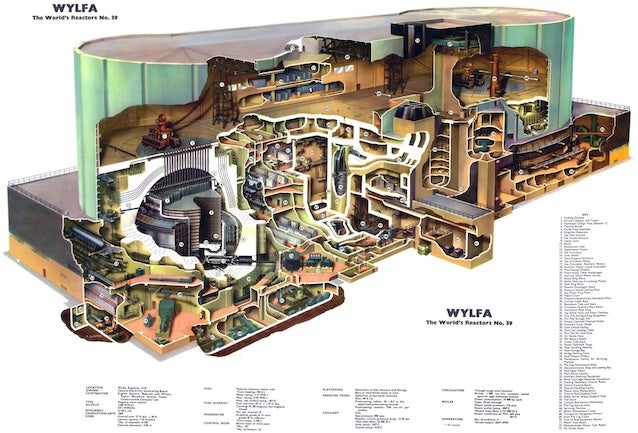
Given that the UK has a limited number of established nuclear sites the decision to use land around the existing Wylfa nuclear site for the first two Rolls-Royce SMR units is significant and indicative of the government engaging with the energy cluster concept. Wylfa was previously home to an NPP that was effectively co-located with an aluminium smelter.
“The theme that we have seen in the UK… is to look for private investment,” says Stuttaford, adding: “The UK Government has tried to send out the right policy message that it wants to see interest from the private sector.”
Nonetheless, where large-scale energy users can provide credible demand, governments can provide policy support, regulatory reform and, potentially, financial mechanisms such as contracts for difference, regulated asset base or public-private partnerships. Developers can provide the nuclear technology and project capability. Infrastructure investors can provide capital. The energy cluster brings those elements together around a physical development rather than as a separate project. AI and data centres provide the immediate catalyst because their electricity requirements are large, concentrated and growing rapidly but the underlying opportunity is considerably broader. If nuclear can be integrated into clusters supplying data centres alongside industrial users, renewable generation and flexible loads, the result could be a new class of energy infrastructure in which nuclear becomes the firm foundation around which an energy-intensive industrial ecosystem is built.
Nuclear’s traditional financing model treated the reactor as a stand-alone infrastructure project whose risks had to be absorbed primarily by government and utilities. The emerging model treats nuclear as one component of a larger industrial system, with the generator, customer, government and technology provider sharing risks and benefits. For an industry that has historically depended heavily on sovereign balance sheets, that could prove to be one of the most significant changes to have yet emerged in the nuclear financing landscape.


