
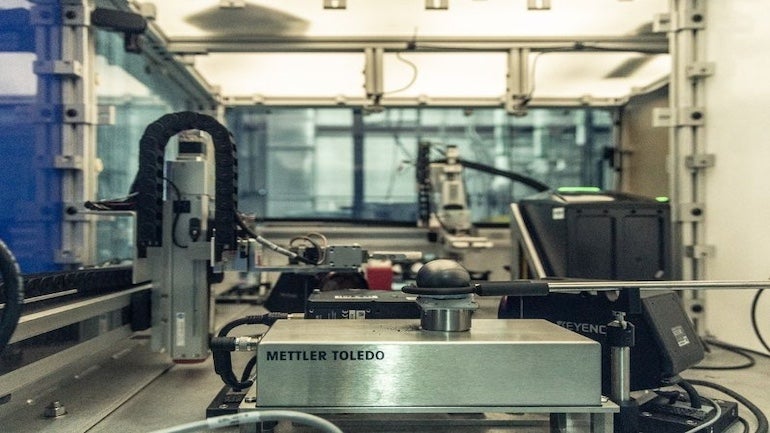
US-based Kairos Power has commissioned an automated fuel pebble quality control and tracking system at its Manufacturing Development Campus in Albuquerque, New Mexico. The system provides individual item accounting at scale for the spherical TRISO (tri-structural isotropic) fuel elements used in Kairos Power’s fluoride salt-cooled high-temperature reactor (KP-FHR) technology.
This addresses a challenge that the US Department of Energy’s (DOE’s) Oak Ridge National Laboratory (ORNL) explicitly designated as “unfeasible with current technology”. ORNL’s assessment was based on three primary engineering roadblocks inherent to pebble-bed reactors:
- Pebble-bed reactors operate using tens of thousands of moving fuel elements, making rapid, individual scanning logistically overwhelming.
- As pebbles circulate, continuous pebble-to-pebble friction inside the reactor core will scratch, degrade, or completely rub off surface-level markings.
- In addition, the high-radiation, high-temperature environment severely limits the effectiveness of traditional non-destructive assay and tracking methods.
However, by laser-engraving data matrix codes into the outer graphite matrix shell, Kairos Power has created a structural identity rugged enough to survive the mechanical friction of a circulating reactor core without damaging the sensitive TRISO fuel particles inside. The newly commissioned line automates a multi-step inspection and identification process which includes:
- Real-time quality control: The automated line verifies manufacturing specifications by checking each pebble’s diameter, geometry, and density in real time.
- Micron-level surface scanning: High-precision lasers scan the exterior of the fuel element to identify defects and assess its structural integrity.
- Laser engraving & identification: An infrared laser etches three redundant data matrix codes (QR-style codes) directly onto the pebble surface.
- Depth without damage: The markings are engraved 0.5 mm deep into the graphite surface. This provides a permanent identity that resists wear from pebble-to-pebble contact inside a circulating reactor core, notably doing so without compromising the structural integrity of the outer graphite shell.
The use of three redundant data matrix codes etched at different positions around the pebble’s spherical surface is the core design choice that enabled Kairos to overcome the material wear problems cited by ORNL.
The three codes are completely independent backups of one another. If mechanical friction, salt erosion, or pebble-to-pebble impacts scratch or scrape away one or even two of the codes during circulation, an optical scanner only needs to find and read one intact code to successfully log the pebble.
Data matrix codes natively use Reed-Solomon error correction mathematics. This allows an individual code to be fully decoded even if up to 30%–40% of its physical surface area is destroyed or obscured. Combined with three separate copies on the sphere, the probability of a pebble becoming unreadable drops drastically.
However, if a pebble suffers such extreme, uniform wear that all three data matrix codes become entirely illegible, the system includes a fail-safe mechanism. The system etches distinct geometrical markings or borders around the codes. Even if the unique serial ID data inside the matrices cannot be read, downstream optical sorting systems can use these surrounding physical shapes to at least identify the pebble type (such as distinguishing a fuel-bearing pebble from a solid graphite moderator pebble).
This multi-tiered approach allows the automated fuel handling systems to maintain continuous, individual accountability for the thousands of pebbles circulating through the reactor.
“By automating our quality control and laser-engraving processes in-house, we are building the foundational capabilities and traceability required to support our iterative approach to fuel development,” said Kirby Boone, a senior engineer on Kairos Power’s fuel team. “The fuel inspection and tracking system streamlines throughput and generates critical data to inform future manufacturing and handling systems for our reactors, from Hermes 2 to the commercial fleet.” The primary goals of implementing this automated system include:
- Material accountability – streamlining inventory control by allowing operators to trace thousands of individual pebbles through testing phases and active reactor operations.
- Data-driven engineering – generating continuous data on pebble wear and performance to inform the development of future commercial-scale manufacturing and fuel handling infrastructure.
- Iterative fuel development – enhancing throughput to support Kairos Power’s rapid prototyping approach as it moves closer to deploying its Hermes demonstration reactor series.
By developing automated inspection infrastructure in-house, Kairos Power can learn from each production campaign to improve manufacturing processes and build the foundational capabilities required for commercial-scale fuel production.
The automated system is currently processing pebbles to support upcoming hardware demonstrations, with a near-term target of 70,000 inspected pebbles for testing platforms that include Kairos’s second Engineering Test Unit (ETU). The same capability will support the future deployment of the Hermes 2 plant in Oak Ridge, Tennessee.
Kairos broke ground for the Hermes 1 Low-Power Demonstration Reactor and the Hermes 2 Demonstration Plant, at the East Tennessee Technology Park in Oak Ridge, Tennessee earlier this year. Hermes 1 and Hermes 2 are co-located advanced nuclear demonstration reactors. They use KP-FHR technology, combining TRISO fuel pebbles with a molten Flibe salt coolant to achieve robust inherent safety at low pressure. While they share the same basic architecture, they serve different roles in Kairos Power’s commercialisation timeline.
The purpose of Hermes 1 was to prove that the KP-FHR nuclear system functions reliably under real nuclear operations. Expected completion date is 2028–2029. Hermes 2 is the first-ever power-producing Generation IV reactor to receive an NRC construction permit. The plant consists of two 35 MWt reactor units that together will supply 50 MWe of electricity to the Tennessee Valley Authority (TVA) grid. Construction began in April with operation targeted for 2030.
These are supported by a series of three ETUs used to test components, train workers, and iron out construction flaws in a non-hazardous environment before loading live nuclear fuel. Each ETU has been built to systematically solve a different engineering challenge. ETU 1, built at Kairos Power’s manufacturing development campus in Albuquerque and now decommissioned focused on fluid dynamics and chemistry. ETU 2, also built in Albuquerque, focuses on modular manufacturing. ETU 3, built in Oak Ridge, focuses on civil construction and safety.
Kairos recently secured $643m in combined private and government financing to support construction of Hermes 2. This includes $368m from investors including Google Ventures and DCVC. Also, $275m in financing was secured from DOE, according to Kairos CEO Mike Laufer. An additional $70m was secured from Samsung C&T Corp under a partnership that was announced in September.


