
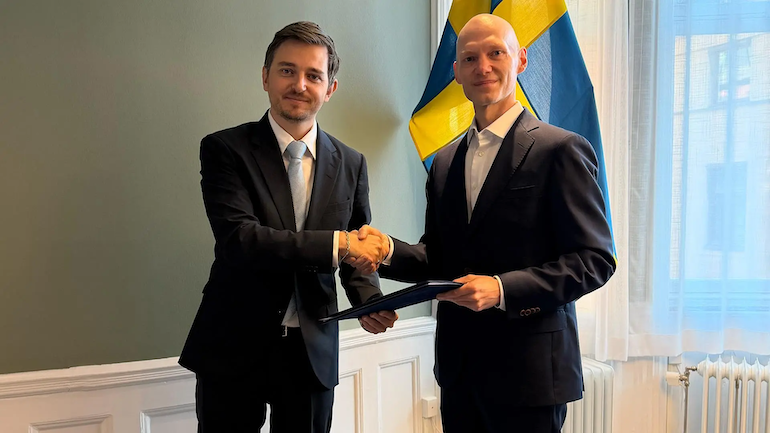
Fortum-owned project company NuCore Energi has submitted a state aid application to initiate discussions with the Swedish state on the framework and conditions required to advance a new nuclear power project in the municipality of Oskarshamn.
Sweden’s state aid framework is designed to support new nuclear power through a state loan, a two-way contract for difference (CfD), and a risk-sharing mechanism with the detailed terms that are to be agreed between the project company and the Swedish state. Any support would also need to be approved by the European Commission under EU state aid rules.
Under the framework, support can only be granted to companies focusing solely on building and operating new nuclear reactors. Forum’s application is therefore being submitted by a separate project company established for the purpose and dedicated to the potential new-build project.
This followed a two-year new nuclear feasibility study covering both small modular reactors (SMRs) and conventional large reactors. As part of the study conclusions announced in March 2025, Fortum announced its intention to enhance its collaboration with two large-scale reactor technology providers, EDF (the 1,650 MWe EPR – European Pressurised Reactor) and Westinghouse-Hyundai (the AP1000), as well as with one SMR developer, GE Vernova Hitachi (the BWRX-300).
Fortum and the selected companies formalised their collaboration by signing Early Works Agreements (EWAs) in June 2025. These will encompass early project planning, site and design adaptation, and targeted licensing and permitting activities, including the continuation of pre-licensing dialogue with Nordic nuclear safety authorities.
The final scope of the project progressed by NuCore Energi, currently ranging from 1,200 to 3,400 MWe, will depend on several factors including technology selection, benefits of building multiple reactor units, expected growth in electricity demand in Sweden, as well as risk-sharing between the project and the state. Over time, additional co-investors, including private investors and potentially the Swedish state, are expected to join the project. Fortum plans to reduce its ownership and eventually become a minority shareholder in NuCore Energi.
The continuation of the project is dependent on key conditions listed in the state aid application. These include, for example, customer offtake commitment for new power and continued long-term political support for nuclear power in Sweden. It also depends on NuCore Energi securing access to and control of the Ävrö site in the municipality of Oskarshamn. The land is currently owned by Oskarshamn Kraftgrupp AB, in which Fortum holds a significant ownership share.
NuCore Energi is the fifth company to apply for state aid under the new framework that has emerged since Sweden reversed its nuclear phase-out policy. Sweden had voted in a non-binding 1980 referendum to phase out nuclear power. Subsequently six of its 12 ageing reactors were shut down. The remaining six reactors generate about 30% of its electricity needs. However, in 2022, the new centre-right coalition government reversed this policy and since 2023, Sweden has completely overhauled its nuclear energy legislation, moving away from a 43-year phase-out policy to actively forcing a massive expansion of its nuclear sector.
Swedish parliament (Riksdag) has passed a series of major legal amendments designed to clear regulatory roadblocks, attract investors, and prepare for up to 10 new reactors by 2045. The Act amending the Environmental Code passed in November 2023 and enacted in January 2024 abolished the previous legal limit that capped nuclear at 10 simultaneous operational reactors. It also repealed the law restricting new builds to existing nuclear sites (Forsmark, Ringhals, and Oskarshamn) allowing reactors to be built in entirely new locations.
The Act on State Aid for Investments in New Nuclear Power, which took effect in August 2025, mitigates massive up-front capital risks for developers by formalising government financial backing. The legislative framework includes:
- State loans: direct government financing capped at the equivalent of four large-scale reactors;
- Contracts-for-Difference (CfD): a two-way price guarantee mechanism between the state and electricity producers to ensure stable revenue.
- Risk and gain-share mechanisms: guarantees for a minimum return on equity for private investors; and
- Political U-turn insurance: legal safeguards protecting investors from being financially penalised if future governments attempt to shut down plants early.
The government has allocated up to SEK400bn ($42bn) in credit guarantees and a SEK220bn 12-year loan package to finance projects up to a total initial capacity of 5,000 MWe.
“The Swedish Government’s nuclear power related policies, and the introduction of a comprehensive risk-sharing model provide a solid basis for enabling new nuclear in Sweden,” said Laurent Leveugle, CEO of NuCore Energi. “New nuclear power would strengthen energy security and improve long-term stability for the Nordic power system. It also supports industrial growth and delivers broader benefits for the Swedish economy.”
The other four state aid applications were from Videberg Kraft (established by Vattenfall but now owned by the government (60%, Vattenfall (20% and the Industrikraft i Sverige consortium (20%); private SMR company Blykalla; nuclear developer Studsvik (which acquired SMR project developer Kärnfull in March and manages these efforts through its ReFirm SMR programme); and independent energy developer Nordic Baseload Power (specifically set up in 2026 to capitalise on Sweden’s new legislation as a specialised division within Nordic Nuclear Energy).
Videberg Kraft has selected Rolls-Royce SMR technology to build three units on the Värö Peninsula near the existing Ringhals NPP following a rigorous evaluation of over 75 global suppliers. This is a 470 MWe generation III+ pressurised water reactor using standardised, factory-manufactured modules transported to the site to reduce field construction timelines. Videberg Kraft is targeting its first operational modular unit by the mid-2030s.
Blykalla is promoting its SEALER (Swedish Advanced Lead Reactor) – a generation-IV liquid lead-cooled fast reactor designed to produce 55 MWe per module (330 MWe total across a proposed six-reactor park). It utilises advanced materials to operate at high temperatures without requiring pressurised water containment, targeting high passive safety margins and the potential to utilise recycled nuclear fuel. The deployment framework focuses on a modular footprint across two strategic sites in east-central Sweden. The application for the first site (Norrsundet, Gävle Municipality): was submitted in May comprising a six-reactor park yielding 330 MWe. A second application in August was for Untra, Tierp Municipality requesting up to eight reactors with a combined electrical capacity of up to 440 MWe.
Studsvik is focuses broadly on an SMR Park Concept of up to 1,400 MWe. Studsvik leverages its existing technical engineering licensing footprint to evaluate a fleet approach of modular light-water reactors (such as the GE Hitachi BWRX-300 boiling water design). Studsvik has submitted two applications for state aid. Project company ReFirm Målma for Kärnfull Next in March proposed a campus of 4-6 SMRs totalling 1,200-1,600 MWe at Valdemarsvik. A second application made in May for Studsvik’s home research site in Nyköping targets 2-4 modular light-water reactors generating 600-1,400 MWe.
Nordic Baseload Power is focusing on large-scale conventional reactors. This project seeks traditional gigawatt-scale Generation III+ light-water reactors (such as the Westinghouse AP1000 or Framatome EPR) to deliver massive, concentrated base load directly to the southern Swedish grid zone. The proposed location is the Barsebäck site, where older reactors are currently being decommissioned. However, Uniper (the site landowner) has publicly stated they are not involved in this specific application and have no current plans to provide land to an external party.


