
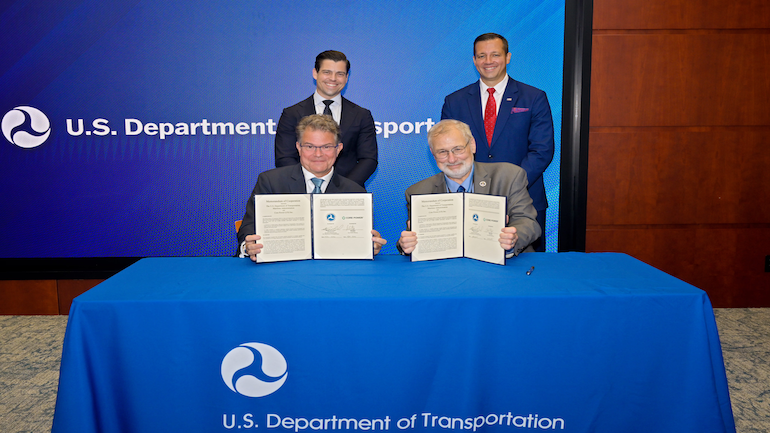
The US Maritime Administration (MARAD) and Core Power (US) have signed a memorandum of cooperation (MOC) to build a fleet of US-flagged nuclear-powered merchant ships. The framework aligns with President Donald Trump’s Maritime Action Plan to revive domestic shipbuilding, reverse industry decline, and counter China’s advancements in nuclear commercial shipping. It also follows MARAD’s recent Request for Information for a commercially viable, system-centric approach to nuclear power in the US marine transportation system. Core Power is targeting first construction from 2028.
The goal of MOC is to turn policy into an actionable commercial pathway. It creates a forum for government, industry and other stakeholders to work through regulatory acceptance, port operations, workforce credentialing, fuel and lifecycle services, insurance and finance, industrial capacity and potential federal demand structures. Reducing uncertainty across these areas will enable private capital to commit to ships, yards and supporting infrastructure.
Core Power plans to develop a dedicated US nuclear-grade integration and lifecycle shipyard for nuclear installation, initial fuelling, testing, commissioning, refuelling, defueling and through-life support, while conventional hulls and marine systems are built at commercial shipyards in South Korea and Japan. Core Power intends to leverage allied shipbuilding capacity to accelerate conventional hull construction while building the specialist nuclear integration and lifecycle capability in the US.
Instead of trying to outcompete China’s massive manufacturing output by building standard commercial vessels from scratch in the US, this approach leverages geopolitical alliances deploy the new fleet. Traditional US commercial shipyards currently lack the scale, modern infrastructure, and capacity to build large merchant hulls at speeds or volume. The framework offloads standard hull fabrication and conventional marine engineering to premier shipyards in Japan and South Korea.
While hulls are built abroad, the nuclear technology, fuel, and installation processes remain strictly within US borders. The dedicated US nuclear-grade integration facility handles sensitive lifecycle tasks: nuclear reactor installation, initial fuelling, system commissioning, mid-life refuelling, and end-of-life defueling. This ensures strict compliance with US civil nuclear regulations and keeps the technology protected from global industrial espionage.
A site for the US nuclear shipyard site has not yet been determined. However, the Port of Corpus Christi Authority in Texas recently signed an agreement with Core Power to study regional readiness for hosting this type of maritime nuclear technology. Concurrently, the Trump administration has designated the Port of Long Beach in California as the first US testing area for nuclear-powered commercial vessels.
While Core Power acts as the master maritime nuclear systems integrator with MARAD as federal coordinator, Core Power has launched technical studies and partnerships with major US nuclear firms such as BWX Technologies (BWXT) and naval architects Glosten with respect to the nuclear technology.
Core Power proposed using light-water reactors (LWRs) to speed up deployment. The light-water small modular reactors (SMRs) for this project will be supplied and built BWXT. Core Power launched a feasibility study to assess and integrate BWXT’s mPower SMR – a 195 MWe / 575 MWt advanced, pressurised LWR design. While BWXT manufactures the reactor components, the delivery of the complete propulsion system relies on a collaborative framework. Core Power will oversee the systems engineering, regulatory assessments, and the overarching techno-economic analysis required to transition the reactor from a land design to a floating system.
Naval Architects Glosten will physically design how the BWXT reactor fits inside the vessel’s hull architecture. The final physical assembly – dropping the BWXT-built reactor into the allied-constructed hulls and completing initial fuelling will take place at the newly planned specialised US nuclear integration shipyard.
As to finance, the $200m capital for the project is privately driven, leveraging investments from major Japanese conglomerates including Mitsui, Mitsubishi, and Sumitomo. Currently Japanese companies collectively hold a majority ownership stake Core Power through a consortium of 13 Japanese companies. The holdings inside the company were built primarily over two major strategic financing rounds.
A block of Japanese maritime and heavy industrial giants anchored specifically by Onomichi Dockyard and Imabari Shipbuilding first injected $80m to take the lead ownership position. The more recent capital injection linked to the MARAD expansion was anchored by the trading houses Mitsui, Mitsubishi, and Sumitomo.
The holdings grant the Japanese consortium significant influence over the company’s corporate governance and strategic direction. The equity is explicitly tied to future industrial agreements. When and if commercial rollout begins, investors’ subsidiaries hold first-right contracts for hull fabrication, heavy engineering, and global shipping logistics.
The initial $200m is not being spent on buying uranium or building ships but on expensive paperwork, design and port feasibility studies. While normal venture capitalists look for quick returns, these Japanese conglomerates operate on decades-long horizons and are uniquely capable of funding this highly speculative, pre-construction phase.
However, the project is not straightforward. No modern framework exists for licensing a privately owned, commercial nuclear cargo vessel in the US. MARAD and Core Power aim to serve as direct intermediaries with the Nuclear Regulatory Commission (NRC) and international maritime bodies to design standard, reproducible licensing and safety baselines.
Private insurers cannot price the risk of a commercial nuclear accident, and civilian fuel loops for marine SMRs do not exist. The forum plans to aggregate government experts and underwriters to structure maritime insurance pools and secure a stable, legally compliant nuclear fuel supply chain.
Investors fear the fleet will fail to secure contracts if competing against cheap, high-emission fossil-fuel ships. MARAD is therefore exploring federal demand structures such as guaranteed government cargo contracts or military logistics backup roles to ensure the fleet has high-utility, revenue-generating routes
Merchant mariners are not trained to operate nuclear reactors, creating a severe operational bottleneck. To tackle this, the framework maps out standardised civilian training and credentialing programmes to produce certified personnel to operate the ships and run the dedicated lifecycle shipyard.
“China is already moving toward nuclear-powered commercial shipping. That should focus minds in Washington. America does not regain maritime strength by building a better version of yesterday’s ship,” said Core Power founder and CEO Mikal Bøe. “We are not asking for another study. Core Power is targeting first construction starts from 2028. Government can set the direction and coordinate; private industry must move the money and the steel.”
However, the 2028 target is highly aggressive and faces major structural obstacles. To make the 2028 window remotely possible, the plan relies on splitting production. Highly automated shipyards in Japan or South Korea could easily begin bending steel and welding standard cargo hulls by 2028 but those hulls cannot become nuclear ships until the US infrastructure is built to receive them.
The NRC has never licensed a commercial, privately owned marine reactor for merchant trade. Even with land-based SMRs, the regulatory review, safety audits, and public comment phases take 3-5 years. Pushing a specialised marine SMR design through the NRC by 2028 is a near impossibility.
The planned US nuclear-grade integration facility is starting entirely from scratch. The project is only in the “feasibility study” phase with regional hubs like the Port of Corpus Christi. Even if site selection is finalised by 2027, the environmental permitting, specialised heavy-crane installation, and nuclear-grade security infrastructure required to build a shipyard takes years.
A realistic timeline for this specialised US nuclear integration shipyard places full operational readiness around 2033 to 2035. When factoring in real-world nuclear regulatory and heavy industrial construction phases, a logical timeline unfolds over three distinct stages.
Phase 1: Planning and Approvals (2026 – 2029) – In 2026–27, Core Power, MARAD and regional entities like the Port of Corpus Christi complete initial infrastructure, safety, and port-microgrid feasibility assessments. In 2027–2028 the final location is chosen, and applications are submitted to NRC. Securing early environmental permits, public reviews, and NRC structural approvals typically takes a minimum of 2-3 years for any new civil nuclear site.
Phase 2: Shipyard Construction & Tooling (2029 – 2033) – 2029–2031: Civil & marine construction takes place in 2029-31 including deepwater dredging, building dry docks, and laying massive concrete foundations capable of handling heavy-lift machinery. 2031–2033 will see installation of high-security fuel storage areas, advanced diagnostic labs, radiation monitoring networks, and specialised heavy cranes designed to lower completed SMR modules safely into waiting ship hulls.
Phase 3: Integration (2033 – 2035): The conventional merchant hulls, begun in highly automated Japanese or South Korean yards around 2028, arrive in the US in 2033-34 as empty, non-nuclear platforms. The BWXT mPower reactors are installed, fuelled, and run through active, high-power system testing in 2034-35. Following extensive safety sign-offs, the first US-flagged commercial nuclear ship officially enters regular service.
Announcing its framework, Core Power hedges its bets with attached “notes”. These say the MOC is non-exclusive. It is not a procurement contract, grant or commitment of federal funds, nor does it commit MARAD to acquire any vessel, technology or service. “First construction from 2028 is a Core Power target and is not a MARAD commitment. Timing remains subject to regulatory, commercial, project and industrial readiness.”


