
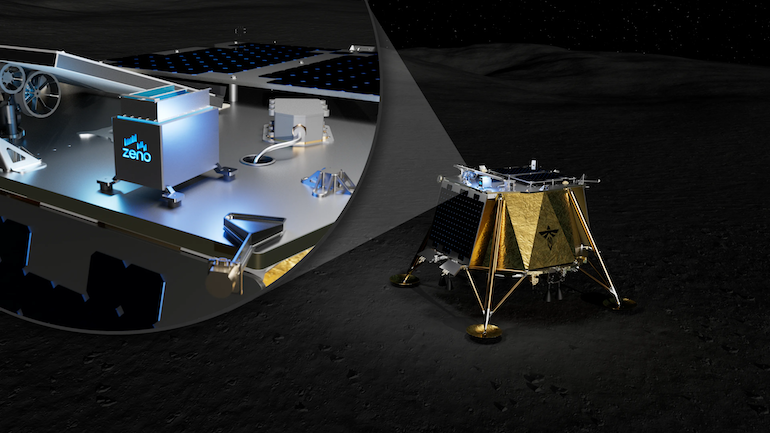
Zeno Power Systems is to deliver its Survive-the-Night Package with a Radioisotope Heater Unit (RHU) on a mission to the Moon’s near side, following a commercial payload agreement Firefly Aerospace. The mission, scheduled to launch no earlier than 2028, will demonstrate Zeno’s technologies designed to enable spacecraft, lunar infrastructure, and future Moon Base systems to operate through the extreme cold and prolonged darkness of the 14-day lunar night.
“Our first Blue Ghost mission gave us firsthand insight into the Moon’s extreme thermal environment, where we measured temperatures ranging from more than 230°F during the lunar day to below -275°F at night, said Ray Allensworth, Vice President of Spacecraft at Firefly Aerospace. “Now we’re looking forward to advancing technologies that can extend missions beyond sunset and support long-duration surface operations required for NASA’s Moon Base initiative and the growing lunar economy.”
Zeno’s Survive-the-Night Package will be on board one of Firefly’s Blue Ghost mission returning to the Moon’s near side as part of NASA’s Commercial Lunar Payload Services (CLPS) initiative. Upon landing, Blue Ghost will first operate multiple NASA CLPS payloads using solar power for the full lunar day, equivalent to approximately 14 Earth days. Zeno’s payload will then operate during the lunar night and transmit operational data back to Earth.
Zeno’s payload is comprised of a 5-Watt thermal americium-241 (Am-241) RHU and dedicated platform that includes structural, communications, electrical power, command and data handling, and thermal management subsystems. The RHU generates passive thermal energy through the natural decay of radioactive material, providing continuous heat without relying on solar power. The lightweight, compact system is designed to keep critical spacecraft components operational during the frigid lunar night, as well as within permanently shadowed regions that never receive direct sunlight.
Rather than just selling a single component, Zeno is delivering an integrated platform built to address the catastrophic thermal issues that have ended many commercial lunar missions Zeno is shifting away from plutonium-238 (Pu-238 – the expensive, highly regulated fuel traditionally used by NASA – in favour Am-241, a chemical byproduct of plutonium decay. This is vastly easier and more cost-effective to source for commercial operations.
Am-241 boasts a 432-year half-life, guaranteeing passive heat generation that outlives any realistic spacecraft timeline.
Zeno is not just putting fuel on the lander. They have engineered a completely self-sufficient subsystem that operates independently from the main spacecraft. The payload includes its own structural cage & containment, command & data handling, independent telemetry & comms and thermal management.
A high-density, impact-resistant shell safely isolates the radioisotope fuel during violent launch, transit, and landing stresses. A dedicated onboard computing monitors system health. Integrated transmitters are designed to bypass the lander’s core systems to send proof-of-survival signals directly back to Earth during the freeze. Passive thermal control loops funnel the exact 5-Watt heat output directly into freezing battery bays and critical components.
Zeno’s system targets the two primary problems facing spacecraft – battery rupture and thermal fatigue. Standard lithium-ion batteries suffer permanent chemical death and freeze solid below -20°C. Zeno’s heat loops keep batteries warm enough to retain their charge capacity. Rapid transitions to extreme cold cause metals to warp and contract violently, snapping structural welds and tearing vacuum seals. Continuous radioactive decay keeps the local structure stable, eliminating this stress.
According to Zeno’s CEO Tyler Bernstein, the US commercial sector is currently playing catch-up. China’s Chang’e-4 lander previously proved the viability of using atomic heater units to successfully survive multiple consecutive lunar nights. By flying this payload on Firefly’s Blue Ghost lander, Zeno plans to transition from a prototype designer to a mass-manufacturer of nuclear space hardware. This test serves as their commercial stepping stone toward building larger Radioisotope Power Generators (RPGs) capable of converting atomic heat into grid electricity for NASA’s upcoming Moon Base Program.
“Hardware capable of surviving the extreme cold of the lunar night will be essential to enabling sustained operations on the Moon,” said Bernstein. “NASA’s Moon Base Program has identified the need for technologies such as radioisotope power systems to support future lunar exploration, and Zeno is proud to answer that call to demonstrate this capability aboard Firefly’s Blue Ghost mission. As demand for long-duration lunar infrastructure grows, we are building the production capacity to support future commercial and government missions.”
This demonstration on Blue Ghost will provide critical data to advance radioisotope and nuclear-powered technologies for future robotic and human lunar missions requiring extended operations beyond sunset.


