
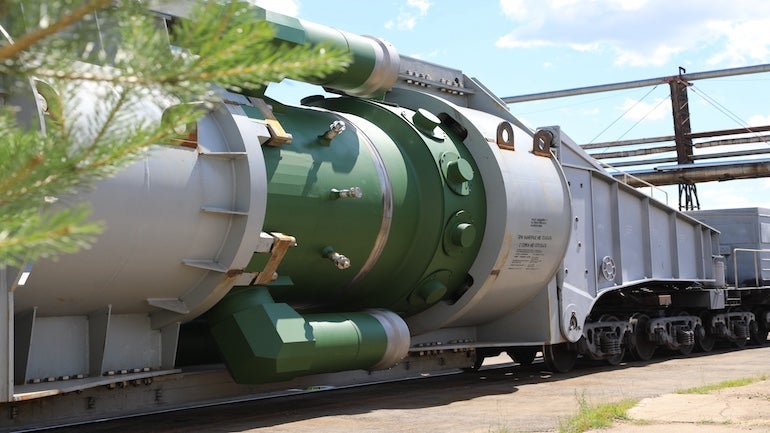
The second RITM-200 reactor for Russia’s Leningrad icebreaker has been completed at Rosatom’s ZiO-Podolsk plant near Moscow Rosatom noted that the construction of any nuclear icebreaker is an extraordinary event in itself. “But the construction of Leningrad is of particular importance. It was no coincidence that the icebreaker received its name in honour of the hero city. In 2024, when the whole country celebrated the 80th anniversary of the lifting of the siege of Leningrad, veterans and blockade survivors took the initiative to name the newest nuclear icebreaker after the Northern capital. And the President of the Russian Federation supported this.”
Rosatom continued: “Last year we resumed the tradition of assigning proper names to special reactor plants. The reactor installations of the future nuclear icebreaker Rossiya were named Ilya and Dobrynya – in honour of the Russian heroes. This year, after consulting with veterans and blockade survivors, we jointly decided to assign the names Iskra and Grom to the Leningrad reactors – in honour of the military operations, thanks to which it was possible in 1943-1944 to first break through the blockade ring, and then completely liberate besieged Leningrad.”
Symbolism often goes hand in hand with advanced technology, Rosatom said. “In the next 40 years, our RITM-200 reactor plants will perform the strategic task of breaking through multi-metre ice as part of the most powerful icebreaker in the world, ensuring uninterrupted navigation of ships along the Northern Sea Route and forming a reliable transport frame for the most important logistics artery of our country.”
Rosatom’s mechanical engineers gave unofficial comical names to the first RITMs. These were names that reflected how the reactor plants behaved during assembly – Affectionate, Grumpy and others. In 2025, the new RITM-400 reactor plants for Rossiya were given official names for the first time – Ilya Muromets and Dobrynya Nikitich.
Currently, 13 small reactor plants for nuclear icebreakers and small NPPs are at various stages of production. This is a record for Russia’s nuclear industry. Several enterprises of Rosatom’s Mechanical Engineering Division are involved. In St Petersburg the metallurgical blanks are produced for the future reactor plants. In Nizhny Novgorod the internal devices for RITMs are being developed. The designer, overall supplier and manufacturer of internal devices for the RITM-200 and RITM-400 reactor units is OKBM Afrikantov. The production of the reactor vessels and control assemblies are carried out at ZiO-Podolsk.
In addition to the icebreaker fleet, reactor units of the RITM series will be used in small nuclear energy projects Rosatom is constructing in Yakutia and Uzbekistan, and in floating power units developed to supply power to remote areas with access to sea.
The Leningrad icebreaker is being built at the Baltic Shipyard (Baltiysky Zavod) in St Petersburg. It is the sixth vessel belonging to the Project 22220 design series, representing the largest and most powerful nuclear icebreakers in the world. The ship’s keel was laid down in January 2024. As of mid-2026, construction is roughly 31% complete, moving slightly ahead of its initial schedule. The ship is planned to be commissioned and delivered to the Arctic fleet by December 2028. RITM reactors are already operating on new generation icebreakers (project 22220) Arktika, Ural, Sibir and Yakutia. Three more nuclear-powered ships of the same project are under construction – Chukotka, Leningrad and Stalingrad.
In 2018, the Russian Government vested Rosatom with the powers of an infrastructure operator for the Northern Sea Route (NSR). The corporation oversees the federal project Development of the Northern Sea Route, and is involved in implementing the development plan for the NSR to 2035 as well as the initiative for the socio-economic development of the Russian Federation to 2030, Year-round Northern Sea Route. One of Rosatom’s strategic goals is to make the NSR an effective transport artery connecting Europe, Russia and the Asia-Pacific region. In December 2024, a federal project for development of the Great Northern Sea Route – a transport corridor from St Petersburg and Kaliningrad to Vladivostok – was approved.


