
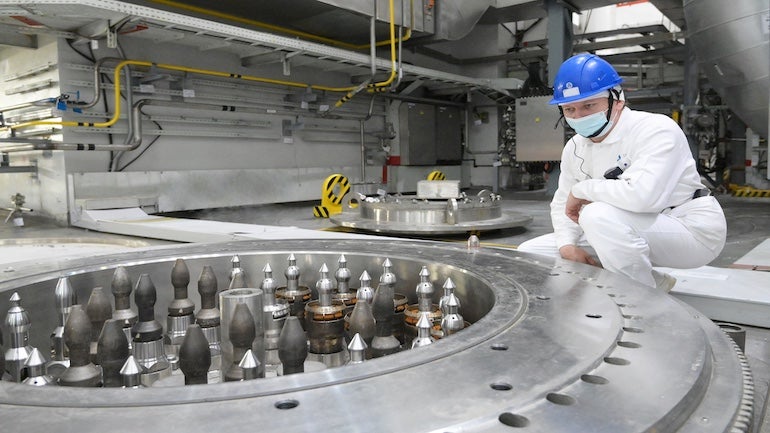
The world’s first programme of pilot operation using uranium-plutonium mixed oxide (mox) fuel with the addition of minor actinides has been completed at the BN-800 fast neutron reactor at unit 4 of Russia’s Beloyarsk NPP. Minor actinides are the most radiotoxic and long-lived components contained in used nuclear fuel.
Three pilot fuel assemblies containing americium-241 and neptunium-237 were loaded into the reactor core in the summer of 2024 and successfully completed the operational cycle during three fuel micro-campaigns. After cooling in the used fuel pool, the irradiated assemblies will be sent for post-reactor studies.
Recycling of minor actinides through afterburning in power reactors is key to the development of fourth generation nuclear energy. Minor actinides are a group of transuranium elements that are formed in nuclear fuel during reactor operation. They include neptunium, americium, and curium and do not occur in nature but arise only from nuclear reactions. They represent only a small share in the mass of irradiated fuel, but make a disproportionate contribution to its radioactive toxicity and residual heat generation. Isotopes of minor actinides are very long-lived (half-lives are hundreds of thousands of years), and it is their presence that determines the timelines and conditions for isolating waste from the environment.
Russia, as part of the closure of the nuclear fuel cycle, already has experience in re-using regenerated uranium and basic actinide plutonium in the nuclear fuel cycle. However, it is the separation from used nuclear fuel and subsequent disposal of minor actinides that can solve the main environmental problems of radioactive waste management. Getting rid of minor actinides will make it possible to achieve radiation equivalence of the original uranium feedstock in nuclear waste hundreds of times faster. In the future, this will significantly reduce the volume and range of radioactive waste requiring deep geological disposal.
The most efficient way to dispose of minor actinides is burning in a reactor. In Russia technologies are being developed that make it possible to burn minor actinides in several ways. Fast neutron reactors are especially suitable for this. Through transmutation they become more stable or short-lived isotopes. Russia has extensive experience with fast reactors. As well as the BN800, which began operation in 2016, the BN600 at unit 3 of the Beloyarsk NPP has been in operation for more than 40 years. In addition, the first serial production high-power fast reactor, the BN-1200M is planned for construction at unit 5 of the Beloyarsk NPP.
“Burning minor actinides in a reactor is not a one-time operation, but a long-term strategy,” said Alexander Ugryumov, Senior Vice President for Scientific & Technical Activities at JSC TVEL (the parent company of Rosatom’s Fuel Division). “Before translating this solution into an industrial scale, we demonstrate the technological feasibility that this idea works. At the next stage, we intend to increase the content of minor actinides in pilot assemblies with mox fuel. In addition, we plan to add minor actinides to high-density uranium-plutonium nitride (SNUP – Smeshannoe Nitridnoi Uran-Plutonievoe) fuel for fast reactors, as well as to test heterogeneous burning of minor actinides. In this case, minor actinides will not be mixed into uranium-plutonium fuel, but are placed in separate fuel rods or separate assemblies that will be installed in certain areas of the reactor.”
Beloyarsk NPP Director Yuri Nosov noted: “We expect that the amount of minor actinides included in the fuel will be significantly reduced, but this must be confirmed by further post-reactor studies. The research results will confirm the concept of minor actinide burning technology and determine its role and weight in a balanced fuel cycle. It is expected that this will help reduce the amount of radioactive waste sent for final isolation by tens of times. As part of the Balanced Nuclear Fuel Cycle, Generation IV power units will help improve the environmental friendliness and energy potential of nuclear energy, allowing irradiated fuel to be used instead of stored. Over approximately 60 years of operation, this will use about four tonnes of minor actinides – this is more than is produced in several thermal reactors.”
The mox fuel qualification programme with minor actinides is carried out in strict coordination with the Federal Service for Environmental, Technological & Nuclear Supervision (Rostechnadzor), which confirmed the safety of operation of innovative assemblies. Experimental mox assemblies containing minor actinides were manufactured at the Mining & Chemical Combine (GKhK – Gorno Khimicheskii Kombinat) in Zheleznogorsk.
In addition, a research liquid salt reactor is currently being created at GKhK at the Gas Chemical Complex, which will make it possible to develop the technology for recycling minor actinides on an industrial scale. Industrial technology for the extraction and separation of minor actinides from used fuel was developed by scientists from the AA Bochvar Research Institute of Inorganic Materials (VNIINM) in Moscow. Also, Bochvar scientists, together with the State Chemical Complex, created the technology for incorporating neptunium and americium into uranium-plutonium mox fuel tablets.


