
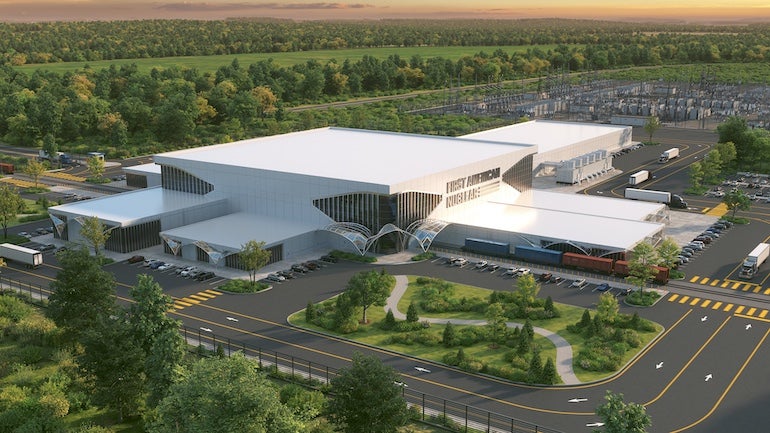
US start-up First American Nuclear (FANCO) has submitted its Regulatory Engagement Plan (REP) to the US Nuclear Regulatory Commission (NRC) for its EAGL-1 fast-spectrum small modular reactor (SMR). This officially begins the pre-application phase, providing a roadmap for technical reviews and topical report submittals that pave the way for an eventual construction permit.
EAGL-1 is a 240 MWe/600 MWt liquid-metal fast reactor (LMFR) and is the only US design currently using lead-bismuth cooling technology. It is designed for clustered deployment to maximise economies of scale while maintaining a footprint ten times smaller than traditional plants. The reactor is designed to use multiple fuel types, including uranium oxide (UO2), mixed oxide (mox), recycled uranium, and transuranic (TRU) fuels.
FANCO’s plan outlines a disciplined schedule of technical interactions to streamline the licensing process. Submittals of white papers and topical reports beginning later this year will cover critical topics such as functional containment, fuel qualification, and lead-bismuth thermal hydraulics.
The company has scheduled monthly calls with NRC project managers and biweekly technical meeting. An electronic reading room will be established to give the NRC secure access to design specifications and test data without overwhelming the public docket.
“FANCO designed EAGL-1 to be licensed under the NRC standards that have kept us safe for decades,” said CEO Mike Reinboth. “This country can’t afford to wait; we need a credible pathway to nuclear now and that is FANCO’s mission.”
FANCO’s technology has benefitted from significant Department of Energy (DOE) support. A DOE Advanced Reactor Demonstration Program (ARDP) development grant for the EAGL-1 was awarded in December 2020 to a consortium that included the designers of the technology. At this stage, it was a technical development project that was part of the Advanced Reactor Concepts-20 (ARC-20) pathway. The award was part of a selection of industry-led projects designed to support innovative designs in their earliest phases. These awards typically ($20-30m) were for initial technical and regulatory development and required a 20% private-sector match.
This funding enabled the team to complete the pre-conceptual engineering required for the EAGL-1 reactor and begin the formal engagement process with the NRC. In early 2025, First American Nuclear was officially incorporated and launched as a “customer-centric” start-up to commercialise the research and to house the intellectual property, manage the federal grants, and attract private venture capital.
Subsequently a formal review was conducted by the Pacific Northwest National Laboratory (PNNL) under a DOE GAIN (Gateway for Accelerated Innovation in Nuclear – PNNL-28013) programme voucher announced in January 2025. This provided FANCO with direct access to the specialised expertise and technical facilities at PNNL to evaluate the licensability of the EAGL-1 reactor design.
The review concluded that the EAGL-1 design is licensable under existing NRC criteria without the need for new rules or novel regulatory frameworks, provided further design development and analysis are completed. As part of the award, FANCO was responsible for a minimum 20% cost-share, which is standard for GAIN recipients.
Additionally, FANCO is building a lead-bismuth test loop that will provide the NRC with unequivocal, real-world performance data, rather than relying solely on models and historical analysis. While advanced nuclear designs often depend on digital simulations, FANCO is using this physical facility to provide empirical data that directly addresses one of the primary historical concerns with lead-cooled technology – material erosion and corrosion.
The loop will be used to validate proprietary thermal-hydraulic calculation codes, proving that the real-world flow and heat transfer of the lead-bismuth alloy match FANCO’s digital predictions. The loop will demonstrate that the reactor can transition from forced to natural circulation to remove decay heat entirely passively without operator intervention or electrical power. Data from the test loop will directly support several Topical Reports planned in the REP, specifically those concerning lead-bismuth thermal hydraulics and principal design criteria.
As of April 2026, FANCO is developing the facility, which is intended to run in parallel with the NRC’s pre-application review. FANCO is collaborating with Purdue University for testing support and technical facilities under a November 2025 memorandum of understanding. Purdue provides the analytical support needed to validate FANCO’s proprietary safety codes, utilising their PUR-1 reactor for related instrumentation and control (I&C) research.
The FANCO design separates EAGL-1 and its core safety systems from the balance of plant (BOP) power conversion block, which includes the turbine, generator, condenser, and condensate systems. The BOP will comprise entirely commercial off-the-shelf systems, which can be sourced from established industrial suppliers. This proprietary system, called Bridge Power, will let FANCO construct and commission the BOP using conventional commercial package boilers while EAGL-1 is under NRC review.
The power conversion structure will begin generating gas power in the short-term, then seamlessly transitions to nuclear when licensing is complete. Bridge Power is designed to meet customers’ immediate energy needs, provide an early revenue stream that eases project financing, and reduce supply chain risk by front-loading procurement of equipment that will be used by both gas and nuclear systems.
In November 2025, FANCO announced plans to establish Indiana as the company’s headquarters, manufacturing facilities, and an energy park. The energy park is designed to be the first in the US to operate in a “closed-fuel cycle”, meaning it will reprocess and reuse used nuclear fuel on-site. FANCO is also proposing a scheme to transform existing coal plants to natural gas and, ultimately, to nuclear power using the same workforce and minimal changes to equipment. FANCO has engaged AtkinsRéalis as primary architect-engineer.
While FANCO’s headquarters is in Carmel, Indiana, much of the early R&D and testing capability is tied to their secondary office and facility in Richland, Washington. FANCO is a member of the Nuclear Energy Institute (NEI), participates in the DOE Defense Protection Act Fuels Consortium and Fast Reactor Working Group.
According to the FANCO website, the company’s team “supported some of the most advanced reactor projects in US history and abroad, from liquid-metal fast reactors to next-generation fuel cycle systems”. The team’s track record “spans the Fast Flux Test Facility, the Global Nuclear Energy Partnership, the Advanced Reactor Concepts programme, and early studies for the Versatile Test Reactor (VTR)”. FANCO claims: “With EAGL-1, we’re translating that experience into a commercially ready solution.”
The website notes: “Using safe and benign lead-bismuth coolant, EAGL-1 takes packaged power plant systems and combines them with a compact low-pressure fast reactor design”…. The streamlined design of EAGL-1 eliminates the need for costly intermediary systems and containment vessels and reduces mechanical complexity while improving overall system reliability.”
However, the world’s only operating lead-bismuth-cooled fast reactors were developed in the 1960s by the Soviet Union. These reactors powered the Alfa-class submarines, which were operational from the 1960s until the 1990s. Use of the reactors was discontinued because of issues such as lead bismuth solidification, corrosion, and the generation of polonium-210. They were decidedly not “benign”.
As to US experience with fast reactors, it was discontinued in the mid-1990s. The EBR-II (Experimental Breeder Reactor-II) was a sodium-cooled fast reactor that operated from 1964 to 1994 at Argonne National Laboratory. The FFTF operated from 1982 to 1992 to test various aspects of commercial reactor design and operation. It was also cooled using liquid sodium, not lead-bismuth. The VTR was a planned DOE project to build a high-flux, fast-neutron test reactor but the project’s funding was cancelled.
Development of a lead-bismuth-cooled fast reactor will require the development of special metals and materials to overcome the problems encountered by the Alpha submarines. Moreover, bismuth is not widely available. Global production is dominated by a few countries, primarily China, which refines most of the world’s bismuth. Other countries have largely ceased their own refining operations.


