
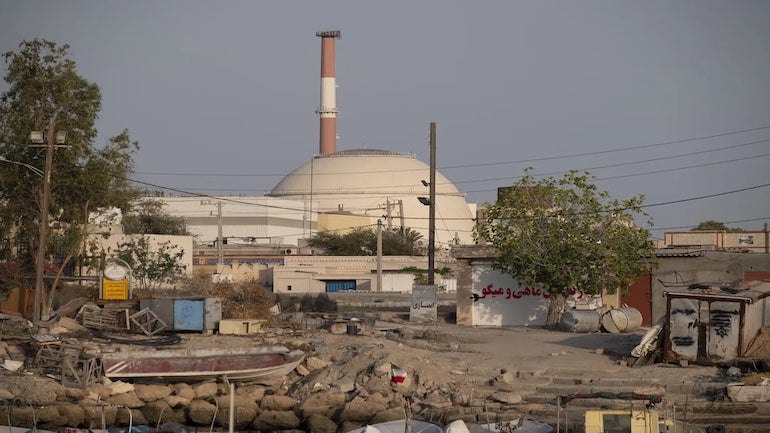
Following a fourth reported missile strike on the site of the Bushehr NPP since the start of US- and Israeli-led military operations against Iran on 28 February, the Russian Ministry of Foreign Affairs (MFA) has expressed concern over the potential risks. “Of particular concern are the repeated reckless attacks on the Bushehr nuclear power plant, which have resulted in human casualties. The shadow of a radiological catastrophe, more devastating than the Chernobyl disaster, looms over the Persian Gulf region and the surrounding part of Eurasia,” the ministry’s website stated.
The Atomic Energy Organisation of Iran (AEOI) reported that, as a result of the blast wave and fragments, one of the auxiliary buildings of the nuclear power plant was damaged and one of the employees of the station’s physical security department was killed. International Atomic Energy Agency (IAEA) Director General Rafael Gross, in a post on X, expressed deep concern over the shelling near the NPP and again called on all parties to exercise maximum military restraint to prevent a nuclear accident.
In letters addressed to the UN Secretary General Antonio Guterres, and the members of the Security Council, Iranian Foreign Minister Abbas Araghchi stated that the attacks on Iranian nuclear installations happen regardless of the fact that these facilities are devoted exclusively to peaceful purposes and are operating under the IAEA’s comprehensive safeguards regime.
“These unlawful attacks expose the entire region to the risk of radioactive contamination with grave humanitarian and environmental consequences, and as such shall not be left unattended,” the letters read.
Araghchi pointed out that Iran has experienced two significant military confrontations within the span of nine months, involving the US, a depository of the Treaty of the Non-Proliferation of Nuclear Weapons (NPT), and Israel, which remains outside the framework of the NPT.
He noted that Iran’s nuclear facilities were attacked and bombed in both instances, and with grave disappointment, the United Nations Security Council, the IAEA Board of Governors and its director general have flatly failed even to condemn the attacks, let alone undertake effective measures within their mandate to prevent their recurrence.
“Now the US Senior officials, who label international humanitarian law as ‘stupid,’ have gained the audacity to state that nuclear facilities are among their targets,” the Iranian foreign minister wrote. He stated that the US permanent representative to the United Nations has openly expressed that attacks against the Bushehr nuclear power plant are “not off the table”.
“Such recklessness is the direct consequence of the inaction of the United Nations and the agency regarding the manifest acts of aggression by the United States and the Israeli regimes, which have only emboldened the aggressors. This course of unlawful attacks inflicted an irreparable blow upon the credibility of the United Nations, the Security Council, the IAEA, and its safeguards system,” Araghchi stated.
“The aggressors’ repeated strikes in the vicinity of the active nuclear power plant in Bushehr is extremely alarming; their proximity to an active nuclear facility constitutes an intolerable escalation entailing a grave risk of radiological release,” Araghchi said.
Rosatom Director General Alexei Likhachev said 198 Russian staff had been evacuated from the Bushehr plant following the latest attack. “As planned, we began the main wave of evacuations today, about 20 minutes after the ill-fated strike. Buses departed from the Bushehr station toward the Iranian-Armenian border – 198 people, to be exact – the largest wave of evacuation – are on the buses.”
Rosatom has been evacuating staff from the plant since conflict in the region began. The latest evacuation had been planned before the attack. “Naturally, travel routes will be communicated to the competent authorities of both Israel and the United States through all channels. We will ask for maximum compliance with the silence regime while the columns are moving,” he added.
Rosatom expressed gratitude to Iran and Armenia for their assistance in evacuating specialists from the plant: “I want to express two more thanks. Gratitude to the Iranian government, our partners, Iranian nuclear scientists, and the Armenian government for previous evacuations, because we carried out this work across the Iranian-Armenian border.”
The first unit of the Bushehr nuclear power plant continues to operate, and a number of employees will remain at the site. “We need to maintain the functionality of both the construction site and the residential town and, of course, assist Iranian partners in operating block number one, but these will be volunteers, this will be a very limited number of people,” Likhachev said.
Russia is assisting with the construction of units 2&3 at the Bushehr NPP, where the first unit with a 915 MWe VVER reactor has been in operation since 2011. Construction of the Bushehr NPP began in 1975 with a West German company but stopped in 1979 after the start of the Islamic revolution. In 1992, Russia and Iran signed an agreement to continue construction of the station using Russian VVER-1000 technology. Unit 1 was officially transferred to Iran in September 2013. First concrete for unit 2 was poured in 2019 and the core catcher was installed in 2024.


