
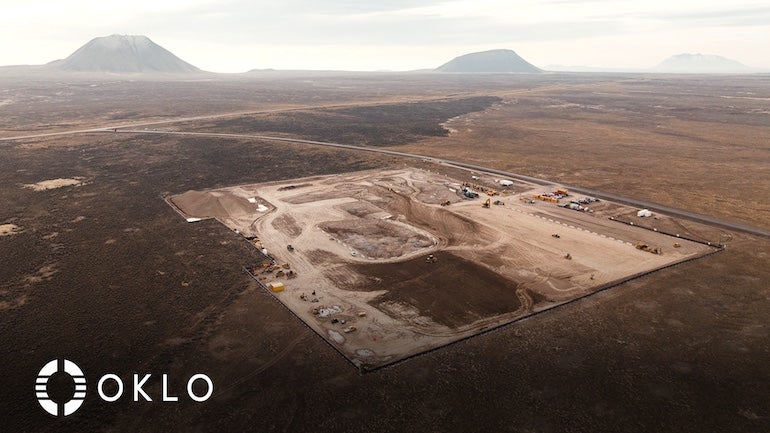
US-based Oklo has signed a US Department of Energy (DOE) Other Transaction Agreement (OTA) to support the design, construction, and operation its Aurora powerhouse at Idaho National Laboratory (INL) under DOE’s Reactor Pilot Program (RPP). Oklo was one of 10 companies selected for DOE support under the RRP, which was established by President Trump’s May 2025 Executive Order (EO) 14301, Reforming Nuclear Reactor Testing at the Department of Energy. One of the targets of the EO was criticality of an advanced nuclear reactor by 4 July 2026.
Oklo’s Aurora powerhouse is a sodium-cooled fast reactor that uses metal fuel and builds on the design and operating heritage of the Experimental Breeder Reactor II (EBR-II), which ran in Idaho from 1964 to 1994.
Following the signing of the OTA, the DOE Idaho Operations Office approved the Nuclear Safety Design Agreement (NSDA) for the fast-fission power plant, and Oklo immediately asked DOE to begin a review of its Preliminary Documented Safety Analysis (PDSA).
The NSDA is the first step under DOE’s RPP authorisation licensing pathway, which offers an accelerated regulatory pathway. The Aurora powerhouse at INL (Aurora-INL) can now enter the next phase of project execution under DOE oversight after initial groundbreaking in September.
After the Nuclear Regulatory Commission (NRC) initially denied Oklo’s first application in 2022 due to lack of technical data, the company pivoted to DOE’s RRP. This allows Oklo to build and test its first reactor at INL under DOE oversight, which is faster than the traditional NRC commercial licensing route.
“The OTA sets the programme structure, while the design agreement reflects DOE’s rigorous authorisation process and safety-first approach,” said Jacob DeWitte, co-founder and CEO of Oklo. “DOE’s pathway for the Aurora-INL supports a stepwise approach to deploying our first powerhouse while we continue progressing our engagement for future commercial licensing by the US Nuclear Regulatory Commission.” Oklo plans to subsequently pursue NRC licensing to support commercial operations.
Robert Boston, Manager of the DOE Idaho Operations Office, said DOE Idaho “is committed to enabling safe, disciplined progress from design to demonstration”. He added: “With the Aurora powerhouse NSDA alongside the Aurora Fuel Fabrication Facility we’re supporting an integrated Idaho effort that can help scale domestic nuclear capability for the next generation of secure and reliable energy.”
The Aurora-INL is supported by Oklo’s broader Idaho work, such as the Aurora Fuel Fabrication Facility (A3F) at INL, which will fabricate the first fuel assemblies for the Aurora-INL. DOE Idaho approved the A3F NSDA in November 2025 and the A3F PDSA in December under DOE’s Advanced Nuclear Fuel Line Pilot Program.
In December 2019, Oklo was selected by the INL following a competitive solicitation to provide access to high-assay low-enriched uranium (HALEU) recovered from the decommissioned Experimental Breeder Reactor II (EBR-II). Oklo was granted access to 5 tonnes of HALEU for the initial core of its first Aurora powerhouse. DOE retains ownership of the material which is processed and treated through electrorefining at INL to downblend recovered uranium to an enrichment level of less than 20% (U-235).
Overall, Oklo has received significant US federal support primarily through competitive grants, cost-share awards, and site access agreements from DOE. While the company is largely privately funded, federal backing has been critical for reactor and fuel development and testing.
In 2024, the DOE granted Oklo $5m to support the first end-to-end demonstration of its advanced fuel recycling process. Oklo has received multiple vouchers through the Gateway for Accelerated Innovation in Nuclear (GAIN) initiative, allowing it to access national laboratory expertise and facilities at no direct cost. In early 2026, Oklo received a DOE grant to study radioactive materials in hot liquid salt, supporting its planned $1.68bn fuel recycling facility in Tennessee.
Oklo is currently manufacturing the non-nuclear components (pumps, heat exchangers) for the Aurora-INL and has developed a high-fidelity “digital twin” of the reactor design to simulate thousands of “what-if” safety scenarios for the DOE’s final authorisation.
By using the digital twin, Oklo can simulate 20 years of reactor wear-and-tear in a matter of weeks. Historical data from EBR-II is also fed into the twin to show that the modern Aurora design will behave exactly like its proven ancestor. The digital twin for the Aurora Powerhouse is primarily being developed at Oklo’s headquarters in Santa Clara, California, in close collaboration with the Argonne National Laboratory (ANL), which developed and operated the EBR-II.
Oklo received a $3.5m in 2022 from the ARPA-E ONWARDS Program specifically to develop digital twin technology. DOE granted Oklo access to the original experimental data from the EBR-II’s 30-year run. This data is used to “benchmark” the digital twin to prove that the software’s predictions match the real-world results recorded in Idaho decades ago. Currently, the twin is being used to finalise the Safety Analysis Report (SAR) required for the 4 July 2026 criticality deadline.
Joint venture with Centrus
Earlier in March, Oklo and Centrus Energy Corp announced that the companies had agreed to pursue discussions regarding a joint venture focused on deconversion services for HALEU and the advancement of related fuel-cycle technologies and supply chains.
When uranium is enriched it exists as uranium hexafluoride and must be “deconverted” into a stable solid, typically uranium oxide or uranium metal before it can be used as fuel. Currently, the US has very limited capacity to deconvert HALEU from gas to metal.
Activities under this joint venture would occur at Centrus’s Piketon site in Pike County, southern Ohio, co-located with its enrichment operations and adjacent to Oklo’s planned 1.2 GWe power campus.
Oklo’s power campus is a planned advanced nuclear energy hub designed to provide carbon-free baseload power for Meta’s (Facebook) regional operations, including its AI superclusters. The project is a multi-billion-dollar private investment that will be built on a 206-acre site formerly owned by DOE. The campus will house a network of multiple Aurora Powerhouse units. Each individual unit is designed to be scalable, typically generating between 15 and 100 MWe. The Campus is targeted to come online as early as 2030 and to reach the full 1.2 GWe target by 2034.
Oklo initially announced plans to deploy two powerhouses in Southern Ohio in May 2023. In August 2025, the company signed an agreement to purchase 206 acres of land at the former Portsmouth Gaseous Diffusion Plant site from the Southern Ohio Diversification Initiative. The vision was expanded in January 2026 to the full 1.2 GWe capacity following the deal with Meta, which includes a mechanism for Meta to prepay for power to fund early-stage development. Pre-construction activities and site characterisation studies are scheduled to begin.
“Advanced nuclear energy development requires not only reactors but also reliable fuel-cycle capabilities that support those reactors,” said DeWitte. “This framework supports deeper discussions with Centrus on potential pathways to expand deconversion capacity, strengthen domestic supply chains, and advance a more efficient fuel-cycle model that operates from the same location.”
Centrus President and CEO Amir Vexler noted: “Centrus is laying the groundwork to rebuild the US nuclear fuel-cycle capacity, including the services needed to support advanced reactor fuels. We look forward to exploring options to co-locate and scale deconversion services to improve efficiency and support growing demand.”
Centrus and Oklo believe developing enrichment and deconversion services at Piketon will raise efficiency, expand domestic capacity, and help solve a potential nuclear fuel bottleneck. There are numerous HALEU-fuelled reactor technologies under development in the US many of which are developing separate fuel fabrication plants. A central hub for deconversion services co-located with HALEU enrichment could eliminate the need for each fuel fabrication facility to establish its own deconversion line and could simplify and reduce the cost of shipping HALEU.
Centrus and Oklo plan to explore opportunities for potential coordination of regulatory and R&D activities, including joint engagement with US federal agencies to propose solutions that support co-location of deconversion and enrichment services.


